

AP Syllabus focus:
‘Apply the rules d/dx(eˣ) = eˣ and d/dx(ln x) = 1/x (for x > 0) to compute derivatives of basic exponential and logarithmic functions and related expressions.’
These notes introduce core derivative rules for exponential and natural logarithm functions, emphasizing how and change and modeling growth effectively in contexts.
Derivatives of Exponential and Natural Logarithm Functions
Understanding how exponential and logarithmic functions behave under differentiation is essential in AP Calculus AB because these functions model growth, decay, scaling, and multiplicative change in many real-world situations. This subsubtopic focuses on recognizing the unique structure of exponential functions and the inverse nature of the natural logarithm, then applying their derivative rules accurately.
Exponential Functions and Their Differentiation
The function is the foundational exponential function in calculus due to its distinctive rate-of-change behavior. It is the only real-valued function whose instantaneous rate of change equals its own output value. Because of this, differentiating is exceptionally simple and appears frequently in mathematical modeling.
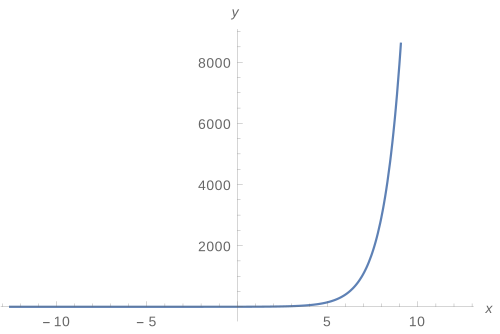
The graph shows the exponential function , which passes through and increases rapidly for larger . It illustrates that the function is always positive and has a horizontal asymptote along the -axis. These visual features support the rule , since the slope is always positive and grows with the function’s height. Source.
Exponential Function: A function of the form whose rate of change at any input equals its current value, making it a natural model for continuous growth.
This intrinsic property leads directly to the rule for differentiating , which is both elegant and powerful.
= Input variable
When exponential expressions incorporate coefficients or constants, these features do not disrupt the structure of differentiation. Instead, constants simply scale the derivative, and the base ensures that the rule remains consistent.
One important aspect for students is recognizing that exponential functions of the form require the chain rule, but this subsubtopic focuses on the basic function and its direct applications. When differentiating expressions involving , students should watch for opportunities to rewrite terms to reveal exponential structure clearly.
Natural Logarithm Functions and Their Differentiation
The natural logarithm, , is the inverse of the exponential function . Its derivative rule reflects the relationship between multiplicative and additive change. Because is defined only for , its derivative maintains the same domain restriction, which is important when interpreting results in applied contexts.
Natural Logarithm: The inverse of the exponential function , defined for , used to convert multiplicative relationships into additive ones.
The derivative of expresses how logarithmic functions grow at a decreasing rate, tracking relative rather than absolute change.
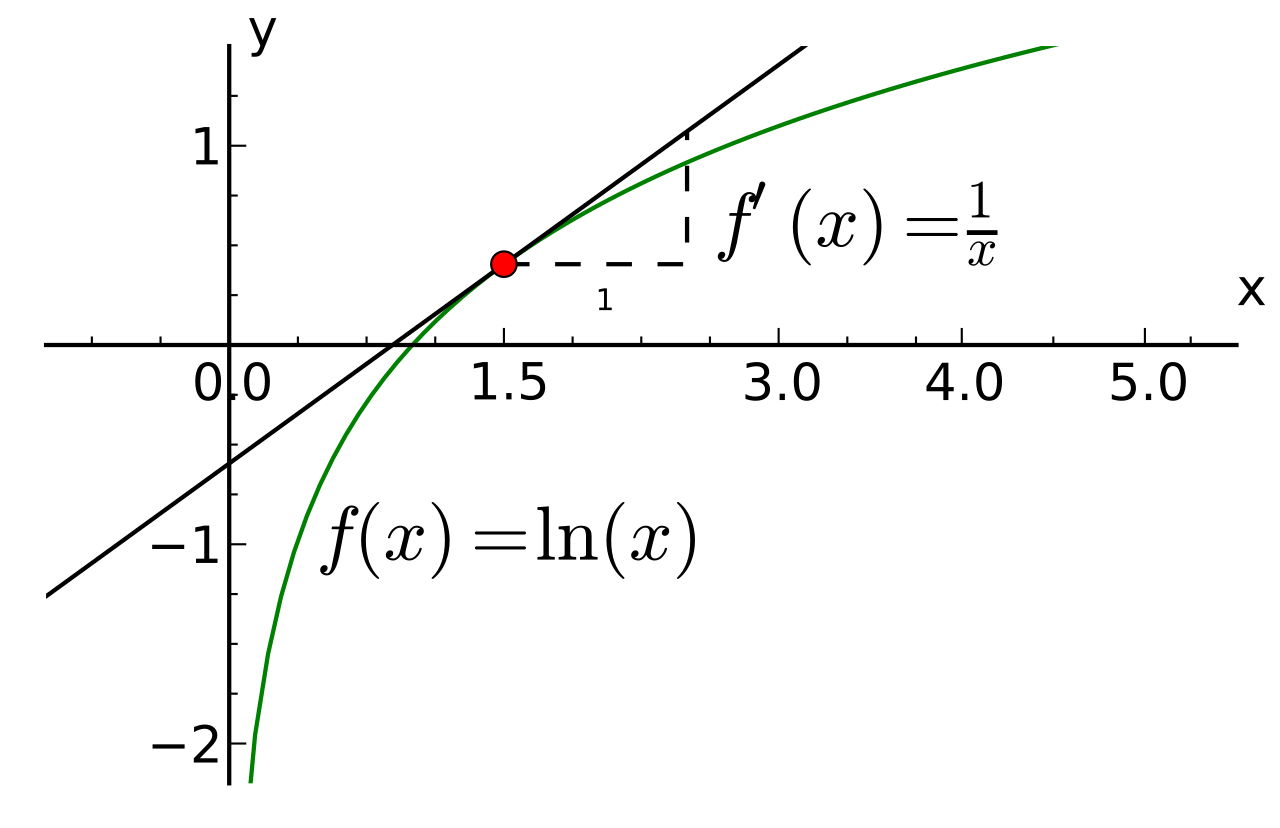
The green curve represents the natural logarithm function , and the black line is the tangent at a specific point. The label highlights that the tangent slope equals , illustrating the rule for . The diagram also visually reinforces the decreasing slope as increases. Source.
= Input variable, restricted to
Students should understand that represents a diminishing rate of change: as increases, the sensitivity of to increases in decreases. This characteristic is essential when logarithmic models are used to represent processes such as information scaling, pH measurement, decibel levels, and other contexts where proportional change is more meaningful than raw change.
Applying the Derivative Rules in Expressions
Both derivative rules in this subsubtopic appear frequently in expressions where exponential and logarithmic functions combine with algebraic structures. A key skill is recognizing when these functions appear in composite or multiplied forms; however, only the basic rule applications fall within this subsubtopic’s scope.
Students should consider the following strategies when encountering exponential or logarithmic expressions:
Identify the functional core
Determine whether the main structure is exponential () or logarithmic (). The derivative rule depends on this recognition.
Check domain restrictions
For expressions involving , ensure that any quantity inside the logarithm remains positive.
Track constants carefully
When exponential or logarithmic functions include coefficients or multiplicative constants, apply the constant multiple rule appropriately.
Interpret derivatives meaningfully
Exponential derivatives represent instantaneous proportional growth, while logarithmic derivatives describe rates tied to relative change.
These techniques help reinforce long-term understanding and support accurate symbolic differentiation.
Interpreting Derivatives in Real-World Contexts
A central aspect of this subsubtopic is relating derivative values to meaningful interpretation. When differentiating , the result indicates that the quantity grows at a rate equal to its current level, essential in continuous growth settings such as populations, investments, and natural processes. Similarly, differentiating yields a rate connected to reciprocal scaling, relevant in modeling where multiplicative effects are translated into additive trends.
Exponential change
The derivative models situations where growth is self-proportional.Logarithmic change
The derivative captures diminishing sensitivity and appears when interpreting phenomena governed by ratios or scaling.
Understanding the meaning behind these derivative rules strengthens conceptual fluency and prepares students for multi-step problems later in the course.
Practice Questions
Question 1 (1–3 marks)
The function P is defined by P(x) = 7 e^(2x).
(a) Find P'(x).
(b) State one property of the exponential function e^x that explains why its derivative rule is especially simple.
Question 1
(a) 1 mark for correct derivative:
• P'(x) = 14 e^(2x).
(b) 1 mark for a valid property, for example:
• The exponential function e^x is the unique function equal to its own derivative.
• The rate of change of e^x is proportional to its value.
Question 2 (4–6 marks)
Let G be a differentiable function defined for x > 0 by G(x) = 3 ln(x) – x/4.
(a) Find G'(x).
(b) The value x = k gives a stationary point of G. Show that k satisfies the equation 3/x – 1/4 = 0.
(c) Hence find the value of k, and determine whether the stationary point is a local maximum or a local minimum, justifying your answer.
Question 1
(a) 1 mark for correct derivative:
• P'(x) = 14 e^(2x).
(b) 1 mark for a valid property, for example:
• The exponential function e^x is the unique function equal to its own derivative.
• The rate of change of e^x is proportional to its value.
FAQ
The number e is the unique base for which the exponential function’s rate of change equals its current value, meaning its derivative rule has no additional constant factor.
For functions with other bases, such as a^x, the derivative includes a multiplying constant ln(a), which complicates differentiation. The base e removes this extra step, making it the natural choice in calculus.
Rewrite when the expression contains products, quotients, or powers inside a logarithm. This is because logarithmic laws can simplify the structure before differentiating.
For example:
• ln(3x) can be rewritten as ln 3 + ln x.
• ln(x^5) becomes 5 ln x.
Simplifying first reduces errors and clarifies the derivative pattern.
The function ln x is defined only for positive inputs because it represents the inverse of the exponential function, which never outputs non-positive values.
When differentiating, the derivative 1/x inherits this restriction; although the expression 1/x exists for x < 0, it does not describe the behaviour of ln x.
Therefore, domain awareness ensures correct interpretation of the derivative in context.
1/x measures how fast ln x changes per unit increase in x relative to its current size. This contrasts with absolute change, which would depend on the total magnitude of change in x.
This makes ln x valuable for modelling situations involving proportional scaling, such as elasticities, reaction rates, or information growth, where the quantity’s sensitivity decreases as it becomes larger.
Useful strategies include:
• Identify which terms grow exponentially and which scale slowly via logarithms.
• Apply the constant multiple rule carefully, ensuring coefficients are not altered unexpectedly.
• Distinguish between differentiating an exponential and differentiating a logarithm; confusing the rules is a common error.
Keeping the function structures clear prevents mixing derivative rules across the two forms.
