

AP Syllabus focus:
‘Recognize expressions that match the definition of a derivative for sine, cosine, exponential, or logarithmic functions and use these known derivatives to evaluate limits.’
This subsubtopic develops skill in identifying when a limit corresponds to a known derivative and using that recognition to evaluate limits efficiently by applying foundational derivative formulas.
Using Known Derivatives to Evaluate Limits
Understanding how limits relate to derivatives allows powerful shortcuts. Many limits that appear complicated are actually disguised forms of a derivative evaluated at a specific point. Recognizing this connection helps streamline computation and strengthens conceptual understanding of how instantaneous change arises from limit processes.
Matching a Limit to the Definition of a Derivative
The definition of the derivative is the foundation for this topic. A derivative represents the instantaneous rate of change of a function at a point, defined through a limiting difference quotient. When a limit mirrors this structure, it can be directly replaced with the corresponding derivative value.
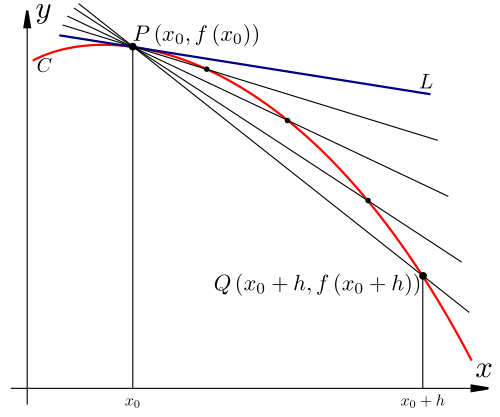
A curve is shown with a secant line connecting the points at and , labeled with the distance along the -axis. As decreases, the secant line approaches the tangent line at , illustrating how the derivative arises as the limit of the difference quotient. This reinforces that many limits simply evaluate the slope of the tangent line at a point. Source.
Derivative of a Function: The derivative of at is the limit of the difference quotient measuring the instantaneous rate of change of at .
Recognizing a limit as a derivative requires attention to structure, including the function being evaluated, the point approached, and the arrangement of numerator and denominator. Because the focus here is on specific functions—sine, cosine, exponential, and natural logarithm—their familiar derivative rules serve as essential tools.
Fundamental Derivatives Used in Limit Evaluation
Limits that correspond to standard derivative forms can be evaluated immediately using known derivatives. The AP syllabus emphasizes fluency with the basic trigonometric, exponential, and logarithmic derivatives, which are especially common in limit problems.
= angle in radians
A wide range of trigonometric limit expressions collapse to sine or cosine derivatives.
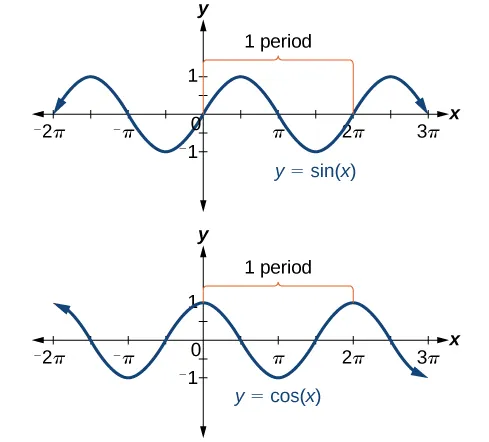
The top graph shows and the bottom graph shows over one full period. The alignment of their peaks, slopes, and intercepts visually highlights that represents the slope of at each point. Period labels add context beyond this subtopic but remain conceptually helpful. Source.
= angle in radians
Because cosine’s derivative introduces a negative sign, attention to sign changes is essential when matching limits to derivative forms. This awareness also supports correct interpretation of limit expressions involving negative factors.
A single exponential derivative formula supports efficient limit evaluation involving the natural exponential function.
= real input
Since is its own derivative, many exponential limit expressions evaluate cleanly once identified as derivative forms, requiring no further substitution adjustments.
The natural logarithm also plays a central role in derivative-based limit evaluation, particularly when limits approach positive real numbers.
= positive real input
Because the logarithm’s derivative involves a reciprocal, limit expressions that simplify to a ratio of small changes often reveal themselves as logarithmic derivatives after structural comparison.
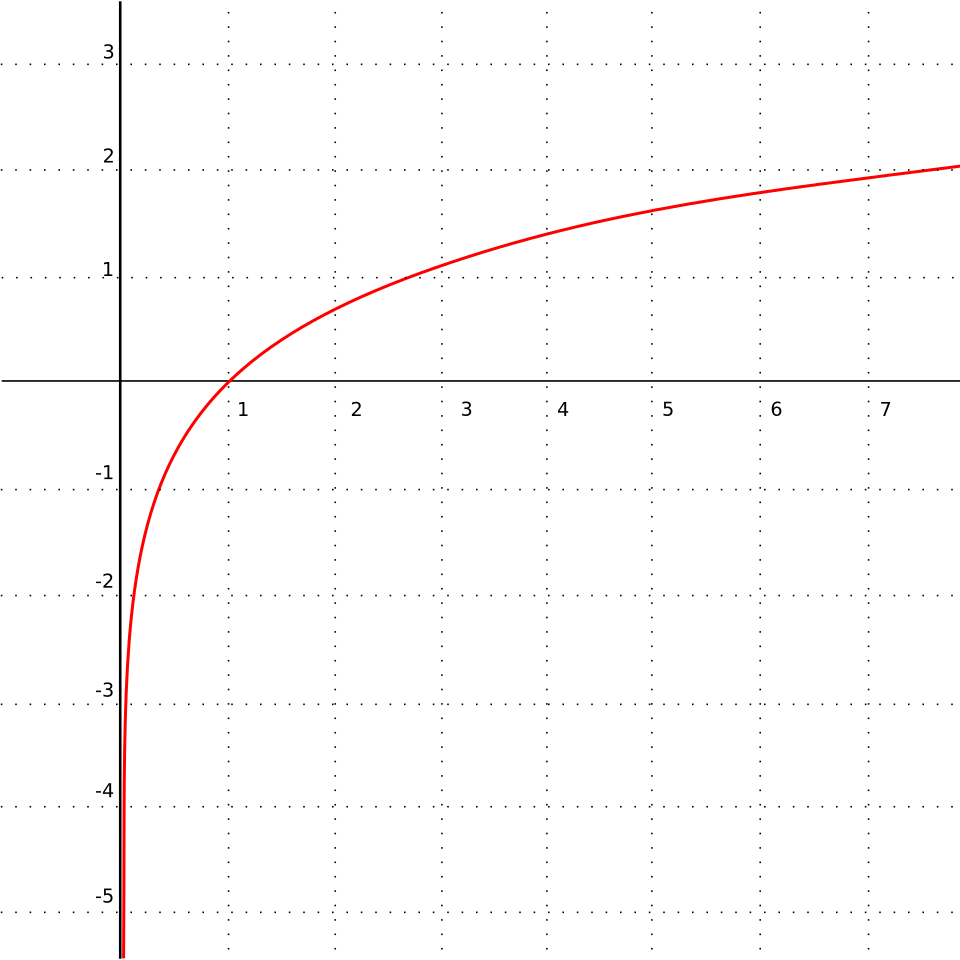
The curve is plotted for positive , passing through and rising gradually while approaching a vertical asymptote at . This supports interpreting derivative-based limits involving , whose slope becomes large near the asymptote and decreases as increases. The full grid and asymptotic behavior provide context that aligns with the derivative’s role in limit evaluation. Source.
Structural Patterns That Signal a Derivative Form
Several recurring patterns indicate that a limit corresponds to a known derivative evaluated at a specific value.
Difference quotient appearance
Expressions of the form
These suggest a derivative at .
Limits involving trigonometric small-angle behavior
Structures resembling small-angle trigonometric limits often reduce to or depending on alignment with the derivative definitions.
Exponentials approaching a point
Limits containing expressions like and a corresponding denominator approaching zero typically match the exponential derivative at .
Logarithmic structures
Expressions where differences of appear over linear differences signal the logarithmic derivative when the denominator mirrors the input change.
Between these patterns, identifying which function’s derivative applies becomes a matter of matching both argument structure and limit form.
Steps for Recognizing and Evaluating Derivative-Based Limits
When approaching a limit that may correspond to a known derivative, the following structured process supports accurate and efficient evaluation.
Identify the function inside the numerator by comparing the expression to a known function such as , , , or .
Locate the evaluation point by matching the shifting variable (often or ) to the point used in derivative definitions.
Check the denominator to confirm whether it represents change in input: either or must appear.
Confirm the limit direction to ensure the expression approaches the derivative definition as or .
Replace the limit with the derivative value once the structural match is verified.
Preserve needed constants or transformations if the expression includes coefficients, factored forms, or signs altering the derivative’s value.
This layered process ensures that derivative-based limit evaluation remains grounded in formal reasoning, even when expressions appear unfamiliar at first glance.
Why Recognizing Derivative Structures Matters
Connecting a limit to a derivative strengthens conceptual understanding of instantaneous change and reinforces why derivative rules exist. Instead of memorizing isolated formulas, students see derivative rules as emerging naturally from limit definitions. Recognizing derivative structures also reduces algebraic workload, allowing students to focus on interpretation and underlying relationships. Additionally, these techniques prepare students for advanced calculus topics where limit–derivative equivalence informs series expansions, differential equations, and deeper theoretical developments.
Practice Questions
Question 1 (1–3 marks)
Evaluate the limit:
lim (x→0) [sin(3x)] / x.
Question 1
• 1 mark: Recognises that sin(3x)/x can be rewritten as 3·[sin(3x)/(3x)].
• 1 mark: Identifies that sin(kx)/(kx) tends to 1 as x→0.
• 1 mark: Final correct answer: 3.
Question 2 (4–6 marks)
Consider the function f defined by f(x) = e^(2x).
(a) Explain why the limit definition of the derivative can be used to evaluate the limit
L = lim (h→0) [f(1+h) − f(1)] / h.
(b) Hence find the exact value of L.
(c) Briefly describe how recognising this limit as a known derivative simplifies the calculation.
Question 2
(a) (2 marks)
• 1 mark: States that the expression matches the structure of the derivative definition for f at x = 1.
• 1 mark: Notes that f is differentiable everywhere, so the limit equals f′(1).
(b) (2 marks)
• 1 mark: Uses the derivative rule for e^(2x) to find f′(x) = 2e^(2x).
• 1 mark: Correct value: L = f′(1) = 2e^2.
(c) (2 marks)
• 1 mark: Explains that recognising the limit as the derivative avoids algebraic manipulation of the difference quotient.
• 1 mark: Clearly states that the result follows immediately from applying the known derivative rule for exponential functions.
FAQ
A limit represents a derivative only when the numerator expresses a change in a single function and the denominator represents the corresponding change in its input.
If the expression mixes unrelated functions or the denominator does not measure input change, it is not a true derivative form.
Check whether the limit can be rewritten into the form f(a+h) − f(a) over h.
If this cannot be done, the limit is not a derivative.
Many trigonometric expressions can be rearranged into a small-angle form or transformed using identities.
Once rewritten, a large portion of the expression cancels, exposing a clear derivative structure.
This arises because sine and cosine have predictable behaviour near zero, allowing more complicated limits to collapse into familiar derivative values.
The derivative definition depends on a specific base point.
If the expression approaches a value other than the one assumed, the limit may represent the derivative at a different point entirely.
To check the evaluation point:
• Compare the inner expression of the function to a + h or x.
• Ensure the denominator matches the difference in inputs.
Yes. Constants can often be factored out without disrupting the derivative structure.
A limit may still represent a known derivative if the functional change and input change match the derivative definition after simplification.
Useful steps include:
• Factor out multiplicative constants.
• Rewrite shifted inputs into the form a + h.
• Confirm that any added constants do not alter the essential difference quotient behaviour.
Exponential and logarithmic functions have especially simple derivative rules, so once a limit matches the derivative structure, little computation is needed.
There is no need to expand or manipulate expressions extensively.
Their smoothness and the absence of oscillatory behaviour mean that rewriting into derivative form typically requires fewer transformations than with trigonometric limits.
