AP Syllabus focus:
‘Use specific rules to find derivatives of sine and cosine, including d/dx(sin x) = cos x and d/dx(cos x) = −sin x, and apply them in graphs and applications.’
This section introduces the foundational derivative rules for sine and cosine, focusing on how these relationships describe changing behavior in trigonometric functions and support deeper calculus applications across graphical and contextual settings.
Derivative Rules for Sine and Cosine
The derivatives of the sine and cosine functions form one of the most important building blocks in differential calculus. These derivative relationships explain how quickly the values of trigonometric functions change with respect to their angle input and allow students to interpret motion, oscillations, and periodic behavior.
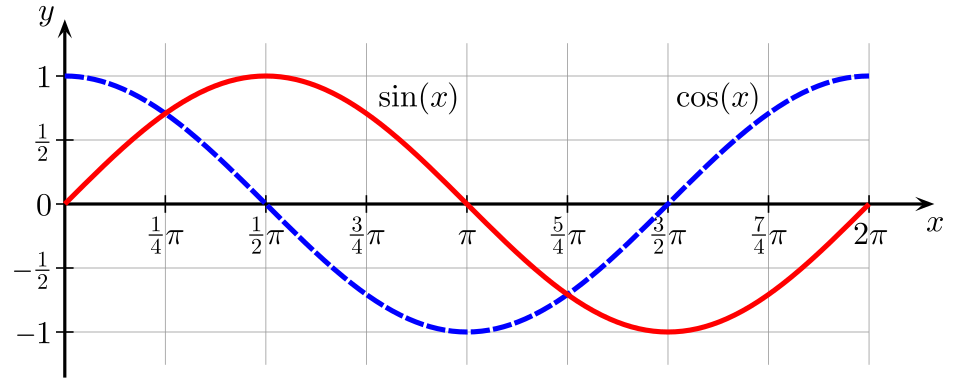
A graph of and over the interval . The curves share the same amplitude and period but differ by a horizontal phase shift. This visual highlights their closely related periodic structures. Source.
= Angle measure in radians
The derivative of sine captures how the sine curve’s output increases or decreases at each point and connects directly to the shape of the cosine curve.
= Angle measure in radians
These rules hold only when angles are measured in radians, a fact essential to AP Calculus AB because the derivative formulas are derived from limit definitions that depend on radian measure.
Understanding the Sine and Cosine Derivatives Conceptually
How the Derivative Reflects Change
The derivative describes the instantaneous rate of change of a function. For trigonometric functions, this rate of change corresponds to how steeply the curve rises or falls at a particular angle. The connections between sine and cosine can be better understood through the following ideas:
The cosine function models the instantaneous rate of change of the sine function, meaning wherever is increasing, is positive, and wherever is decreasing, is negative.
The negative sine function models the instantaneous rate of change of the cosine function, showing the cosine curve decreases most rapidly where is positive.
Relating Derivatives to Graphs
Graphical interpretation is an essential aspect of AP Calculus AB. When analyzing graphs:
At points where the sine graph has a horizontal tangent (such as peaks and troughs), , matching the derivative rule.
Where the sine graph rises most steeply, the cosine function reaches its highest positive values.
The cosine graph behaves similarly: its horizontal tangents correspond to values where .
This interplay emphasizes the periodic and cyclical nature of trigonometric derivatives, helping students visualize the connections between a function and its derivative.
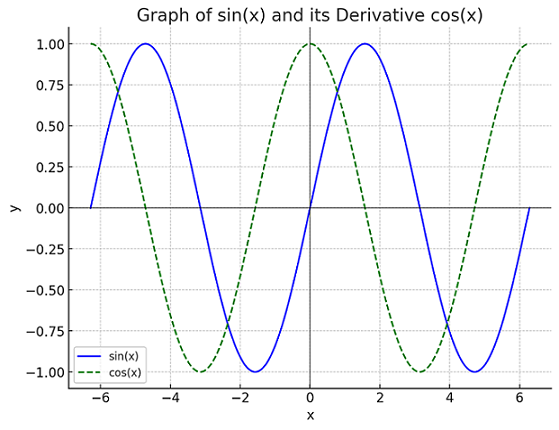
A combined graph of and its derivative , with each curve clearly distinguished. At points where the sine curve has horizontal tangents, the cosine curve crosses the axis, indicating a derivative of zero. This illustrates how describes the instantaneous rate of change of . Source.
Applying the Derivative Rules in Graphs and Contexts
The syllabus requires not only computing derivatives but also understanding their meaning in both graphical and applied contexts. To support this goal, students should be able to use the derivative rules in the following ways:
Interpreting Behavior from the Derivative
Use the sign of to determine where is increasing or decreasing.
Use the sign of to determine where is increasing or decreasing.
Recognize how changes in amplitude or shifts in trigonometric models affect the interpretation of derivatives, even though the derivative formulas for sine and cosine remain structurally unchanged.
Communicating Graphical Insights
Students should be able to connect derivative values to features on a graph:
Positive derivative → the original function is rising.
Negative derivative → the original function is falling.
Zero derivative → the original function has a horizontal tangent, often indicating a local maximum or minimum for sine and cosine.
These interpretations are crucial for modeling cyclic phenomena in applied problems, such as motion, wave behavior, or seasonal trends.
Structural Properties and Symmetry in Trigonometric Derivatives
Sine and cosine are highly structured and exhibit symmetrical properties that make their derivatives especially elegant.
Periodicity and Derivatives
Both sine and cosine are periodic with period , meaning their patterns repeat. Their derivatives share the same periodicity:
Because , and repeats every , the rate of change of sine follows a predictable cycle.
The derivative likewise mirrors the periodic structure of the sine curve.
This consistent behavior supports reasoning about long-term patterns in applied contexts without computing values at every step.
Connections to Unit Circle Structure
While AP Calculus AB does not require a formal proof of these derivative rules, students should recognize that their correctness comes from limit definitions supported by special limit relationships involving sine and cosine. These relationships emerge from geometric behavior on the unit circle, reinforcing the importance of radians for derivative calculations.
Practical Uses in Modeling and Interpretation
The derivative rules for sine and cosine allow students to analyze real-world situations involving oscillatory motion or periodic change:
Velocity in harmonic motion can be modeled as the derivative of sinusoidal position functions.
Rates of change in temperature, sound waves, or electrical signals often rely on sinusoidal modeling.
Graph interpretation becomes more intuitive because the derivative functions describe how fast and in what direction quantities are changing at each moment.
These applications highlight why mastering the derivatives of sine and cosine is fundamental for success in AP Calculus AB and for understanding broader mathematical modeling.
Practice Questions
Question 1 (1–3 marks)
The graph of y = sin x is shown for values of x near 2π.
(a) State the value of the derivative of sin x at x = 2π.
(b) Explain what this derivative value indicates about the behaviour of sin x at that point.
Question 1
(a) 1 mark
• Correct value: 1 mark for stating cos(2π) = 1.
(b) 1–2 marks
• 1 mark for identifying that the derivative being positive means the function is increasing at x = 2π.
• 1 additional mark for explaining that the tangent line has positive slope or that the graph rises as it passes through x = 2π.
Question 2 (4–6 marks)
A function is defined by f(x) = 3 cos x − 2 sin x.
(a) Find f ’(x).
(b) Determine the value of f ’(π/2).
(c) Using your answer to part (b), describe the behaviour of f near x = π/2, making clear reference to whether the function is increasing or decreasing at that point.
Question 2
(a) 2 marks
• 1 mark for differentiating 3 cos x correctly to obtain −3 sin x.
• 1 mark for differentiating −2 sin x correctly to obtain −2 cos x.
Final answer: f ’(x) = −3 sin x − 2 cos x.
(b) 1–2 marks
• 1 mark for correct substitution of x = π/2.
• 1 mark for correct evaluation: f ’(π/2) = −3 sin(π/2) − 2 cos(π/2) = −3(1) − 2(0) = −3.
(c) 1–2 marks
• 1 mark for stating that the negative derivative means the function is decreasing at x = π/2.
• 1 mark for interpreting this behaviour clearly, such as noting that the tangent has negative slope or the function is falling as it passes that point.
FAQ
Radians preserve the natural relationship between arc length and angle, allowing the derivative limits for sine and cosine to hold as standard formulas.
Degrees introduce a constant conversion factor, which would alter every derivative and break the simplicity of the rules.
Using radians ensures that the rate of change of sine aligns exactly with cosine, maintaining the clean derivative relationships used throughout calculus.
The sign indicates whether the function is rising or falling:
• If the derivative of sine (cosine) is positive, sine is increasing.
• If the derivative is negative, sine is decreasing.
Similarly, if the derivative of cosine (negative sine) is positive, cosine is increasing; if negative, cosine is decreasing.
This allows you to infer local trends without needing the full graph.
Both functions are periodic and related by quarter-turn shifts on the unit circle.
Each differentiation effectively shifts the function by 90 degrees, causing the sequence sine → cosine → negative sine → negative cosine → sine.
This cyclic behaviour reflects the geometric symmetry of circular motion and explains why repeated differentiation never produces new function shapes.
A tangent line’s slope equals the derivative at the point of tangency.
By examining how steeply the graph rises or falls at different locations, you can anticipate whether the derivative will be positive, negative, or zero.
This is especially helpful when sketching approximate graphs of derivatives or checking the plausibility of computed values.
Many oscillatory systems mirror these relationships:
• Harmonic motion, where velocity is proportional to the cosine of displacement.
• Electrical alternating currents, where voltage and current align in sine–cosine phase shifts.
• Sound waves, in which pressure changes follow sinusoidal patterns.
These applications rely on the fact that the rate of change of a sinusoidal process follows another sinusoid with a predictable phase shift.