AP Syllabus focus:
‘Human–environment interaction includes the use of natural resources and land-use decisions that shape landscapes and ecosystems.’
Human societies depend on natural resources and make deliberate land-use decisions that alter environments, shape economic activities, and influence spatial patterns, making this relationship central to geographic analysis.
Understanding Natural Resources
Natural resources are materials or substances from the environment that people value and use for economic, cultural, or technological purposes. Geographers categorize resources to understand how their distribution and availability affect human activity.
Key Types of Natural Resources
Renewable resources such as solar energy, wind, and forests regenerate naturally within human timescales.
Nonrenewable resources including fossil fuels, minerals, and metals form slowly and are finite.
Biotic resources come from living organisms (e.g., timber, fish).
Abiotic resources come from nonliving systems (e.g., water, ores, fossil fuels).
Energy resources play a major role in shaping global economic systems and spatial patterns of development.
When analyzing natural resources, geographers focus on availability, accessibility, and cultural valuation, all of which influence how societies prioritize particular forms of land use.
Natural Resource: A material or substance from the environment that people consider useful and valuable for economic, cultural, or technological purposes.
Landscapes shaped by resource use reflect both environmental conditions and human choices, illustrating how societies modify their surroundings to meet needs.
Land Use as Human–Environmental Interaction
Land use refers to the ways humans utilize and manage Earth’s surface for activities such as agriculture, industry, transportation, recreation, and settlement. These decisions reshape ecosystems, influence spatial organization, and reflect social and economic priorities.
Major Categories of Land Use
Agricultural land use (cropland, pastures, plantations)
Residential land use (housing, urban neighborhoods)
Commercial and industrial land use (business districts, factories, warehouses)
Transportation land use (roads, railways, airports)
Recreational land use (parks, sports facilities)
Conservation land use (protected forests, wildlife reserves)
Each type of land use involves trade-offs, as converting land for one purpose often restricts or eliminates its use for another.
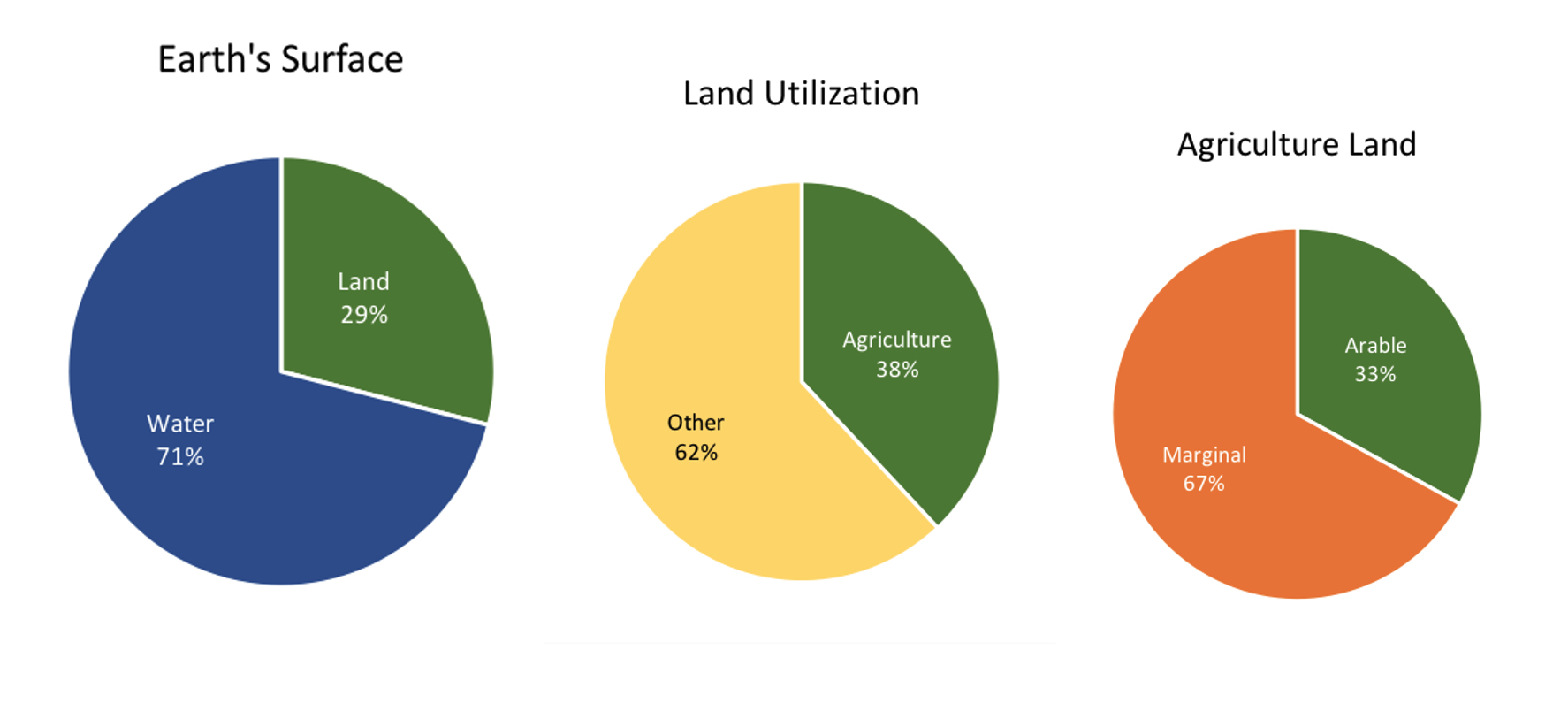
Pie charts compare Earth’s surface as land versus water, the proportion of land used for agriculture, and the division of agricultural land into arable and marginal categories. The figure highlights that land is a finite natural resource and that agriculture covers a substantial share of habitable land. The specific numerical percentages extend beyond the AP syllabus but help visualize the relative scale of each land category. Source.
Land Use: The human management and modification of Earth’s surface for economic, cultural, or infrastructural purposes.
Geographers analyze how these decisions reflect broader social structures such as economic development, political systems, demographic pressures, and cultural values.
Human Impacts on Landscapes and Ecosystems
Human use of natural resources frequently causes environmental change. These impacts vary widely depending on the intensity of land use, technological practices, and policy decisions.
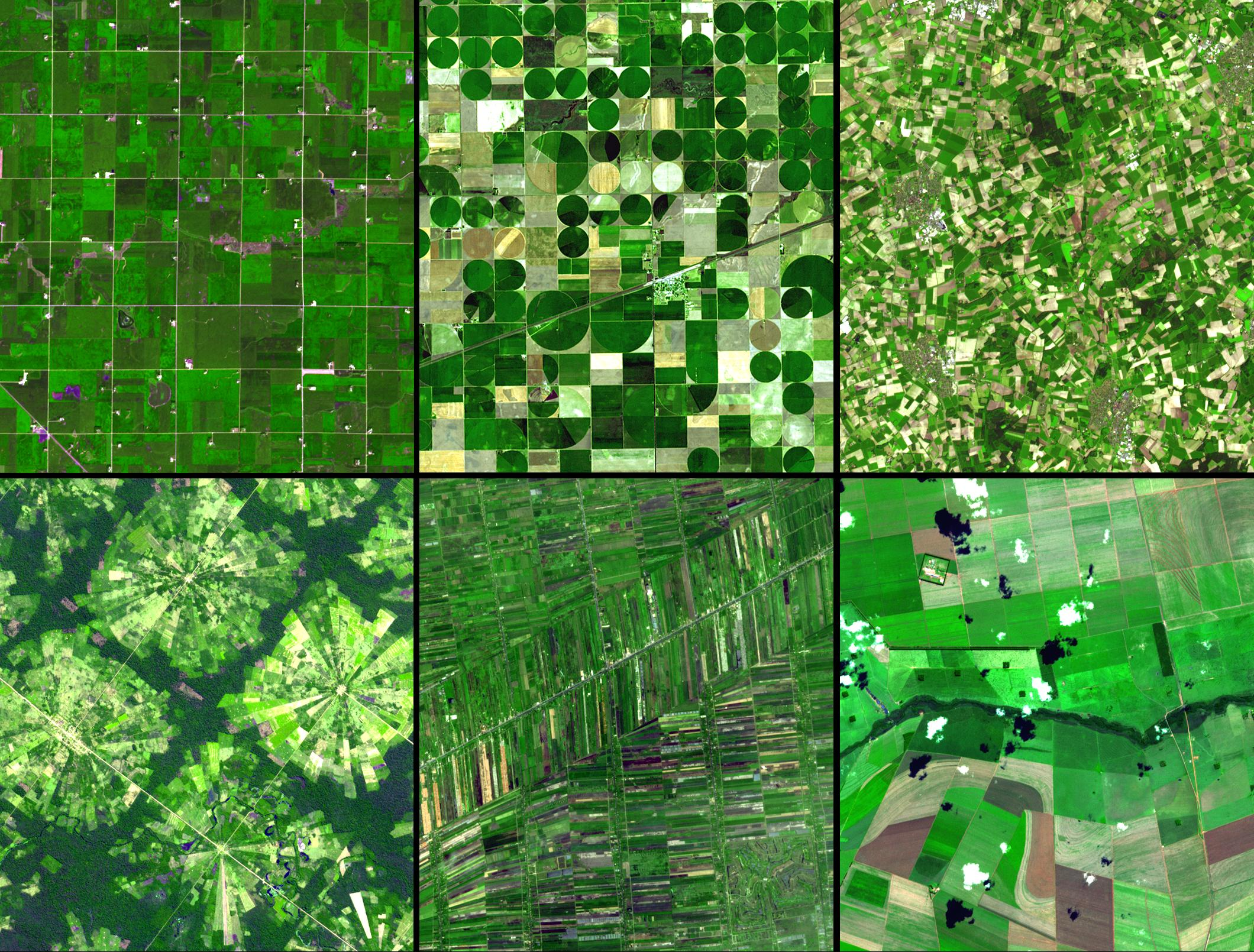
This montage shows six satellite views of agricultural landscapes around the world, each with a distinct spatial pattern such as grids, circular center-pivot fields, or elongated strips. These visible arrangements reveal how cultural practices, technology, and environmental conditions shape land-use patterns. The focus on cropland aligns with the major land-use categories highlighted in this subtopic. Source.
Environmental Effects of Resource Use and Land Decisions
Deforestation for agriculture, settlement, or logging reduces biodiversity and contributes to climate change.
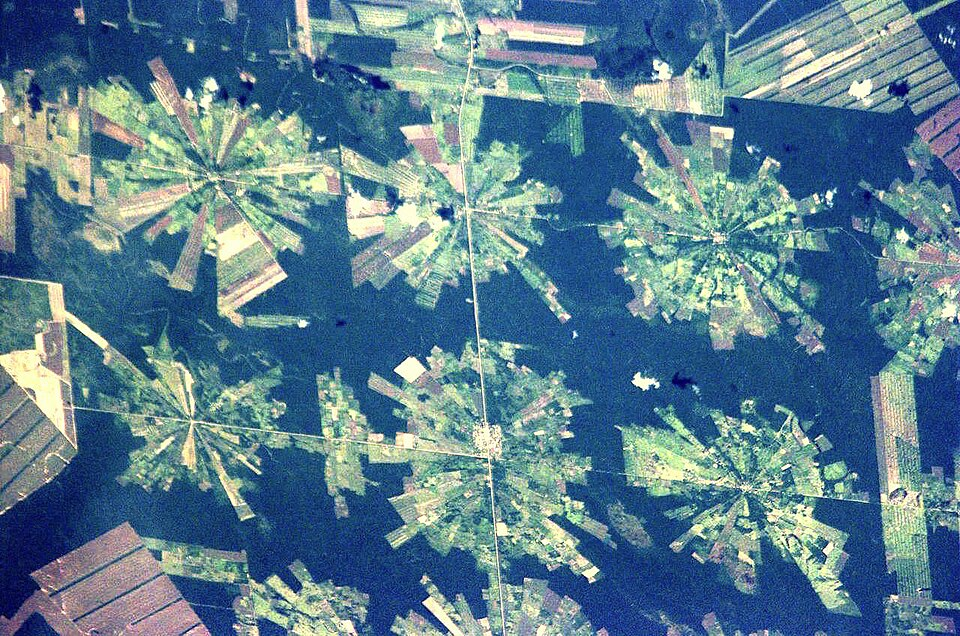
This astronaut photograph captures extensive deforestation in the Tierras Bajas region of Bolivia, where forest has been cleared for agriculture and ranching. The sharp geometric patterns illustrate how land-use decisions reshape ecosystems and fragment habitats. The specific Bolivian location adds geographic detail beyond the AP requirement but effectively demonstrates land-use change in a tropical forest environment. Source.
Overfishing and unsustainable harvesting deplete biotic resources.
Mining and drilling alter landforms, contaminate water systems, and generate waste.
Urbanization increases impervious surfaces, disrupts natural drainage, and fragments habitats.
Agricultural expansion can degrade soils through erosion, salinization, or nutrient depletion.
Water withdrawal for irrigation and industry can create shortages and ecological stress.
These changes underline the significance of policy and planning in balancing land-use needs with environmental limits.
Spatial Patterns of Resource Use
Natural resource distribution varies across space, creating geographic patterns that influence population distribution, economic development, and geopolitical relationships.
Spatial Pattern: The arrangement or organization of phenomena across Earth’s surface.
Such patterns illustrate how environmental characteristics and human choices combine to shape distinct regional landscapes.
Land-Use Planning and Sustainability
Modern geographic thinking emphasizes sustainable resource management, which seeks to meet human needs without compromising future generations. Land-use planning helps communities make informed decisions about how to use space efficiently and responsibly.
Principles of Sustainable Land Use
Protect ecosystem services such as water filtration, pollination, and carbon storage.
Encourage compact urban development to reduce sprawl.
Preserve agricultural land and prevent soil degradation.
Promote renewable energy and reduce dependence on nonrenewable resources.
Apply zoning regulations to manage competing land-use demands.
Incorporate environmental impact assessments into development decisions.
Sustainability highlights how social, economic, and environmental systems are interdependent and require careful coordination.
Resource Use, Policy, and Governance
Governments, organizations, and communities play essential roles in regulating land use and managing natural resources. These decisions operate at multiple scales, from local zoning rules to global environmental agreements.
Governance Strategies
Establishing protected areas to conserve ecosystems
Regulating extraction industries and pollution
Managing water rights and allocation
Supporting sustainable agriculture and forestry practices
Coordinating international agreements on climate and resource use
These policies reflect the complex relationship between human needs, environmental limits, and geographic contexts.
Practice Questions
Question 1 (1–3 marks)
Explain one way in which the use of non-renewable natural resources can influence land-use patterns.
Question 1
Total: 3 marks
1 mark for identifying a clear influence (e.g., mining requires large areas of land).
1 mark for explanation of how this affects land use (e.g., land is cleared or repurposed for extraction sites, infrastructure, or waste storage).
1 mark for linking this to broader spatial or environmental outcomes (e.g., settlement patterns shift towards resource-rich areas; landscapes become degraded or fragmented).
Question 2 (4–6 marks)
Using a real-world example, analyse how agricultural expansion can lead to environmental change. In your answer, refer to both human decisions and ecological impacts.
Question 2
Total: 6 marks
1 mark for naming a valid real-world example (e.g., soy farming in the Brazilian Amazon; palm oil plantations in Indonesia).
1 mark for describing the agricultural expansion taking place (e.g., clearing forest for cropland or pasture).
1 mark for identifying a relevant human decision or driver (e.g., market demand, government policies, or technological change).
1 mark for explaining a direct environmental impact (e.g., loss of biodiversity, soil erosion, or habitat fragmentation).
1 mark for explaining an indirect or secondary impact (e.g., changes in carbon emissions, altered hydrological cycles, or increased vulnerability to natural hazards).
1 mark for an analytical link showing how human choices produce the observed environmental outcomes (e.g., demonstrating cause-and-effect or connecting social demand to ecological consequences).
FAQ
Cultural beliefs shape what societies consider valuable, acceptable, or sacred, which in turn affects how resources are extracted, protected, or avoided.
Some communities restrict the use of forests, rivers, or mountains due to spiritual significance, while others emphasise economic productivity.
Cultural norms also determine practices such as communal grazing, rotational farming, or conservation behaviours, influencing long-term land-use patterns.
Suitability depends on physical characteristics such as soil fertility, drainage, slope, and climate, which affect crop yields and labour requirements.
Human factors also matter, including access to markets, technology, and capital investment.
Intensive agriculture is more likely where high-value crops, irrigation, and fertilisers can offset land constraints, while extensive systems dominate where land is abundant but labour or technology is limited.
Governments shape land use through zoning laws, taxation, subsidies, and environmental regulations.
They may protect land for agriculture or conservation, restrict development in sensitive ecosystems, or promote industrial growth through incentives.
Policies can also support sustainable practices such as reforestation, water management, and soil conservation, altering long-term landscape change.
Land degradation occurs when resource use exceeds the environment’s capacity to recover.
Common drivers include overgrazing, deforestation, and unsustainable irrigation, which can cause soil erosion, salinisation, and nutrient loss.
Over time, degraded land supports fewer crops, holds less water, and becomes more vulnerable to desertification, forcing communities to shift land uses or abandon marginal land.
Because land is finite, groups with different interests—such as farmers, conservationists, industry, and local communities—may compete for the same space.
Conflicts often emerge when resource extraction disrupts traditional livelihoods or when land is reallocated without community consent.
These disputes may be intensified by population growth, climate stress, or unequal access to political power, making negotiated land-use planning essential.