AP Syllabus focus:
‘Theories of human–environment interaction have evolved from environmental determinism to possibilism, explaining different views of environment and society.’
Environmental determinism and possibilism offer contrasting explanations for how the environment shapes human behavior, influencing geographic thought and interpretations of cultural and spatial patterns across the world.
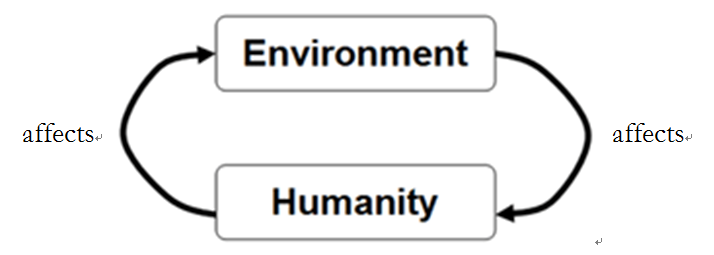
A simplified diagram showing reciprocal influences between the environment and humanity, illustrating that human–environment relationships operate in two directions. This supports the possibilist idea that humans modify environments rather than merely responding to them. The diagram includes general systems terminology not specific to the AP syllabus. Source.
Understanding Environmental Determinism
Environmental determinism is an early geographic theory proposing that the physical environment alone shapes human activities, cultural traits, and societal development.
Environmental Determinism: The theory that the physical environment is the primary cause of cultural and societal differences.
Environmental determinism emerged in the late 19th and early 20th centuries, drawing heavily on ideas from geographers such as Friedrich Ratzel and Ellen Churchill Semple. These thinkers argued that climate, landforms, and natural resources directly influenced human potential. Under this worldview, societies in “favorable” environments—particularly temperate climates—were believed to be more advanced, while those in tropical or harsh environments were assumed to have limited development.
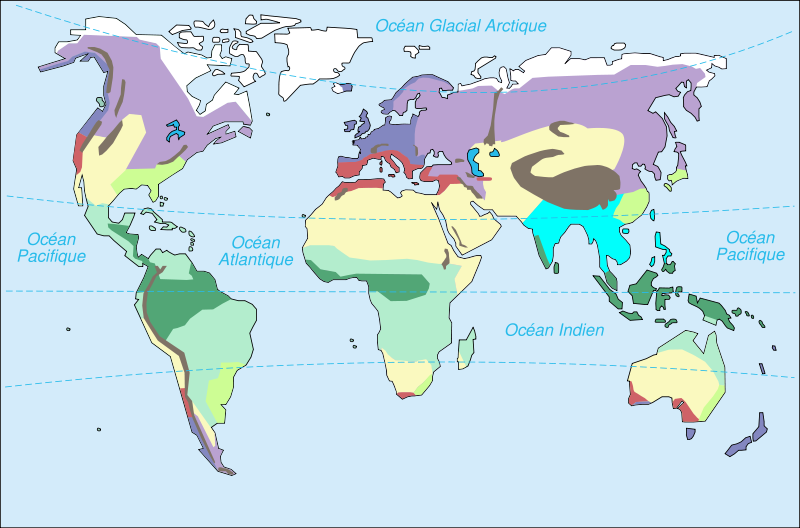
A global climate-zone map illustrating broad spatial patterns of temperature and moisture that early environmental determinists attempted to link to cultural development. Students can focus on the differences among tropical, arid, and temperate regions. The map provides additional climatic detail beyond what the AP syllabus requires. Source.
Core Principles of Environmental Determinism
Climate as a driver of culture, with temperate climates seen as producing more industrious and rational populations.
Geographic conditions shaping societal success, suggesting that environment determined economic systems, political organization, and cultural complexity.
Human agency minimized, implying that people passively responded to environmental constraints.
Criticisms of Environmental Determinism
Environmental determinism eventually faced strong criticism for oversimplifying complex human–environment relationships and for promoting biased, ethnocentric interpretations.
Key concerns included:
Reductionism, because it attributed all cultural and societal differences solely to nature.
Lack of human agency, ignoring innovation, adaptation, and cultural choice.
Historical misuses, where deterministic arguments were sometimes employed to justify colonialism or racial hierarchies.
Despite its flaws, environmental determinism remains important to study because it shaped early geographic thought and influenced debates about how humans relate to their surroundings.
Understanding Possibilism
In response to the limitations of environmental determinism, geographers in the early 20th century advanced possibilism, a theory emphasizing human agency in modifying or responding to environmental conditions.
Possibilism: The theory that the physical environment offers constraints and opportunities, but humans possess the ability to choose and develop cultural practices within those limits.
This framework, associated with French geographer Paul Vidal de la Blache, shifted focus away from the environment as an absolute force. Instead, it highlighted the role of culture, technology, and decision-making.
Core Principles of Possibilism
Environment provides a range of possibilities, rather than dictating outcomes.
Human creativity and technology shape cultural responses, enabling societies to alter landscapes and adapt in innovative ways.
Multiple cultural pathways, meaning different groups in similar environments may develop distinct lifestyles and institutions.
One key implication is that development and cultural variation result from human choices, not predetermined environmental conditions.

A nighttime view of the Las Vegas Strip standing out against the surrounding desert, demonstrating how technological innovation enables human settlement in harsh environments. This scene exemplifies key possibilist ideas about overcoming environmental constraints. The image includes real-world detail beyond the scope of the AP syllabus but directly reinforces the concept of human agency. Source.
Comparing the Two Theories
Understanding the contrast between environmental determinism and possibilism is essential for analyzing geographic thought within the framework of the AP Human Geography curriculum.
Key Differences
Agency
Environmental determinism: Minimal; environment controls humans.
Possibilism: Strong; humans actively shape environments within limits.
Role of Technology
Environmental determinism: Technological change seen as limited by nature.
Possibilism: Technology expands possibilities for adaptation.
Cultural Variation
Environmental determinism: Cultures reflect environmental conditions.
Possibilism: Cultures reflect choices, traditions, and innovations.
Why the Shift Occurred
The evolution from environmental determinism to possibilism reflects broader changes in social sciences. As anthropologists and sociologists demonstrated the importance of culture, and as technological advancements increased human capacity to alter the environment, determinism appeared increasingly outdated. The shift also aligned with growing rejection of geographically based hierarchies.
Applications in Modern Geography
Though possibilism replaced environmental determinism as the dominant framework, modern geography incorporates insights from both, emphasizing nuanced human–environment interactions.
Contemporary Relevance
Cultural landscape analysis often applies possibilism by examining how people use creativity and technology to modify environments.
Sustainability studies recognize environmental constraints while highlighting human agency in managing resources responsibly.
Hazards geography acknowledges natural forces but also focuses on preparedness, vulnerability, and adaptive responses.
Political and economic geography evaluates how environmental factors influence opportunities while avoiding deterministic explanations.
Balancing Constraints and Agency
Modern geographic approaches emphasize that:
Environments influence but do not dictate human outcomes.
Human decisions, shaped by culture, economics, and politics, determine how societies respond to environmental conditions.
Technological development continually reshapes what is possible within physical landscapes.
Importance for AP Human Geography
Studying environmental determinism and possibilism allows students to understand the evolution of geographic thought and recognize how interpretations of human–environment interaction have changed over time. These frameworks help explain the ways societies navigate environmental limits while creating diverse cultural and spatial patterns, aligning with the syllabus focus on how theories shape our understanding of nature–society relationships.
Practice Questions
Question 1 (1–3 marks)
Explain the core difference between environmental determinism and possibilism in the study of human–environment interaction.
Question 1
1 mark for identifying that environmental determinism argues the environment controls or dictates human actions and cultural development.
1 mark for identifying that possibilism argues humans have agency and can adapt or modify the environment within limits.
1 mark for explicitly contrasting the two perspectives (for example, stating that one emphasises environmental control while the other emphasises human choice).
Question 2 (4–6 marks)
Using examples, analyse how the shift from environmental determinism to possibilism changed the way geographers interpret cultural and spatial patterns.
Question 2
Up to 2 marks for describing environmental determinism and its emphasis on environmental control over human societies.
Up to 2 marks for describing possibilism and its emphasis on human agency, technology, and cultural decision-making.
Up to 2 marks for analysing how this shift influenced geographic interpretation, such as:
recognising multiple possible cultural outcomes in similar environments
acknowledging human innovation and technological adaptation
rejecting simplistic or ethnocentric explanations of development
Credit examples relevant to either theory if they support the analysis (e.g., climate-based explanations of culture for determinism, technological modification of environments for possibilism).
FAQ
Environmental determinists often relied on emerging fields such as climatology, evolutionary theory, and physical anthropology to argue that environmental conditions shaped human abilities and behaviours.
They believed climates influenced mental acuity, productivity, and social organisation, drawing on what were then considered scientific correlations.
However, many of these claims were based on limited datasets and biased assumptions rather than rigorous empirical evidence.
Possibilism recognises that cultures develop through human choice, tradition, and innovation, rather than being predetermined by environmental factors.
It avoids ranking societies based on climate or geography, reducing the ethnocentric interpretations that determinist arguments often supported.
This perspective values the diversity of cultural responses to similar environmental conditions.
Technology increases the number of viable options for living in or modifying challenging environments.
Examples include:
Large-scale irrigation enabling agriculture in arid landscapes.
Air conditioning allowing dense settlement in hot climates.
Renewable energy infrastructure expanding development possibilities in remote areas.
These innovations demonstrate how human agency continues to grow beyond earlier environmental constraints.
Colonial powers used environmental determinism to justify political and economic domination by portraying colonised regions as environmentally inferior and therefore less capable of self-governance.
These arguments helped legitimise unequal power structures and resource extraction, embedding deterministic thinking into policy, education, and international relations.
The legacy of this association contributed to the eventual rejection of determinism within academic geography.
Most geographers now use integrative frameworks that acknowledge both environmental influences and human agency.
These approaches may include:
Political ecology, which examines how power, economics, and environment interact.
Cultural ecology, which studies adaptive strategies and cultural practices shaped partly by place.
Systems thinking, which views environment–society relations as dynamic and reciprocal.
Such frameworks avoid one-sided explanations, recognising that human–environment interaction is complex and context dependent.