AP Syllabus focus:
‘Push/pull factors and intervening opportunities or obstacles can be cultural, demographic, economic, environmental, or political.’
Intervening obstacles and opportunities shape migration by altering how, when, and why people move. These factors interact with push and pull forces, influencing migration pathways and final destinations.
Intervening Obstacles and Opportunities in Migration
Migration is rarely a simple movement from a place of origin to a destination. Instead, it is shaped by intervening obstacles and intervening opportunities, which alter the likelihood, direction, and outcomes of migration flows. These factors operate across multiple scales and may reinforce, redirect, or completely prevent movement. Push and pull factors set the basic conditions for migration, but intervening elements determine whether migration actually occurs and how migrants navigate their journey.
Understanding Intervening Obstacles
Intervening obstacles are forces that hinder or block movement. They may prevent potential migrants from beginning a journey, slow movement along a route, or stop migration before reaching an intended destination. Obstacles can emerge unexpectedly or be embedded in structural conditions.
Intervening Obstacle: A factor that complicates or prevents migration by creating barriers that limit an individual’s or group’s ability to move.
Intervening obstacles are significant because even strong push and pull factors cannot guarantee migration if barriers are too great to overcome.
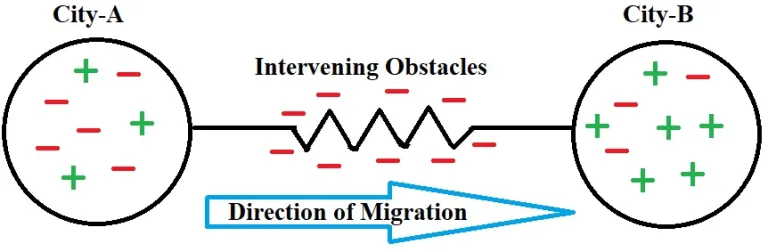
This diagram illustrates migrants moving from City-A to City-B while encountering intervening obstacles along the route. Green plus signs represent pull factors, and red minus signs represent push factors at both origin and destination. The schematic emphasizes that even when a destination has strong pull factors, intervening obstacles can slow, reduce, or prevent migration. Source.
These barriers can be:
Cultural, such as language differences, restrictive gender norms, or social discrimination.
Demographic, including age restrictions, family responsibilities, or population pressures.
Economic, such as high travel costs, loss of income during movement, or lack of financial resources.
Environmental, including physical distance, hazardous terrain, climate conditions, or natural disasters.
Political, such as strict border controls, visa systems, or conflict zones blocking transit.
These categories frequently overlap. For instance, migrants may face both political obstacles (difficulty obtaining documentation) and economic obstacles (inability to pay processing fees). The cumulative effect can deter migration entirely or redirect individuals to alternative destinations.
Understanding Intervening Opportunities
Intervening opportunities are unexpected chances or advantages that arise along a migration route, reducing the need or desire to continue to the originally intended destination. They do not push migrants from their place of origin; rather, they present alternative pull factors that reshape movement decisions.
Intervening Opportunity: A favorable circumstance encountered during migration that reduces the attractiveness of the originally intended destination by offering closer or more attainable benefits.
Intervening opportunities can shift migration flows significantly. Migrants may stop in a location that offers employment, safety, or community connections even if it was never their destination of choice. These opportunities may be:
Economic, such as finding a job in a city encountered en route.
Social or cultural, including discovering an established diaspora community that provides housing and support.
Political, such as encountering a country with more accessible asylum procedures.
Environmental, like finding fertile farmland or resource-rich land that supports settlement.
Demographic, including regions with favorable age structures offering labor market openings.
In many historical migrations, the availability of economic opportunities along routes—such as work in ports, rail hubs, or mining towns—altered movement patterns and produced new settlement regions.
Intervening opportunities are unexpected chances or advantages that arise along a migration route, reducing the need or desire to continue to the originally intended destination.
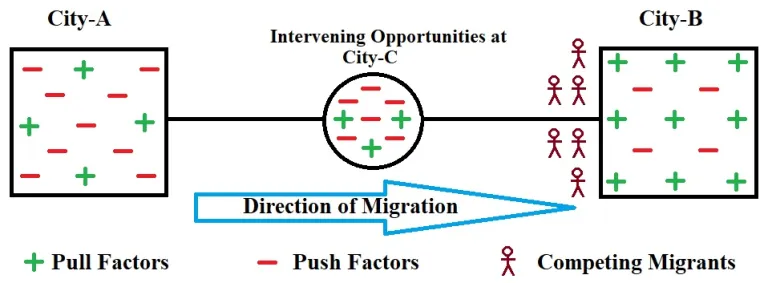
This diagram depicts an origin (City-A), an intended destination (City-B), and an intermediate location (City-C) offering intervening opportunities. Some migrants settle in City-C because its pull factors are sufficient, while others continue toward City-B. The image includes additional detail beyond the syllabus by illustrating “competing migrants” near City-B, showing how destination competition may influence migrant decisions. Source.
Interactions with Push and Pull Factors
Push and pull factors remain essential motivators of migration, but intervening obstacles and opportunities modify these forces. Migrants may be strongly pushed by economic hardship or political instability, but if obstacles are overwhelming, migration may cease. Conversely, weak pull factors in an originally intended destination may be outweighed by strong opportunities encountered along the way.
Spatial Scales of Intervening Factors
Intervening obstacles and opportunities operate at multiple spatial scales:
Local scale: Neighborhood-level discrimination, local job availability, environmental hazards, or family obligations.
Regional scale: Differences in state or provincial policies, regional labor demands, or the presence of conflict zones.
National scale: Border controls, visa quotas, demographic policies, or national economic programs.
Global scale: International treaties, large-scale environmental events, global labor markets, or multinational migration networks.
Different scales interact. For example, a global economic crisis may create national-level tightening of immigration laws, which then shapes regional and local migration outcomes.
Cultural, Demographic, Economic, Environmental, and Political Dimensions
Intervening obstacles and opportunities are explicitly categorized in the AP Human Geography specification as cultural, demographic, economic, environmental, or political. Each of these dimensions contributes uniquely:
Cultural factors influence whether migrants feel socially integrated during their journey.
Demographic factors shape where opportunities exist, especially in regions seeking workers of particular age groups.
Economic factors strongly affect both opportunities (job availability) and obstacles (movement cost).
Environmental factors determine whether travel is physically possible or safe.
Political factors set the legal framework governing migration, affecting both barriers and possibilities.
These dimensions highlight that all migration decisions are multifaceted. Rarely does a single factor determine movement; instead, migrants evaluate combinations of risks, rewards, and unforeseen circumstances.
When Intervening Factors Redirect Migration
Many migration patterns change course due to intervening factors. Migrants may:
Settle in a nearby city because travel funds ran out (economic obstacle).
Stop in a region with available farmland (environmental opportunity).
Avoid an intended destination due to conflict (political obstacle).
Remain in a country with more accessible legal pathways (political opportunity).
Join a community of co-nationals encountered on the route (cultural opportunity).
These redirections demonstrate the dynamic nature of migration. Migrants continually reassess conditions, responding to barriers and opportunities as they arise.
Practice Questions
Question 1 (1–3 marks)
Explain the difference between an intervening obstacle and an intervening opportunity in the context of migration.
Question 1 (1–3 marks)
Award up to 3 marks.
1 mark for identifying that an intervening obstacle is a barrier that hinders or prevents migration.
1 mark for identifying that an intervening opportunity is a favourable circumstance encountered during migration that encourages settlement before reaching the intended destination.
1 mark for explicitly contrasting the two, such as stating that obstacles block movement while opportunities redirect movement.
Question 2 (4–6 marks)
Using a real or hypothetical migration scenario, analyse how cultural, economic, and political factors can act as intervening obstacles and intervening opportunities that alter an individual’s or group’s intended migration path.
Question 2 (4–6 marks)
Award up to 6 marks.
1 mark for describing a migration scenario (real or hypothetical).
1–2 marks for explaining at least one cultural factor as an obstacle or opportunity (e.g., language barriers, supportive diaspora communities).
1–2 marks for explaining at least one economic factor as an obstacle or opportunity (e.g., cost of travel, job availability en route).
1–2 marks for explaining at least one political factor as an obstacle or opportunity (e.g., visa restrictions, more accessible asylum procedures elsewhere).
Award full marks only if the student clearly analyses how these factors alter the original migration path, not merely lists them.
FAQ
Intervening obstacles tend to have a stronger influence on long-distance migration because travellers encounter more borders, jurisdictions, and environmental barriers. This increases the likelihood of delays, route changes, or complete abandonment of the journey.
For short-distance migration, obstacles such as cost, terrain, or administrative barriers are generally smaller, meaning migrants are less likely to alter plans significantly. However, highly localised factors, such as neighbourhood discrimination or local planning restrictions, can still impede movement.
Yes. When a location along a migration route becomes attractive due to economic expansion, improved infrastructure, or political reforms, it can evolve into a new migration destination.
This may generate secondary migration flows as:
Migrants stop earlier than planned.
Others follow initial settlers through chain migration.
The new settlement area becomes incorporated into regional migration networks.
These corridors often emerge rapidly when opportunities grow faster than in traditional destinations.
Well-developed transportation networks reduce certain obstacle types, especially environmental and economic barriers. Accessible transport lowers travel costs, shortens journey time, and minimises physical hazards.
However, transportation systems can also create new obstacles:
High tolls or fares may restrict low-income migrants.
Transport hubs may be heavily policed, increasing the risk of interception.
Limited routes can force migrants through risky or congested areas.
Thus, networks mitigate some barriers while reinforcing others.
Low-income migrants are more sensitive to changes in cost, risk, and time, making nearby opportunities especially appealing. Settling earlier can reduce financial strain and avoid long, uncertain travel.
Intervening opportunities may offer:
Immediate employment.
Access to affordable housing.
Support from local communities or informal networks.
These factors can be decisive when continuing the journey requires substantial resources migrants do not possess.
In many cases, yes. Digital communication allows migrants to gather information about border rules, travel conditions, and job opportunities before moving, reducing uncertainty.
It also:
Helps migrants avoid dangerous routes by sharing real-time warnings.
Enables contact with diaspora communities that can offer guidance or support.
Allows remote job searching, which can lessen economic risk.
However, access to technology is uneven, and misinformation online can create new forms of obstacles.