AP Syllabus focus:
‘Migration is commonly divided into push factors that drive people away and pull factors that attract them.’
Migration occurs when people evaluate the conditions of one place against the opportunities in another, responding to pressures that push them out and attractions that pull them in.
Push and Pull Factors in Human Migration
Push and pull factors are central concepts in human geography because they explain why people relocate across space. Migration rarely results from a single cause; instead, it emerges from the interaction of cultural, demographic, economic, environmental, and political conditions that shape human decision-making. Understanding these factors helps geographers interpret population movements at local, regional, and global scales, as well as the consequences those movements create for both origin and destination areas.
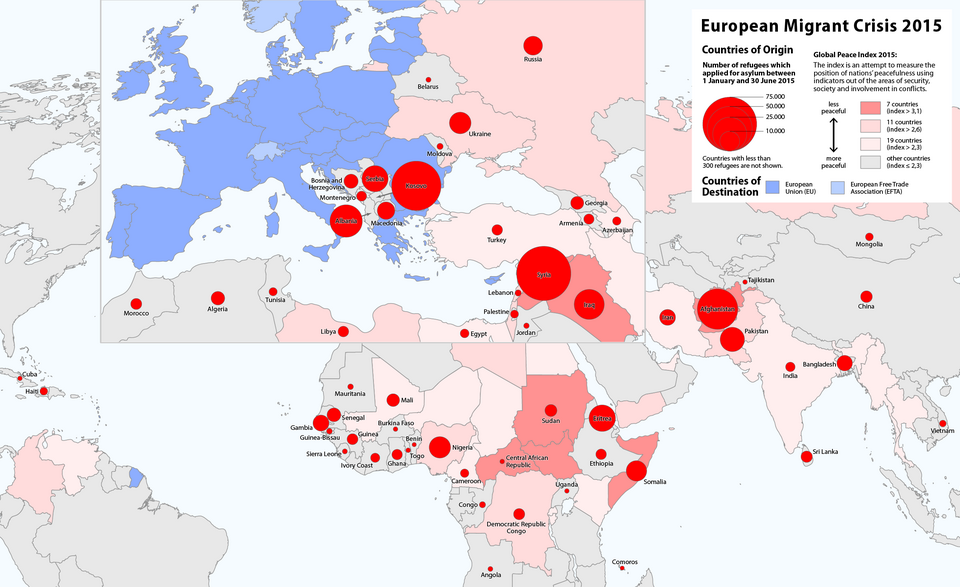
European migrant crisis, 2015: origins of asylum applicants to Europe. Red circles and shaded regions show major source areas of refugees and asylum seekers, illustrating strong political and environmental push factors. Some country-level details exceed syllabus needs, but the visual effectively demonstrates how intense push factors generate large migration flows. Source.
The Push–Pull Framework
Migration is commonly divided into push factors—conditions that compel people to leave a place—and pull factors—conditions that encourage people to move to a particular destination. These factors operate simultaneously, and individuals assess them within their own contexts, resources, and constraints.
Push Factor: A negative condition or circumstance that motivates a person to leave their current location.
A push factor alone does not cause migration without some perception of a viable alternative location.
A range of attractions also motivates movement toward new destinations.
Pull Factor: A positive condition or opportunity that draws a person toward a new location.
Because both push and pull dynamics are influenced by broader structural forces, geographers classify migration factors into several major categories for analysis.
Cultural Push and Pull Factors
Cultural Push Factors
Cultural conditions can create strong pressures for people to migrate. These may include:
Religious persecution, where individuals or groups experience discrimination or violence because of their beliefs.
Ethnic conflict, such as tensions between majority and minority communities.
Discrimination based on language or identity, making daily life restrictive or unsafe.
Cultural Pull Factors
Destinations offering:
Religious freedom,
Cultural acceptance, and
Social diversity
are strong pull factors. People may also be drawn to places where relatives or communities with shared cultural backgrounds already reside.
Demographic Push and Pull Factors
Demographic Push Factors
These involve population characteristics and pressures in the origin:
Imbalanced age structures, such as too many young people competing for limited local jobs.
High population density, creating competition for space and services.
Rapid population growth, straining community resources.
Demographic Pull Factors
Destinations may attract migrants with:
Aging populations that need labor,
Lower population densities, or
Growing communities seeking newcomers to support economic development.
Economic Push and Pull Factors
Economic motivations are among the most common migration drivers.
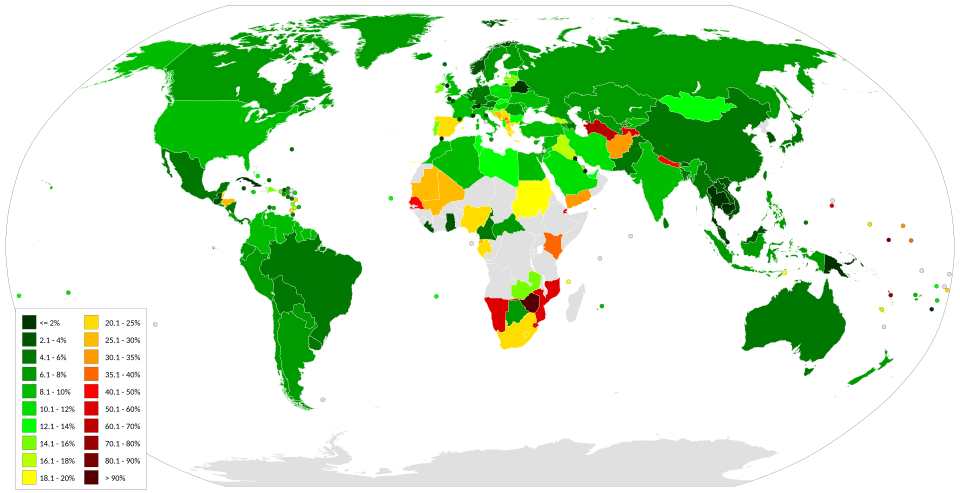
World unemployment rates shown using a color gradient, where darker or warmer shades indicate higher unemployment. Regions with consistently high unemployment reflect strong economic push factors encouraging out-migration. The legend and exact percentages exceed syllabus requirements, but the global spatial pattern is directly relevant. Source.
Economic Push Factors
People may migrate due to:
Unemployment or underemployment,
Low wages,
Economic recessions,
Loss of agricultural land caused by mechanization or environmental change.
Economic Pull Factors
Migrants often seek destinations that promise:
Higher wages and employment opportunities,
Access to global or diversified labor markets,
Educational and career advancement,
Economic stability and investment.
Environmental Push and Pull Factors
Environmental Push Factors
Environmental stress can force people to leave their homes. Major examples include:
Climate-related hazards, such as droughts, floods, or hurricanes.
Soil degradation or crop failure, reducing agricultural viability.
Lack of freshwater, especially in arid or rapidly urbanizing regions.
Environmental pollution or industrial hazards that threaten health and safety.
Environmental Pull Factors
People may be drawn to places offering:
Stable climates,
Fertile land and freshwater,
Cleaner environments,
More predictable natural conditions for agriculture or daily life.
Political Push and Pull Factors
Political Push Factors
Political instability frequently leads to migration. Key drivers include:
War, conflict, or civil unrest, which directly endanger residents.
Authoritarian governance, limiting freedom of expression or movement.
Violation of human rights, including restrictions on political participation.
Government policies that disadvantage particular groups.
Political Pull Factors
Migrants may seek destinations with:
Stable governments,
Legal protections and civil liberties,
Asylum policies, or
Transparent political systems that offer security and predictability.
Interactions Among Push and Pull Factors
Migration decisions typically emerge from a combination of factors. A person may face economic and environmental push factors simultaneously, while also being attracted by strong economic pull factors elsewhere. Migrants evaluate:
Relative safety,
Job prospects,
Social networks, and
Long-term stability
to determine whether relocation is possible and worthwhile.
The Role of Perception and Information
Migration is shaped not only by actual conditions but also by how people perceive those conditions. Media, social networks, and community narratives can influence awareness of opportunities and risks. Such perceptions may amplify both push and pull dynamics, even when information is incomplete.
Scale of Push and Pull Factors
Push and pull factors operate at multiple scales:
Local factors may include neighborhood-level violence or job availability.
National factors may involve government policies or economic cycles.
Global factors include climate change, international labor markets, and geopolitical conflicts.
Understanding these scales helps geographers analyze patterns of movement across borders and within countries.
How Push and Pull Factors Shape Global Migration Patterns
The interaction of push and pull forces generates diverse migration flows, including rural-to-urban migration, international labor migration, and movements linked to environmental change or political crisis.
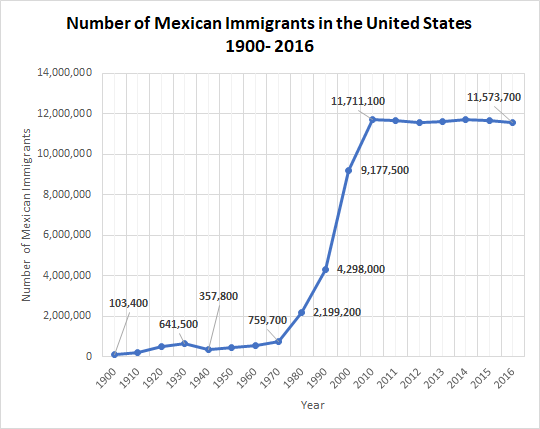
Long-term trend of Mexican immigration to the United States, 1900–2016. The graph shows slow early growth, rapid late-20th-century increases, and leveling after 2010, illustrating how migration flows respond to shifting push and pull factors. Year-specific values exceed syllabus needs, but the overall pattern helps students visualize long-term migration dynamics. Source.
Practice Questions
(1–3 marks)
Explain the difference between a push factor and a pull factor in human migration.
Question 1 (1–3 marks)
1 mark for identifying that a push factor is a negative condition that encourages people to leave an area.
1 mark for identifying that a pull factor is a positive condition that attracts people to a new area.
1 mark for providing a clear distinction between the two (e.g., push = origin-based pressures; pull = destination-based opportunities).
Maximum: 3 marks.
(4–6 marks)
Using examples, analyse how economic and environmental push and pull factors combine to influence international migration patterns.
Question 2 (4–6 marks)
Award marks for any of the following, up to 6 marks:
1–2 marks for describing economic push factors (e.g., unemployment, low wages, recessions).
1–2 marks for describing environmental push factors (e.g., drought, floods, soil degradation).
1–2 marks for describing economic or environmental pull factors (e.g., job availability, stable climate, fertile land).
1–2 marks for explaining how these factors interact to shape migration flows (e.g., migrants leave drought-stricken agricultural regions and move to places with labour demand).
1–2 marks for using relevant examples of international migration that illustrate these combined influences.
Maximum: 6 marks.
FAQ
Individuals often act on perceived conditions rather than objective realities. Migrants may interpret media reports, family messages, or social networks as more accurate than official information.
Perception can magnify or diminish the significance of push or pull factors. For example, a destination’s job market may be overstated within migrant networks, encouraging movement even when actual opportunities are limited.
Social networks provide information, assistance, and reassurance to potential migrants. These connections reduce the uncertainty of moving and can make a destination seem more attractive.
Pull factors become stronger when established migrants offer support such as temporary housing, job leads, or cultural familiarity. This can create self-reinforcing migration flows over time.
Influence varies depending on the context. In crisis situations, push factors such as conflict or environmental disaster dominate.
In more stable contexts, pull factors tend to guide voluntary migration, as individuals weigh opportunities for work, education, or improved living standards. Most migration involves an interaction of both forces rather than one acting alone.
Governments can shape conditions that serve as either push or pull forces without creating explicit migration policies. Examples include:
Economic management that affects employment rates
Environmental regulations influencing land or water quality
Investment in infrastructure that attracts labour
Political stability or instability also alters safety perceptions, influencing both emigration and immigration tendencies.
Short-distance migrants often respond to localised factors such as neighbourhood safety, housing cost, or access to services. These factors usually involve low financial and social risk.
Long-distance migrants typically respond to broader structural forces, including international wage differences, climatic shifts, or political instability.
Barriers such as cost, documentation, and cultural distance mean long-distance moves require stronger combined push and pull factors.