AP Syllabus focus:
‘Migration decisions reflect multiple causal factors—cultural, demographic, economic, environmental, and political—that vary by place and scale.’
Migration results from diverse influences shaping why people leave one place and move to another. Understanding these causes helps geographers analyze movement patterns across varying scales and contexts.
Classifying Migration Causes
Migration involves complex motivations that rarely occur in isolation. Instead, individuals and groups evaluate multiple pressures and opportunities before moving. The AP syllabus highlights that migration decisions reflect cultural, demographic, economic, environmental, and political factors, and these influences vary widely depending on the place of origin, destination, and scale of analysis. Because migration is multidimensional, geographers classify causal factors to better interpret patterns, identify dominant drivers, and understand how different contexts produce different forms of movement.
Cultural Causes of Migration
Cultural migration causes arise from characteristics of identity, lifestyle, community, and social expectations. These factors shape decisions by influencing how people perceive belonging, safety, and personal freedom.
Key Cultural Drivers
Cultural conflict or discrimination, including threats to language, religion, or ethnicity.
Educational or social opportunities, such as access to universities or cultural institutions.
Family expectations that promote staying close to relatives or following kin abroad.
Culture: Shared patterns of beliefs, values, and practices that shape group identity and influence behavior.
Cultural factors often overlap with other drivers, especially economic and political ones, reinforcing or weakening a person’s attachment to place. Cultural motivations tend to be strongest where social norms restrict individuals or where minority groups experience limited expression.
Demographic Causes of Migration
Demographic causes relate to characteristics of populations that influence movement. These causes vary across scales, from local pressures linked to age distributions to national-level trends in fertility and mortality.
Major Demographic Forces
Age structure, especially youth-dominated populations seeking employment elsewhere.
Household dynamics, including marriage patterns or changing family size.
Life-cycle transitions, such as retirement moves or mobility linked to family formation.
Demographics: Statistical characteristics of a population, such as age, sex, or family composition, that shape patterns of behavior and change.
Demographic factors rarely initiate migration alone but frequently modify other motivations, such as amplifying economic push factors when large youth cohorts compete for scarce jobs.
Economic Causes of Migration
Economic causes are among the most powerful drivers of migration. People often move when economic opportunities differ significantly between places.
Central Economic Motivations
Employment availability, including higher wages and labor demand in destination regions.
Economic decline, such as job loss, recessions, or collapsing industries.
Access to resources, from farmland to markets and financial systems.
Economic migration: Movement primarily motivated by differences in income, employment, or economic opportunity between origin and destination.
These forces operate at multiple scales, from rural-to-urban migration within a country to international labor flows shaped by global economic inequalities.
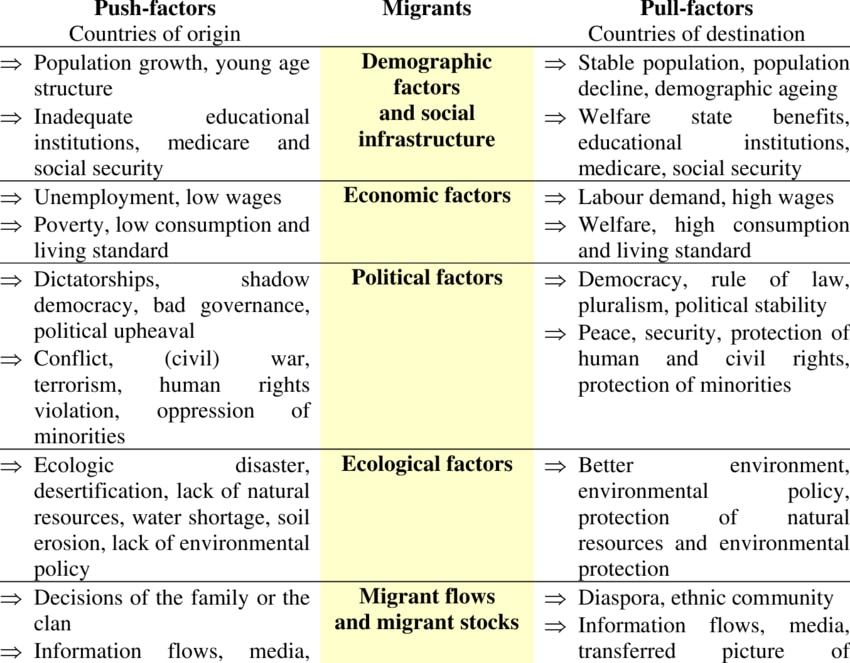
This table organizes migration causes into broad categories, pairing push factors with corresponding pull factors. It highlights how demographic, economic, political, ecological, and migrant-flow considerations can shape migration patterns. The India-specific examples exceed syllabus requirements but illustrate the same classification framework used in human geography. Source.
Environmental Causes of Migration
Environmental factors influence movement when natural conditions limit safety, livelihoods, or basic needs. Environmental causes can be both sudden and long-term, affecting populations differently depending on local resilience.
Types of Environmental Drivers
Natural disasters, such as earthquakes, floods, or hurricanes.
Long-term environmental change, including desertification, sea-level rise, or soil depletion.
Resource scarcity, particularly shortages of water, arable land, or energy.
Environmental migration: Movement caused wholly or partly by changes in environmental conditions affecting safety or resource access.
Although environmental factors often push people to leave, they can also act as pull factors when destinations offer favorable climates or resource availability.
Political Causes of Migration
Political influences emerge from government actions, conflict, and institutional structures. These factors shape migration by either restricting or enabling movement.
Key Political Drivers
Armed conflict or political instability, pushing residents to seek safety.
Discriminatory policies, such as restrictions based on ethnicity, religion, or political affiliation.
Government-led programs, which may encourage or discourage movement for strategic or economic goals.
Political migration: Movement influenced by government decisions, policies, conflict, or political conditions that affect personal security or rights.
Political factors often intersect with cultural or economic pressures, producing complex pathways to both voluntary and forced migration.
Interaction of Multiple Causes
While migration is often classified using the five major categories, real-world decisions rarely fit neatly into one classification. Migrants typically experience overlapping push and pull forces. Geographers analyze these combinations to understand both the immediate causes and the broader structural conditions shaping migration.
Overlapping Motivations
Economic + demographic: Young adults leave regions with high youth unemployment.
Cultural + political: Minority groups move due to restricted cultural rights and discriminatory laws.
Environmental + economic: Farmers relocate when environmental degradation undermines agricultural livelihoods.
Understanding how these causal factors interact across place and scale helps geographers interpret why migration patterns differ between regions and why the same event may produce different outcomes for different groups.
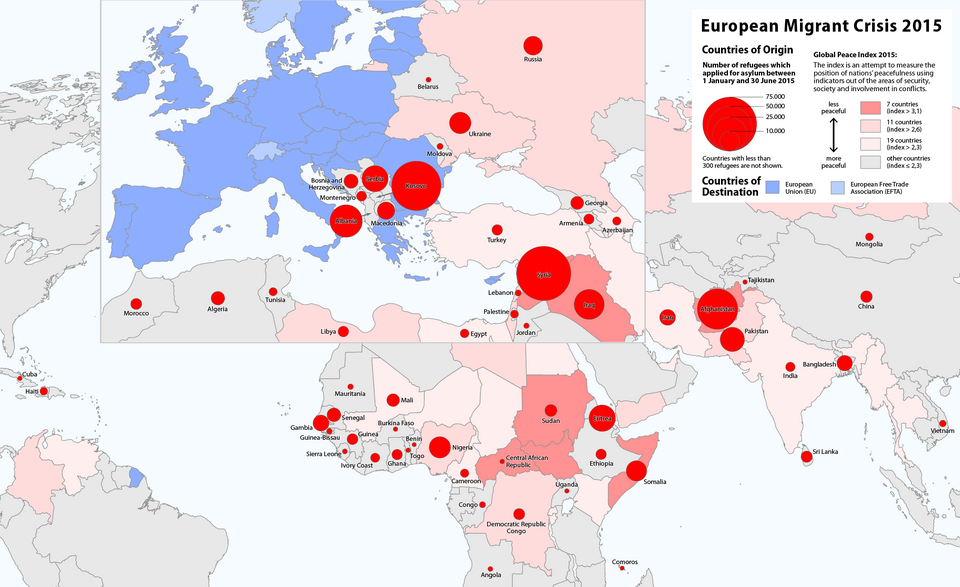
This map shows major origin countries of asylum seekers entering Europe in 2015, with circle size representing the volume of applicants. It illustrates how political conflict, violence, and economic hardship can interact to generate large-scale migration flows. Additional conflict-related shading provides contextual information beyond syllabus requirements. Source.
Practice Questions
Question 1 (1–3 marks)
Identify two different categories of migration causes and briefly explain how each category can influence an individual's decision to migrate.
Mark scheme
1 mark each for identifying up to two correct categories:
Cultural
Demographic
Economic
Environmental
Political
Up to 1 additional mark for a brief explanation of how each identified category can influence migration decisions, for example:
Cultural: conflict or discrimination may push people to leave.
Economic: job opportunities may pull migrants to a destination.
(Maximum 3 marks)
Question 2 (4–6 marks)
Using specific examples, explain how multiple categories of migration causes can interact to influence a migration flow.
Mark scheme
Award up to 6 marks total, based on the following:
1 mark for recognising that migration is often influenced by a combination of factors rather than a single cause.
Up to 2 marks for describing at least two different categories of causes (e.g., political instability, economic opportunity, environmental stress, demographic pressure).
Up to 2 marks for explaining clearly how these categories interact (e.g., environmental degradation increasing economic hardship; political conflict reinforcing cultural persecution).
Up to 1 mark for using a relevant example to support the explanation (e.g., Syrian refugees fleeing due to conflict and economic collapse; rural-to-urban migration driven by both job opportunities and demographic youth bulges).
(Maximum 6 marks)
FAQ
Geographers look for the factor that most directly triggers movement at a particular time, often identified through migrant interviews, policy reports, or sudden contextual changes.
They also assess which factor creates the strongest push or pull pressure. For example:
If conflict intensifies and migration spikes, political factors may be primary.
If wages rise abroad while conditions remain stable at home, economic causes may dominate.
In practice, primary drivers are identified by analysing temporal patterns, policy changes, and the relative strength of competing pressures.
Migrants may experience different pressures at the local, national, and global scales. Local conditions, such as crop failure or family expectations, differ greatly from national-level economic crises or regional conflicts.
Scale variation also emerges because:
Push factors often operate close to home (e.g., environmental degradation).
Pull factors may operate at broader scales (e.g., global labour markets).
Understanding scale helps geographers avoid oversimplifying complex migration flows.
Globalisation intensifies connections between places, making economic and cultural pull factors more accessible through global media and communication networks.
It also magnifies disparities between regions, increasing awareness of relative opportunities. This can strengthen economic pull factors and indirectly reinforce cultural or political motivations.
Global networks additionally allow migrants to receive information from diasporic communities, reducing perceived risks and making multi-causal migration more likely.
Migrants do not respond only to objective conditions; they also weigh risks, probability of success, and personal thresholds for uncertainty.
Perceived risk influences:
Whether a migrant prioritises safety over economic gain.
How strongly they respond to pull factors if destination conditions appear uncertain.
The likelihood of undertaking multi-stage or step migration.
Uncertainty can therefore alter the relative importance of migration causes even when conditions remain constant.
Historical flows create established networks, cultural linkages, and economic ties that persist over time. These legacies influence which causes appear most significant in the present.
For example:
Former colonial connections may make cultural or linguistic pull factors more influential.
Long-standing labour agreements can amplify economic pull factors.
Historic conflicts can shape political identities and affect ongoing push pressures.
Thus, the classification of present-day causes often reflects a blend of current conditions and inherited spatial relationships.