AP Syllabus focus:
‘Migration has political effects that can influence policies and relationships within and between places.’
Migration reshapes political systems by influencing government policies, electoral dynamics, international relations, and power structures. These political effects emerge at local, national, and global scales.
Political Effects of Migration
Migration produces significant shifts in how governments operate, how policies are designed, and how states relate to each other. Because population movement alters who lives where—and under what conditions—political institutions respond with new regulations, administrative frameworks, and diplomatic actions. These impacts can reinforce stability, generate conflict, or reshape long-term governance strategies.
National Political Responses
Migration commonly prompts governments to modify laws, adjust policy priorities, and redefine national identity narratives. States attempt to balance humanitarian responsibilities, security concerns, and economic needs, which can generate both cooperation and polarized debates.
Immigration policy reform, including changes to visa categories, citizenship pathways, and asylum procedures, is often triggered by migration inflows.
Border control measures such as surveillance systems, physical barriers, or expanded patrols reflect political decisions about national security and sovereignty.
Integration policies, including language programs or civic education requirements, aim to regulate how migrants participate in political life.
Political parties may shift their platforms to respond to migration-related concerns, influencing elections and legislative agendas.
Introducing these structures can redefine the relationship between the state and its population by determining who has access to political rights or long-term residency.
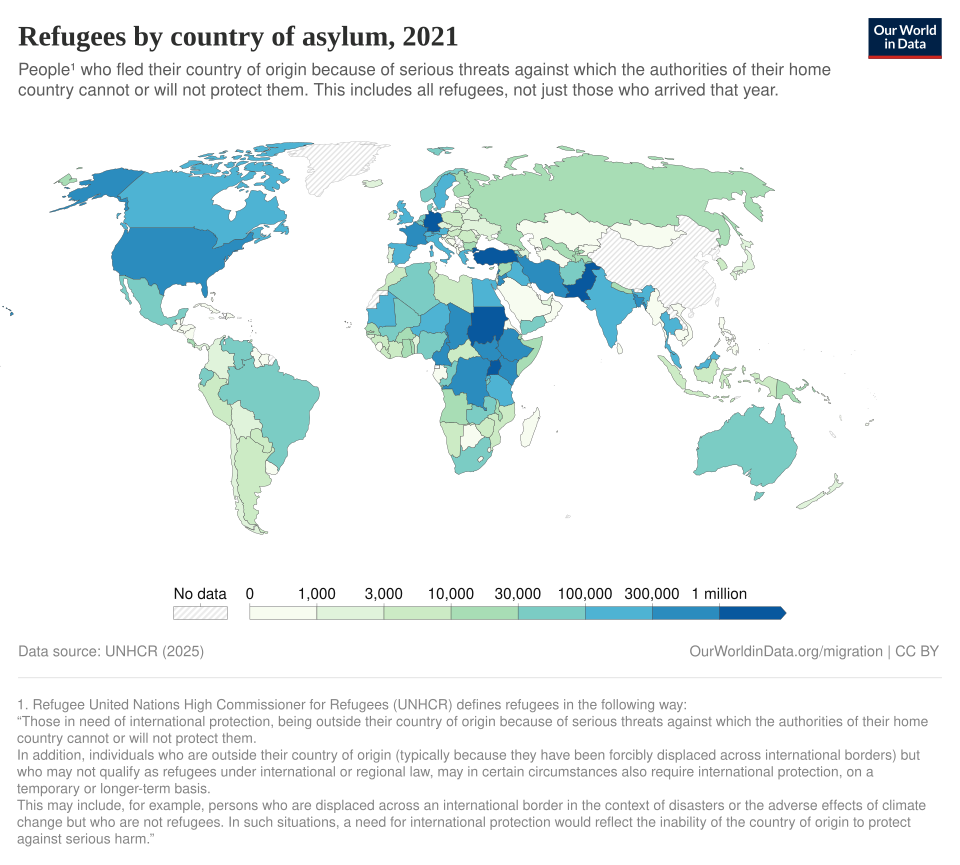
This world map shows the distribution of refugees by country of asylum in 2021, illustrating global variation in protection responsibilities. It highlights how migration flows shape diplomatic relations and negotiations among states. The map includes quantitative detail beyond the syllabus, but visually reinforces how migration influences political relationships between places. Source.
Political Debates and Polarization
Migration can heighten political contestation in democratic and non-democratic systems alike. Competing interpretations of migration’s benefits and challenges shape public discourse.
Parties may use migration as a mobilizing issue, appealing to concerns about employment, cultural change, or security.
Debates over migrant inclusion can deepen ideological divides, with some groups emphasizing humanitarian values and others prioritizing restriction.
Policy disagreements may escalate into institutional gridlock if migration becomes a major partisan conflict.
These dynamics can influence voter turnout, coalition-building, and long-term political alignments.
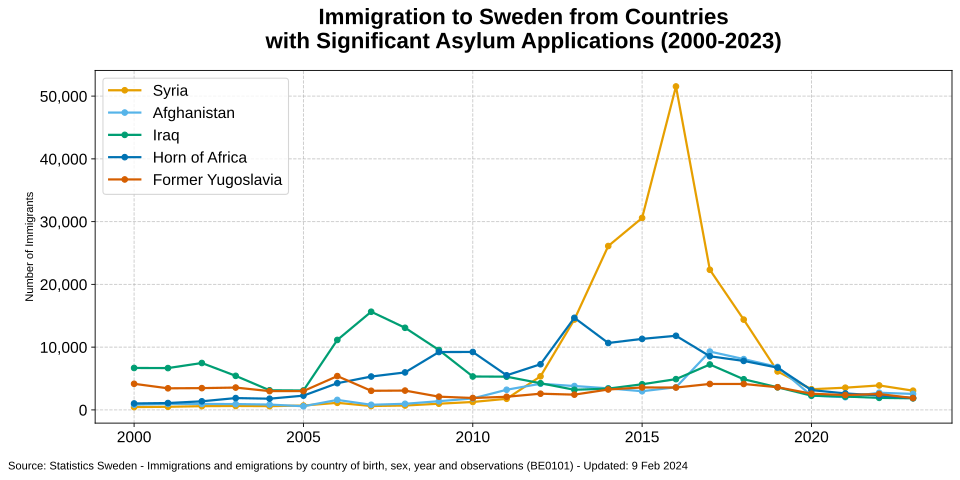
This chart displays changes in annual immigration to Sweden from several asylum-origin countries, highlighting how migration trends fluctuate over time. These shifts often become focal points in national political debates about asylum policy, integration, and national identity. The figure contains more detail than required by the syllabus but effectively shows how migration patterns can shape political discourse. Source.
Electoral Impacts
Migration affects electoral geography by altering the demographic composition of districts. Changes in population distribution can shift political power and representation.
Internal migration may modify congressional district boundaries, leading to redistricting to maintain equal population representation.
Areas receiving migrants may gain political influence, while regions experiencing out-migration may lose representation.
Migrants who obtain citizenship can become significant voting blocs, shaping outcomes in competitive elections.
These effects demonstrate how migration alters power balances within states.
Policy-Making and Governance
Governments must adapt administrative and institutional structures as migration evolves. This can extend beyond immigration agencies to include education, healthcare, and housing.
Migration can necessitate interagency coordination, requiring collaboration between federal, state, and local governments.
Expanding migrant populations may lead to new regulatory frameworks governing labor markets, documentation systems, and social services.
International agreements may be created to manage labor migration, border management, or refugee protection.
These governance adjustments reflect the political necessity of responding to changing population compositions.
International Relations and Diplomacy
Migration is deeply tied to geopolitics. Movements of people across borders influence how countries negotiate, cooperate, or experience tension.
Countries may sign bilateral or multilateral agreements to regulate migration flows, labor exchanges, or border security.
Refugee crises can strain diplomatic relationships if neighboring states disagree on responsibility sharing.
Destination countries may offer development aid or political incentives to countries of origin to manage migration pressures.
Migration thus becomes a component of foreign policy, affecting alliances and diplomatic priorities.
State Sovereignty and Security
Migration can influence how governments assert control over territory and regulate entry.
States may intensify national security measures when large-scale migration is perceived as a threat.
Sudden influxes of refugees may challenge state capacity to manage borders and maintain order.
Governments may debate sovereignty issues, defining who has the right to enter and under what conditions.
These concerns shape political rhetoric and legal frameworks surrounding migration.
Human Rights and Legal Frameworks
Migration pressures governments to navigate international human rights obligations. The treatment of migrants becomes a central political issue.
Countries must comply with international refugee law, influencing asylum policies and detention practices.
Political debates often emerge about balancing national interests with humanitarian responsibilities.
Courts may intervene in migration cases, influencing policy through judicial review.
This legal environment highlights how migration affects the relationship between state authority and universal human rights norms.
Local Political Effects
Local governments also experience political changes driven by migration.
City councils and municipal leaders may adopt welcoming policies or declare sanctuary status.
Local political coalitions may shift as migrant communities gain influence in civic organizations or local elections.
Municipal governments may advocate for state or federal policy adjustments to address local migration realities.
These localized effects reveal how migration politics operate at multiple scales simultaneously.
Migration and Public Policy Priorities
As populations shift, political priorities evolve. Migration may elevate new issues to national prominence.
Governments may prioritize education funding, housing policy, or emergency services to meet migrant needs.
Political leaders may adjust budgets and long-term planning to incorporate demographic change.
Ongoing migration can reshape political agendas by highlighting topics such as diversity, citizenship, and integration.
These shifts underscore how migration influences not only specific policies but broader governance trajectories.
Practice Questions
(1–3 marks)
Explain one way migration can influence political debates within a country.
Question 1 (1–3 marks)
1 mark
• Identifies a valid political effect of migration (e.g., increased political debate, polarisation, party shifts, changes in policy focus).
2 marks
• Provides a clear explanation of how migration shapes political debate (e.g., parties using migration as a mobilising issue, disagreements over integration policy).
3 marks
• Offers a developed explanation linking migration to political consequences such as heightened ideological divides, electoral impacts, or policy gridlock.
(4–6 marks)
Assess how international migration can affect political relationships between countries of origin and destination. Refer to specific political processes in your answer.
Question 2 (4–6 marks)
1–2 marks
• Identifies basic political effects of international migration on relationships between states (e.g., diplomatic negotiations, shared responsibility for refugees, border agreements).
3–4 marks
• Provides explanation of how these effects operate (e.g., refugee flows prompting bilateral agreements, destination countries offering aid, tensions arising from uneven migration pressures).
5–6 marks
• Demonstrates clear assessment, weighing different consequences or providing balanced reasoning.
• May reference contrasting outcomes (e.g., cooperation vs. conflict) and link specific political processes such as foreign policy decisions, international law, or diplomacy.
FAQ
Migration can act as a catalyst for new political parties or movements when existing parties fail to address public concerns about border control, identity, or integration.
This often leads to the rise of single-issue or populist parties that prioritise migration control, national sovereignty, or protectionist policies.
Such movements may then shape mainstream party agendas by shifting the political spectrum or pushing migration to the forefront of public debate.
Local governments often experience migration impacts more immediately than national institutions, especially in housing, schools, and social services.
As a result, municipalities may adopt more welcoming or restrictive measures depending on local needs, demographics, or political attitudes.
This can produce policy mismatches where local strategies—such as sanctuary policies—conflict with national priorities on enforcement or border control.
Media framing can amplify or downplay migration issues, influencing how the public perceives migrants and shaping political agendas.
Common narratives include:
Security-focused coverage highlighting border breaches or crime
Humanitarian coverage emphasising suffering or displacement
Economic narratives centred on labour shortages or welfare impacts
These narratives can increase political pressure on governments to act, sometimes accelerating shifts in immigration or asylum policy.
Large or sudden migration flows can test government capacity, sometimes causing administrative strain in asylum systems, housing, or employment services.
If poorly managed, this can undermine trust in government institutions, creating openings for political backlash or anti-establishment movements.
However, effective management—through clear communication and long-term planning—can strengthen governance by demonstrating responsiveness and adaptability.
Bodies such as the UNHCR, IOM, and regional blocs play a major role in coordinating responses to migration, influencing how states craft policies and negotiate responsibilities.
They may:
Facilitate resettlement programmes
Establish legal standards for refugee protection
Mediate disputes between states over border management
Provide technical support for managing migration data
Their involvement can encourage cooperation but may also generate political tension when states perceive external influence as limiting national sovereignty.