AP Syllabus focus:
‘Population distribution and density affect political, economic, and social processes, including the provision of services such as medical care.’
Population distribution shapes how societies function by influencing political representation, economic development, and access to essential services. Understanding these impacts helps explain geographic inequalities and planning challenges.
How Population Distribution Shapes Societal Functioning
Population distribution refers to the pattern of where people live across space, and population density describes the number of people per unit of land.
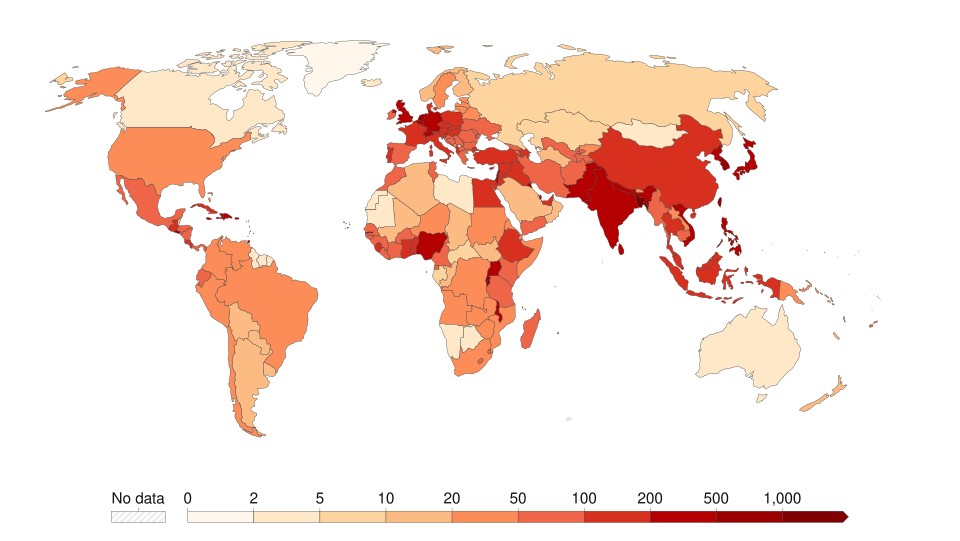
This map shows global population density by country in 2022, with darker shades indicating higher numbers of people per square kilometer. It reinforces the idea that population is clustered in particular regions, shaping where political attention, infrastructure, and services are most needed. The legend’s reference year and numerical classes extend beyond the AP syllabus but help contextualize density variation. Source.
These spatial patterns directly influence how societies organize political power, allocate resources, and plan infrastructure. When geographers evaluate these impacts, they consider how uneven concentrations of people create advantages in some places and pressures in others.
Political Impacts of Population Distribution
Population distribution affects multiple political processes because governments must respond to the needs of people where they are most concentrated.
Areas with high population density typically receive greater political attention due to larger voting populations and intensified demand for public services.
Regions with low population density may face underrepresentation and difficulties maintaining services such as schools or postal systems.
Political boundaries and districting are often redrawn based on population counts to ensure equitable representation, reflecting the principle of “one person, one vote.”
When geographers analyze these effects, they assess how demographic hotspots influence policy-making and public funding flows.
Impacts on Economic Processes and Development
Economic Effects of High-Density Areas
High-density areas tend to be hubs of economic activity, but they also experience significant strain.
Dense urban centers encourage agglomeration, where businesses cluster for efficiency, innovation, and labor access.
High density can increase land values, altering housing markets and encouraging vertical development.
Overcrowding puts pressure on transportation networks, utilities, and employment, potentially producing congestion and widening inequality.
Economic Effects of Low-Density Areas
Low-density regions face their own challenges, often characterized by limited economic diversification and reduced opportunities.
Sparse populations lead to higher per capita costs for infrastructure such as electricity grids, roads, and broadband networks.
Employers may struggle to attract workers, reinforcing cycles of out-migration.
Economic development policies often target these regions to counteract geographic disadvantages.
Understanding these patterns helps explain why governments invest differently across regions to stabilize economic conditions.
Social Impacts and Access to Services
The most direct societal effects of population distribution involve access to core social services, including education, transportation, sanitation, and especially medical care, as emphasized by the syllabus.
Access to Medical Care
Medical care availability is strongly influenced by where people live. Dense areas support more health facilities because demand is high enough to sustain them.
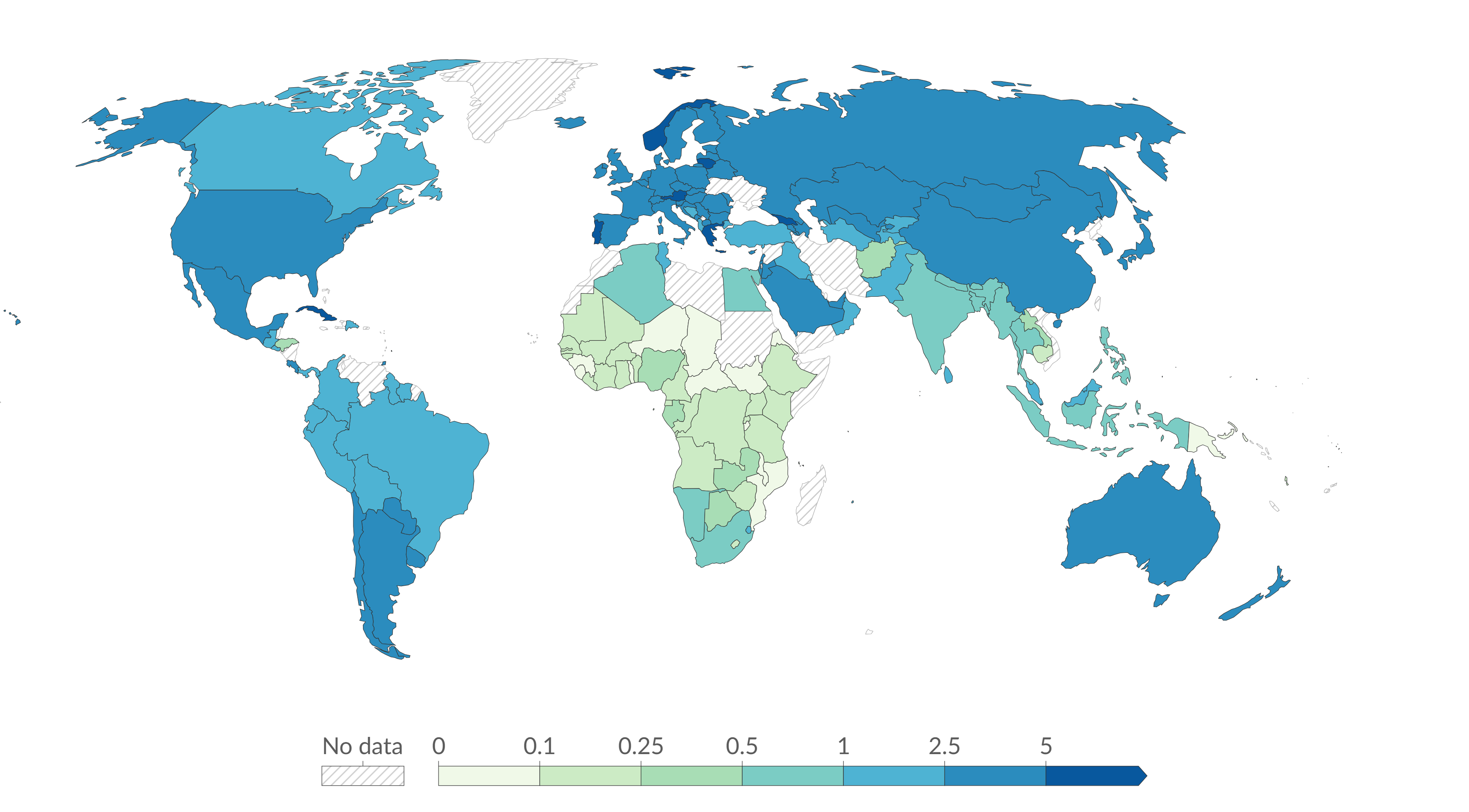
This map shows the number of medical doctors per 1,000 people worldwide, with darker shades representing higher physician density. It visualizes disparities in healthcare access, demonstrating how population concentration and economic development shape medical service availability. The exact numerical classes and reference year exceed syllabus requirements but enhance conceptual clarity. Source.
Medical Underservice: A condition in which a population lacks sufficient access to healthcare providers, facilities, or resources relative to its needs.
High-density regions tend to have hospitals, specialized clinics, and emergency services nearby. However, crowding can lead to long wait times and uneven quality. Meanwhile, rural or sparsely populated regions often have fewer providers, longer travel times, and limited emergency response capacity.
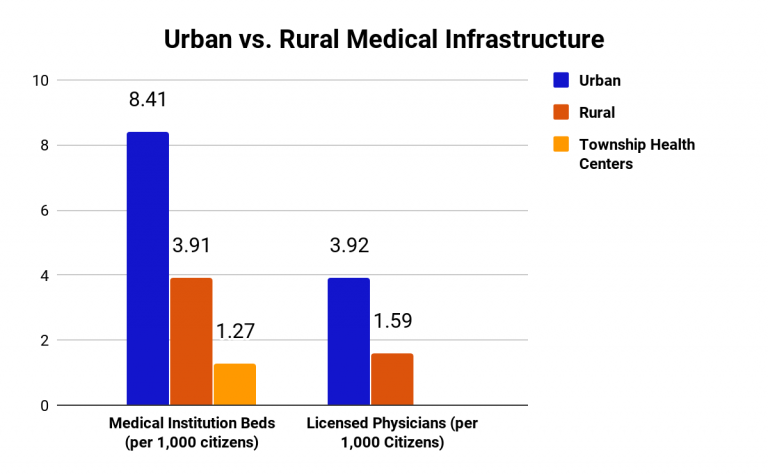
This bar chart compares medical resources across urban, rural, and township areas in China, illustrating how health infrastructure is concentrated in denser population centers. It reinforces the note’s discussion of rural under-service and how population distribution shapes service access. The specific case data exceed AP requirements but provide a clear real-world example of these geographic patterns. Source.
This disparity affects health outcomes such as life expectancy, infant mortality, and chronic disease management. These outcomes are central to how population distribution influences social well-being.
Population density also affects education, as high-density districts may deal with overcrowded classrooms, while low-density regions struggle to maintain enough students to justify school operations.
Housing and Social Infrastructure
Social infrastructure responds to population distribution in ways that shape quality of life.
High-density areas face housing shortages, rapid gentrification, and rising rents.
Low-density areas may have aging housing stock and reduced accessibility to social amenities.
Public transportation systems thrive in dense areas but are often impractical in low-density communities, increasing reliance on cars.
These differences demonstrate how spatial patterns affect people’s daily lived experiences.
Interplay Between Services and Population Density
Population density reveals the pressure populations place on land and resources, influencing how governments must plan to meet needs. Services must scale with population concentration.
High-density regions require extensive, well-coordinated service networks such as sewer systems, hospitals, and public transit.
Low-density regions require broader geographic coverage for essential services, making provision more costly per person.
Because population distribution is uneven across local, regional, and national scales, planners must tailor service delivery mechanisms to meet distinct geographic challenges.
Feedback Loops Between Population Patterns and Services
Population distribution influences services, but services also influence where populations settle. Areas with strong social and economic services attract migrants, reinforcing growth. Conversely, regions with weak service infrastructure may lose population, further diminishing resources. These feedback loops are central to understanding long-term geographic change.
Service Accessibility: The ease with which populations can reach and use essential public services, influenced by distance, capacity, and distribution of facilities.
Population density shapes these dynamics by determining where investment is economically or politically viable. As a result, geographers study how current settlement patterns create future patterns of opportunity and constraint.
Multi-Scale Variation in Societal Impacts
The effects of population distribution on society and services vary across scales:
Local scale: Neighborhoods differ in school quality, healthcare access, and transportation options.
Regional scale: States or provinces may experience uneven development and political power imbalances.
National scale: Countries with highly concentrated populations (e.g., primate cities) encounter unique planning challenges.
Understanding scale helps geographers identify patterns that might otherwise be hidden, highlighting how population distribution shapes societal functioning in diverse and meaningful ways.
Practice Questions
Question 1 (2 marks)
Explain one way in which high population density can influence the provision of medical services.
Mark scheme
1 mark for identifying an influence (e.g., increased demand for healthcare facilities).
1 mark for explaining how this affects provision (e.g., higher density can support more hospitals but may also cause overcrowding and longer waiting times).
Question 2 (5 marks)
Using your knowledge of population distribution, analyse how uneven population distribution can create social and economic challenges for governments when planning public services.
Mark scheme
Award up to 5 marks:
1 mark for identifying at least one social challenge (e.g., unequal access to healthcare or education).
1 mark for explaining how sparsely populated areas may experience service shortages due to high per capita costs.
1 mark for identifying at least one economic challenge (e.g., infrastructure investment disparities).
1 mark for linking dense areas with overcrowding, pressure on services, or increased infrastructure demand.
1 mark for overall analytical coherence showing how differing densities create contrasting service needs for governments.
FAQ
Emergency services rely heavily on proximity and accessibility. Densely populated urban areas often have shorter response times because facilities such as fire stations, ambulance hubs, and police units are located closer together.
In contrast, sparsely populated rural regions may face longer response times due to greater travel distances, limited road networks, and fewer service stations.
Governments may address these gaps through mobile units, volunteer responders, or regional service-sharing agreements.
Public transport requires a critical mass of users to remain financially viable. In low-density areas, fewer passengers mean reduced fare revenue.
This typically results in:
Infrequent services
Limited routes
Higher per capita operating costs
Consequently, governments must decide whether subsidising services is justified or whether resources should be redirected to essential services such as healthcare or education.
High-density areas require robust, high-capacity water and sanitation infrastructure to prevent contamination and maintain public health. This often involves complex underground pipe networks, treatment plants, and continual monitoring.
Low-density areas may rely on simpler systems such as septic tanks or small-scale community water supplies, but these can be costlier to maintain per person and vulnerable to environmental risks.
Planners must therefore balance efficiency, cost, and sustainability across different settlement patterns.
In densely populated areas, schools may face overcrowding, requiring additional teachers, temporary classrooms, or extended school days.
In remote or low-density areas, funding challenges arise because pupil numbers may be too small to justify specialist teachers, advanced facilities, or diverse subject offerings.
Governments often use per-pupil funding formulas, catchment area adjustments, or school consolidation to manage disparities.
Governments may combine several approaches to overcome long distances and low patient numbers:
Telemedicine to provide remote consultations
Mobile clinics visiting communities on a rotating schedule
Incentives to attract doctors to rural posts, such as housing benefits or loan repayment schemes
Regional hospitals supported by smaller satellite clinics
These strategies help offset geographic barriers while ensuring basic health services remain accessible.