AP Syllabus focus:
‘Population distribution and density affect the environment and natural resources; this relationship is often described using carrying capacity.’
Population distribution directly shapes how communities use land, strain natural resources, and alter environments, making the concept of carrying capacity essential for understanding geographic patterns and sustainability.
Environmental Impacts of Population Distribution
Population distribution refers to the pattern of where people live, and density measures reflect how tightly populations are packed into specific spaces. These patterns determine how humans interact with landscapes and help explain why some environments experience greater stress than others. Where large numbers of people live in concentrated areas, the demand for space, food, water, and energy can intensify environmental pressures. Conversely, sparsely populated regions may experience fewer direct impacts but can still face degradation depending on economic activities, resource extraction, or agricultural land use.
How Density Shapes Environmental Pressure
High population density typically increases the intensity and frequency of human–environment interactions.
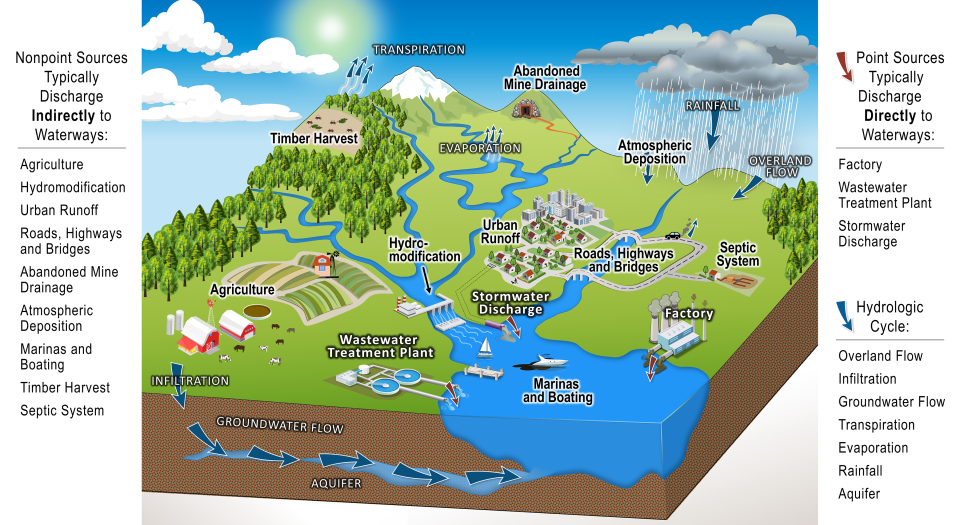
This diagram illustrates how different human land uses—such as agriculture, roads, and urban areas—introduce pollutants into a watershed through surface runoff. It shows how water moves through the landscape, carrying these pollutants into streams, rivers, and lakes. The figure includes extra detail on point and nonpoint sources and elements of the hydrologic cycle that extends slightly beyond the AP specification while still supporting the concept of environmental pressure from population distribution. Source.
These interactions often include land conversion, water withdrawal, and waste generation. At the same time, low-density regions may experience different challenges, such as overuse of fragile ecosystems by dispersed agricultural or pastoral systems.
Key environmental impacts associated with density include:
Land-use change, such as deforestation, urban expansion, and habitat fragmentation.
Water stress, particularly where freshwater sources must support large populations.
Soil depletion, especially in agricultural zones with limited rotation or intensive cultivation.
Air and water pollution, concentrated near dense settlements or industrial clusters.
Resource depletion, including minerals, fossil fuels, and forests.
These impacts illustrate how density affects the environment at varying scales—from local ecological disruption to large-scale regional resource shortages.
Understanding Carrying Capacity
The concept of carrying capacity is central to analyzing the environmental consequences of population distribution. Carrying capacity describes the maximum population size that an environment can sustainably support without long-term depletion of resources or ecological collapse.
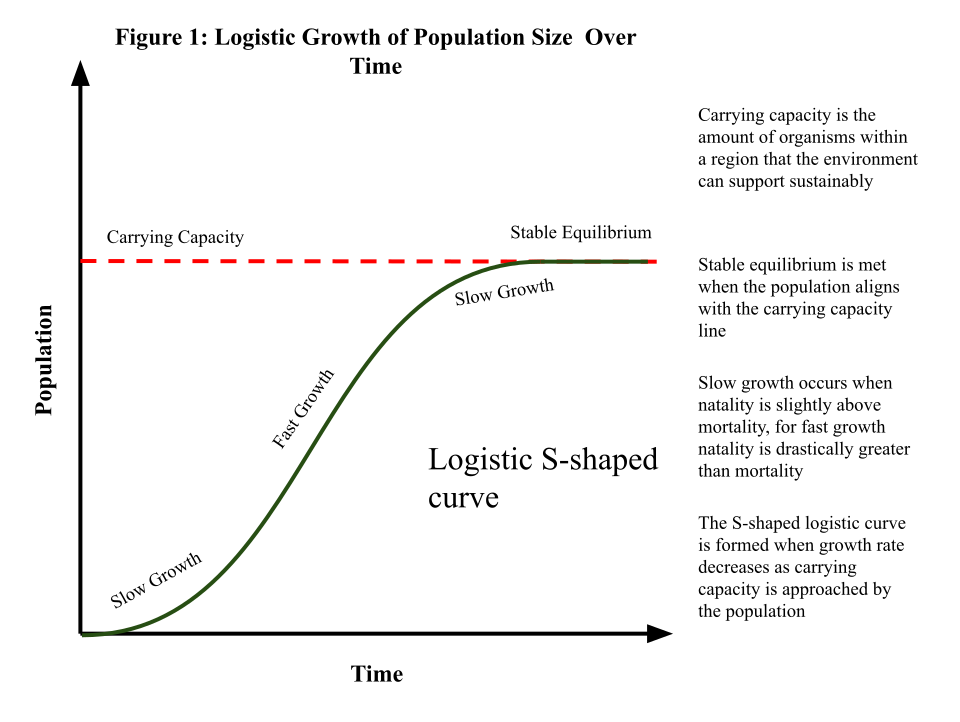
This graph shows a population growing rapidly at first and then slowing as it approaches the environment’s carrying capacity, forming an S-shaped curve. The horizontal line represents the maximum population that the environment can support over the long term. This visual emphasizes how resource limits eventually constrain growth, even when population size has been increasing quickly. Source.
Carrying Capacity: The largest population an environment can sustain over time without degrading its resource base or ecological functions.
A sentence here ensures spacing before potential additional definition blocks.
Factors Affecting Carrying Capacity
Several interacting factors influence whether an area can sustain a given population:
Resource availability
Regions with abundant freshwater, fertile soils, and favorable climates generally support higher populations. In contrast, arid, mountainous, or heavily polluted regions have lower carrying capacities.Technological development
Advancements in agriculture, water management, and renewable energy can increase carrying capacity by raising productivity or reducing environmental impact. However, technology can also intensify degradation if it enables overuse of resources.Consumption levels
High per-capita consumption increases resource demand and raises environmental pressure, potentially lowering carrying capacity even in areas with modest population sizes.Land-management practices
Sustainable farming, zoning regulations, and environmental protections help maintain ecological integrity. Poorly managed landscapes reduce resilience and diminish carrying capacity.
Environmental Consequences of Exceeding Carrying Capacity
When a population surpasses the carrying capacity of its environment, the imbalance can trigger a series of negative environmental outcomes. These consequences highlight why geographers analyze population distribution and density when assessing environmental challenges.
Resource Depletion
Overpopulation in areas with limited resources can lead to rapid extraction of timber, minerals, and groundwater. As these resources diminish, the environment’s ability to regenerate declines, creating a feedback loop of scarcity.
Land Degradation
Excessive population pressure often accelerates processes such as desertification, soil erosion, and nutrient depletion. These changes impair agricultural productivity and reduce the land’s capacity to support human settlement.
Water Scarcity
Densely populated regions regularly face water shortages, especially where agricultural, industrial, and domestic uses compete. Declining water tables, polluted rivers, and shrinking lakes are common signs of carrying capacity stress.
Pollution and Waste Accumulation
High-density settlements generate significant waste. Without adequate infrastructure, pollution can accumulate and damage ecosystems, reduce biodiversity, and undermine public health.
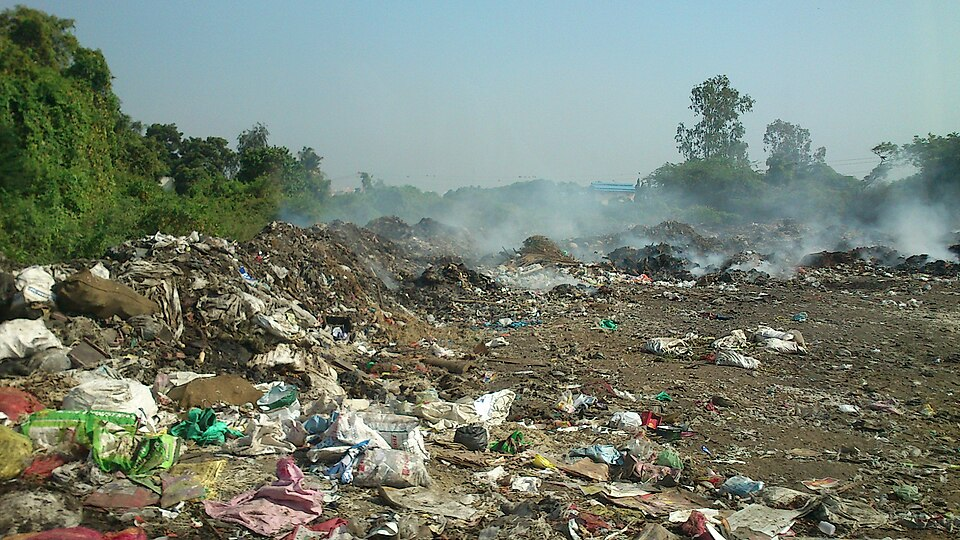
This photograph shows an open garbage dump where unmanaged waste covers the landscape and smoke rises from decomposing or burning trash. Such conditions reflect how high population density and inadequate infrastructure can degrade land, air, and nearby water resources. Images like this help illustrate environmental stress that emerges when human demands on local systems exceed their effective carrying capacity. Source.
Climate Implications
Large populations concentrated in urban and industrial regions contribute substantially to greenhouse gas emissions. The resulting climate change further reduces carrying capacity by altering precipitation patterns, intensifying heat waves, and disrupting ecosystems.
The Spatial Dimension of Carrying Capacity
Carrying capacity varies at local, regional, and global scales. Local carrying capacity may hinge on soil quality or water access, while regional capacity may depend on trade networks, government policies, or environmental regulations. Globally, carrying capacity reflects the planet’s aggregate ability to support human life within ecological limits.
Population distribution interacts with these scales. Some areas exceed their local carrying capacity but remain viable through imported food, water, or energy, while other self-sufficient regions maintain low densities and minimal external inputs.
How Geographers Use Carrying Capacity
Geographers use carrying capacity to evaluate the sustainability of existing population patterns, predict environmental strain, and analyze how technological or policy changes may affect future resource availability. By linking environmental conditions to population distribution and density, carrying capacity becomes a critical tool for understanding the long-term balance between human populations and the ecosystems that support them.
Practice Questions
(1–3 marks)
Explain how high population density can contribute to environmental degradation in a specific location.
(1–3 marks)
1 mark: Identifies a link between high population density and an environmental impact (e.g., pollution, deforestation, waste accumulation).
1 mark: Provides a clear explanation of how density increases pressure on land or resources.
1 mark: Uses a specific location to contextualise the explanation (e.g., Lagos, Mumbai, Manila).
(4–6 marks)
Using the concept of carrying capacity, analyse how population distribution can influence the sustainability of resource use in a region. Refer to at least two environmental impacts in your response.
(4–6 marks)
1 mark: Defines or clearly references carrying capacity as the maximum population an environment can sustainably support.
1 mark: Explains how population distribution affects resource demand.
1 mark: Describes at least one environmental impact (e.g., water scarcity, soil degradation).
1 mark: Describes a second environmental impact linked to exceeding carrying capacity.
1 mark: Analyses how sustainability is influenced by the balance between population density and resource availability.
1 mark: Uses regional or real-world examples to support the analysis.
FAQ
Carrying capacity for renewable resources depends on the rate at which ecosystems can replenish themselves. When extraction exceeds regeneration, long-term capacity declines.
For non-renewable resources, carrying capacity is tied to finite availability. Once depleted, these resources cannot be replenished, so overuse permanently lowers the region’s ability to support its population.
Technological advancements can boost food production, improve water delivery, or create synthetic materials that reduce pressure on natural resources.
However, these solutions may hide emerging scarcity by preventing immediate shortages, leading to overconsumption. When technologies fail or become unsustainable, underlying environmental limits reappear sharply.
Regions with concentrated populations experience faster resource depletion and more visible environmental stress, while sparsely populated areas may remain underutilised.
This imbalance can create:
Overexploitation hotspots
Strained infrastructure in dense areas
Untapped resource potential in low-density regions
Governments often redirect resources to manage these disparities.
Common indicators include:
Declining water quality or availability
Increased soil erosion or loss of fertile land
Reduced biodiversity
Rising waste accumulation
Greater reliance on imported food, water, or energy
A combination of these signals suggests that population demands are outpacing environmental capacity.
Cultural norms shape consumption patterns, agricultural traditions, and attitudes toward conservation. For example, dietary preferences affect land use, while traditional farming methods may either preserve or degrade soils.
Cultural values also influence willingness to adopt sustainable technologies. Regions with strong conservation ethics often maintain higher carrying capacity by limiting waste and resource overuse.