AP Syllabus focus:
‘Social, cultural, political, and economic factors influence fertility, mortality, and migration rates.’
Human demographic patterns shift in response to interconnected social, political, and economic forces that shape fertility, mortality, and migration rates, producing distinct population dynamics across regions.
Social Influences on Demographic Change
Social factors directly affect how populations grow, shrink, and move.
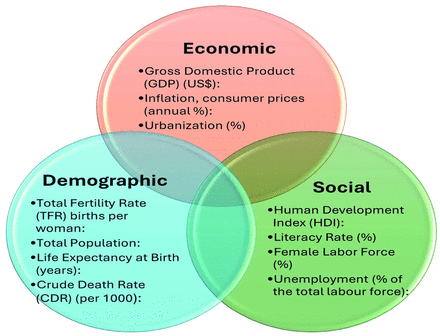
This diagram illustrates how economic, social, and demographic indicators combine to shape fertility levels in a population. It emphasizes that fertility reflects overlapping conditions such as economic development, literacy, and life expectancy. The figure includes additional detail beyond the AP syllabus but reinforces the interconnected nature of demographic influences. Source.
Social Factors Affecting Fertility
Social expectations surrounding family roles and reproductive behavior often influence the number of children individuals have.
Cultural norms about family size, such as valuing large families for labor or lineage continuation, can increase fertility.
Gender norms, especially those limiting women’s education or employment, typically correlate with higher fertility rates because women may have fewer opportunities outside household roles.
Access to education, particularly for girls and women, tends to lower fertility by increasing knowledge of contraception and expanding life opportunities.
Religious beliefs may also shape attitudes toward contraception, family planning, or desired family size.
Fertility Rate: The average number of children a woman is expected to have during her reproductive years.
Social changes can also interact with economic or political shifts, creating compounding effects on demographic patterns across regions.
Social Factors Affecting Mortality
Mortality rates vary widely depending on access to medical care, nutrition, and stable living conditions.
Healthcare access, including availability of clinics, vaccinations, and prenatal care, reduces death rates.
Nutrition and sanitation, influenced by lifestyle and community infrastructure, affect infant and child mortality.
Education, especially maternal education, is strongly associated with improved health outcomes and lower mortality.
Social inequality, including disparities in income or racial discrimination, can produce uneven mortality patterns within the same country.
Social Factors Affecting Migration
People often migrate in response to social structures and opportunities.
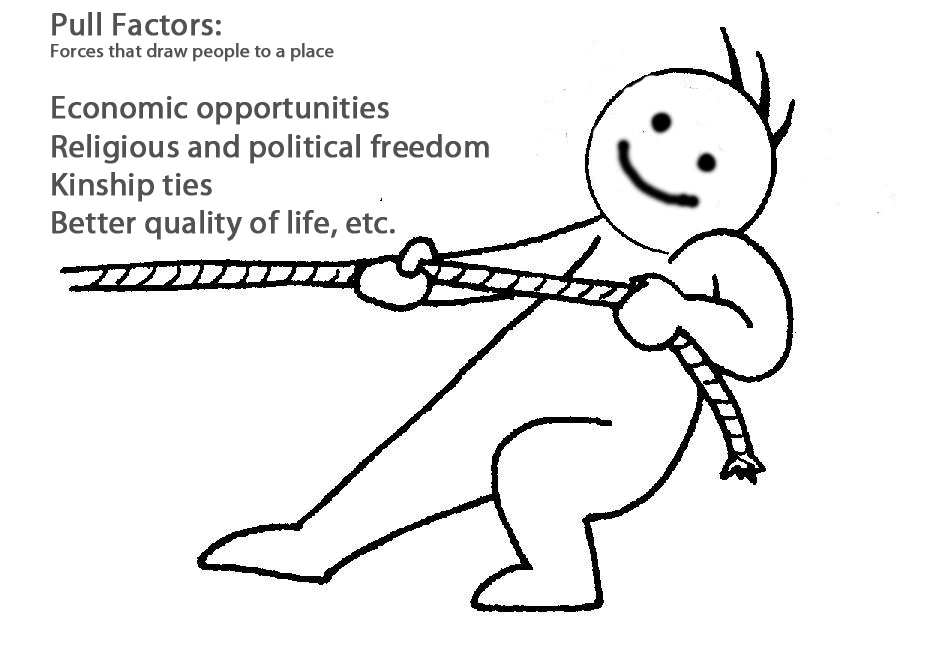
This cartoon highlights typical pull factors that attract migrants, including economic opportunities, religious and political freedom, and higher quality of life. It reinforces how migration decisions reflect perceived social and economic benefits at a destination. The image focuses specifically on pull factors rather than presenting the full push–pull model. Source.
Family networks encourage chain migration, where relatives follow earlier migrants to a shared destination.
Education access, including the desire to attend universities abroad, draws many internal and international migrants.
Social stability, such as the absence of conflict or persecution, can either retain populations or push them away.
Political Influences on Demographic Change
Political decisions shape demographic processes through laws, policies, and governance structures. Governmental choices often directly influence fertility, mortality, and migration through regulation, enforcement, and public investment.
Political Factors Affecting Fertility
Governments may directly or indirectly seek to influence birth rates.
Pronatalist policies, such as subsidies or tax incentives for families with multiple children, raise fertility.
Antinatalist policies, including family-planning programs or limits on family size, reduce fertility.
Legal rights for women, such as property ownership or workplace protections, can empower reproductive choice and lower fertility.
Political Factors Affecting Mortality
Public investment and governance quality deeply affect health outcomes.
Funding for healthcare systems, including hospitals, vaccination programs, and emergency services, reduces mortality.
Environmental regulations, such as pollution controls, affect life expectancy.
Political stability, reducing conflict and violence, often leads to lower mortality and longer life expectancy.
Political Factors Affecting Migration
Migration is closely tied to political conditions and decisions.
Immigration policies shape who may legally enter or remain in a country.
Refugee and asylum laws protect people fleeing conflict or persecution.
Conflict and political instability push populations out of affected regions, producing refugees or internally displaced persons.
Refugee: A person forced to migrate across international borders due to conflict, persecution, or human rights violations.
Political actions frequently intersect with economic and social factors, creating complex migration systems influenced by policy, opportunity, and risk.
Economic Influences on Demographic Change
Economic conditions strongly guide population growth and movement. Employment opportunities, income, and national development levels shape demographic behavior across regions and over time.
Economic Factors Affecting Fertility
Economic conditions can either encourage or discourage childbearing.
High economic development tends to lower fertility as families prioritize education, career advancement, and higher living costs.
Agricultural or labor-based economies often correlate with higher fertility because children contribute economically to household labor.
Job availability for women encourages delayed marriage and childbirth, reducing fertility.
Economic Factors Affecting Mortality
Mortality is closely linked to economic well-being.
Income levels determine access to food, housing, and healthcare.
Economic inequality produces varying life expectancies within the same population.
National wealth, often measured through development indicators, enables better public health systems and lower death rates.
Economic Factors Affecting Migration
Economic motivation is one of the most common drivers of migration.
Employment opportunities, such as jobs in manufacturing, technology, or construction, pull migrants toward certain regions or countries.
Poverty may push individuals to move in search of better wages or more stable livelihoods.
Regional economic disparities, including wage gaps or uneven development, create large-scale internal and international migration flows.
Economic conditions often connect back to political decisions and social structures, producing demographic patterns that reflect the combined effects of opportunity, constraint, and long-term development.
Practice Questions
Question 1 (1–3 marks)
Explain one social factor and one economic factor that can influence a country’s fertility rate.
(3 marks)
Mark scheme:
1 mark for correctly identifying a relevant social factor (e.g., gender norms, education levels, cultural expectations).
1 mark for correctly identifying a relevant economic factor (e.g., cost of living, employment opportunities, level of economic development).
1 mark for explaining how either the social or economic factor influences fertility (e.g., higher female education reduces fertility by delaying childbirth; higher living costs reduce the number of children families can afford).
Question 2 (4–6 marks)
Discuss how political and social factors together can shape patterns of migration within and between countries.
(6 marks)
Mark scheme:
1 mark for identifying at least one political factor affecting migration (e.g., immigration policies, refugee/asylum laws, political stability).
1 mark for identifying at least one social factor affecting migration (e.g., family networks, educational opportunities, social stability).
1 mark for explaining how a political factor influences migration flows (e.g., restrictive immigration policies reduce cross-border movement).
1 mark for explaining how a social factor influences migration flows (e.g., family networks encourage chain migration).
1 mark for linking political and social factors to show how they may interact (e.g., conflict forcing migration while social networks guide destination choice).
1 mark for using clear geographical reasoning or examples to demonstrate patterns of movement (e.g., internal displacement, regional migration).
FAQ
Social norms shift through changes in education, media exposure, and generational attitudes, which collectively influence decisions about family size, health behaviour, and lifestyle.
Over time, increased access to information and changing gender expectations can reshape how communities view childbirth, healthcare, and risk.
These gradual shifts often produce long-term demographic changes rather than immediate effects.
Political stability enables predictable governance, allowing basic services such as vaccination campaigns, emergency response, and disease monitoring to function reliably.
Stable governments can also distribute limited resources more efficiently, reducing preventable deaths.
In contrast, instability interrupts healthcare access, supply chains, and infrastructure maintenance, driving mortality upward regardless of income.
Major transitions such as industrialisation, deindustrialisation, or rapid growth in the service sector can reshape labour demand.
These shifts often lead to:
Internal migration from rural to urban areas
International migration toward regions experiencing labour shortages
Declines in out-migration from areas where new economic opportunities emerge
Economic transitions change both the push factors in origin regions and the pull factors in destination regions.
Governments shape fertility through social policy areas such as childcare provision, parental leave, taxation, and education access.
For example, improved childcare availability reduces the opportunity cost of childrearing, often raising fertility, while expensive housing markets may discourage larger families.
Even when not explicitly labelled as population policies, these measures significantly affect reproductive decision-making.
Social networks reduce the uncertainty and risk associated with moving by providing information, accommodation, and emotional support.
Migrants are more likely to choose destinations where they already know people, especially when political or economic conditions make migration complex.
These networks create self-sustaining migration streams, reinforcing patterns across generations.