AP Syllabus focus:
‘Malthusian theory is used to analyze population change by comparing population growth with resource availability and its consequences.’
Population growth and resource availability interact in complex ways, shaping how societies confront scarcity. Malthusian theory provides a foundational geographic framework for understanding limits and demographic pressures.
Malthusian Theory and Resource Limits
Malthusian theory remains one of the most influential classical explanations of the relationship between population dynamics and resources. Proposed by Thomas Robert Malthus in 1798, it asserts that populations grow faster than the resources needed to support them, leading to unavoidable constraints and human suffering unless checked. Geographers examine this theory to understand how population growth, resource availability, and environmental limits interact across spatial and temporal scales. This perspective continues to shape debates on sustainability, food security, and demographic futures.
Core Principles of Malthusian Theory
Malthus argued that human population tends to grow exponentially, while food production grows arithmetically, creating an inherent imbalance.

Graph illustrating Malthus’s model, with one steeply rising curve for exponential population growth and one straight line for linear food production. The growing gap between the two lines shows how population demand can eventually outstrip available food resources. This simplified diagram directly supports the use of Malthusian theory to analyze population change relative to resource limits. Source.
Exponential Growth: A pattern in which a population increases by a constant percentage, resulting in increasingly rapid expansion over time.
Normal sentence: These checks are essential to understanding how societies adapt when resource stress becomes acute.
Preventive and Positive Checks
Malthus identified preventive checks as strategies or behaviors that reduce birth rates before scarcity becomes severe. These include social norms, delayed marriage, and moral restraint. He contrasted these with positive checks, which increase mortality when resource shortages intensify.
Preventive Checks (Reduce fertility):
Delayed marriage and reduced childbearing
Social expectations limiting family size
Cultural or economic decisions to postpone reproduction
Positive Checks (Increase mortality):
Famine or widespread food shortages
Disease outbreaks accelerated by weakened health
Conflict and war triggered by competition for scarce resources
These checks reveal how populations remain constrained by environmental and economic realities. AP Human Geography emphasizes that these processes illustrate the broader theme of carrying capacity, the maximum population size an environment can sustainably support.
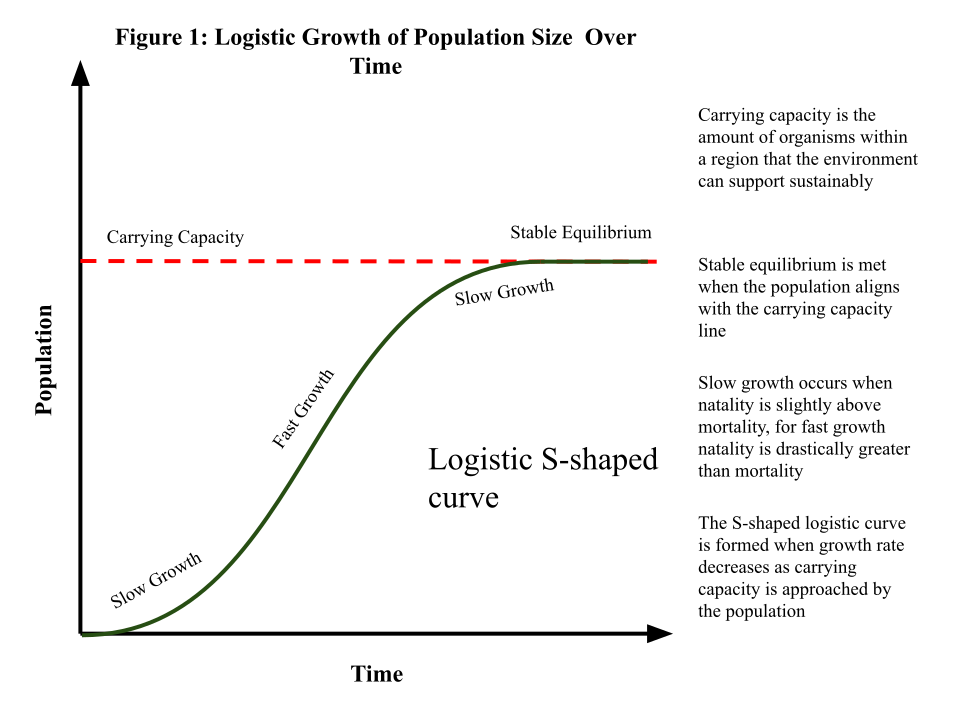
Diagram of a logistic growth curve rising rapidly at first and then bending to approach a horizontal line labeled carrying capacity. The figure shows how population growth slows as it nears the environment’s long-term support limit, visually reinforcing the concept of carrying capacity used in Malthusian analysis. The graph includes ecological modeling details that extend beyond AP Human Geography requirements but still clarify the population–resource relationship. Source.
Carrying Capacity: The ability of a region to support a population without environmental degradation or resource exhaustion.
A normal sentence here reinforces that carrying capacity remains a critical concept for evaluating population pressures globally.
Resource Limits and Land Pressure
Malthusian theory argues that as population increases, the pressure on land and its resources intensifies, particularly in agricultural societies.
Key geographic patterns associated with Malthusian resource stress include:
Rapid land degradation due to overuse
Lower agricultural yields as marginal land is brought into production
Increased competition for fertile soil, water, and labor
Rising food prices linked to scarcity
These patterns help geographers analyze where and why resource limitations are most acute. The theory highlights how physical environments influence population sustainability and how communities must adapt when they surpass environmental limits.
Technological Change and Malthusian Perspectives
While Malthus believed resource limits were fixed, modern geographers recognize that technology, innovation, and global trade can expand carrying capacity. However, Malthusian concepts remain relevant as population growth continues in many regions and environmental stress becomes widespread.
Key technological influences that shape resource availability include:
Agricultural innovations such as mechanization or improved crop varieties
Fertilizers and irrigation networks that boost yields
Transportation systems that allow food to be moved across long distances
Industrial and energy technologies that reshape environmental capacity
Although these developments challenge strict Malthusian predictions, AP Human Geography students analyze how resource strain persists where technological access is limited, populations grow rapidly, or environmental degradation reduces productivity.
Geographic Applications of Malthusian Theory
Geographers apply Malthusian theory to evaluate how population pressures, food systems, and resource scarcity intersect across different scales. This lens helps explain local, national, and global differences in vulnerability to resource shortages.
Applications include:
Assessing regions where population growth outpaces agricultural capacity
Identifying areas prone to famine, malnutrition, or food insecurity
Analyzing demographic pressures on water, soil, and ecological systems
Evaluating how resource competition shapes migration and conflict
Malthusian analysis is especially useful when studying rural regions with limited agricultural technology, high fertility rates, or fragile ecosystems. It also provides a framework for understanding how climate change may exacerbate resource limits, intensifying the challenges Malthus described centuries ago.
Malthusian Thought in Contemporary Debates
Modern discussions about sustainability, environmental decline, and global population growth frequently draw on Malthusian ideas. While critics argue that innovation can offset resource shortages, Malthusian theory emphasizes enduring constraints and highlights the risks faced by societies that exceed ecological limits.
Across AP Human Geography, Malthusian theory remains a valuable conceptual tool for evaluating population–resource relationships and understanding how societies navigate the pressures arising from demographic and environmental change.
Practice Questions
Question 1 (1–3 marks)
Explain the basic principle of Malthusian theory in relation to population growth and resource availability.
Mark scheme
Award up to 3 marks:
1 mark for stating that population grows faster than resources or food supply.
1 mark for identifying that population growth is exponential while resource growth is linear.
1 mark for noting that this imbalance leads to potential shortages, constraints, or checks on population.
Question 2 (4–6 marks)
Using geographic reasoning, analyse how Malthusian theory can be applied to understand pressures on land and agricultural resources in rapidly growing regions.
Mark scheme
Award up to 6 marks:
1 mark for identifying that rapid population growth increases demand for land and food.
1 mark for explaining that this increases pressure on agricultural resources or carrying capacity.
1 mark for describing how land degradation or reduced yields can occur through overuse.
1 mark for linking these pressures to Malthus’s prediction that resource limits constrain population.
1 mark for including a geographic perspective, such as reference to spatial patterns, specific types of regions (e.g., rural, developing), or environmental conditions.
1 mark for a clear analytical connection showing how Malthusian concepts help interpret resource stress or food insecurity.
FAQ
Malthus focused primarily on food resources derived from agriculture, arguing that agricultural land could only expand or improve at a slow, linear rate.
He saw staple crops, fertile land, and basic subsistence supplies as the most vulnerable because they depend heavily on environmental conditions and have natural limits on productivity.
He also suggested that regions reliant on subsistence farming face the greatest risk, as resource scarcity emerges more quickly when there is little technological or economic flexibility.
Malthus viewed moral restraint, such as delaying marriage and limiting childbearing, as a culturally driven choice that could slow population growth before resource pressure became critical.
He saw it as particularly important in societies where access to contraception, economic planning, and formal social policies was limited.
He believed preventive checks were more humane than positive checks because they reduced the likelihood of famine, disease, or conflict.
Malthusian theory suggests that vulnerability varies depending on how quickly population growth outpaces local agricultural capacity.
Regions with limited arable land, high fertility rates, or environmental degradation tend to experience resource strain sooner.
In contrast, areas with efficient farming methods, diversified food sources, or strong trade links are less likely to face the immediate consequences predicted by Malthus.
Several assumptions are frequently challenged:
That food production increases only linearly and cannot accelerate through innovation.
That population growth always follows an unchecked, exponential pattern.
That human societies cannot significantly expand carrying capacity.
Critics argue that technological advances, global food distribution, and agricultural intensification have altered the relationship between population and resources.
Climate change can reduce crop yields, intensify land degradation, and disrupt water supplies, all of which place additional pressure on agricultural systems.
These environmental stresses can make the resource limits described by Malthus more pronounced, especially in regions already facing population pressure.
In some cases, climate change may effectively lower carrying capacity, making Malthusian concerns about scarcity more applicable to contemporary geographic analysis.