AP Syllabus focus: ‘The law of demand states there is an inverse relationship between price and quantity demanded, creating a downward-sloping curve.’
Demand is a core building block for understanding how markets coordinate economic activity. The law of demand explains how buyers respond to price changes and why demand curves typically slope downward.
The Law of Demand
Law of Demand: Holding other relevant factors constant, a higher price leads to a lower quantity demanded, and a lower price leads to a higher quantity demanded.
The AP focus is the inverse relationship between price and quantity demanded, which is why a demand curve slopes downward from left to right.
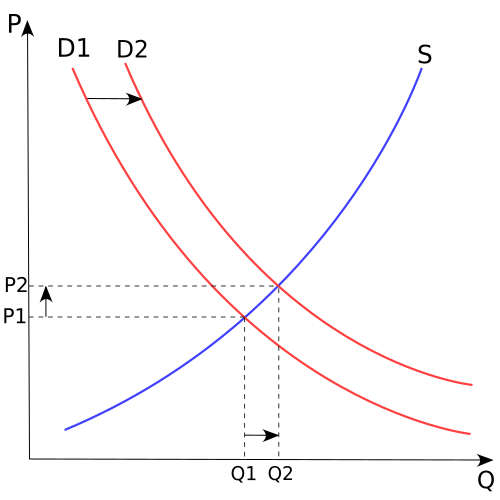
A standard supply-and-demand diagram showing the demand curve (D) sloping downward from left to right, with Price (P) on the vertical axis and Quantity (Q) on the horizontal axis. This visual representation reinforces the law of demand: higher prices correspond to lower quantities demanded, holding other factors constant. Source
This relationship describes buyer behaviour in a market for a good or service when price changes and everything else is unchanged.
What “quantity demanded” refers to
Quantity demanded: The amount of a good or service that consumers are willing and able to buy at a specific price over a given period of time.
The law of demand links price to quantity demanded; it does not describe other influences on buying behaviour unless those influences are explicitly held constant.
Why demand curves slope downward
A downward slope reflects predictable responses to price changes. Key logic includes:
Substitution behaviour: When a good becomes more expensive, buyers tend to switch toward relatively cheaper alternatives, reducing quantity demanded of the now-higher-priced good.
Purchasing-power effects: A higher price means the same income buys fewer units, so consumers often cut back on purchases, lowering quantity demanded.
Diminishing marginal benefit: As consumers consume more units of a good, the additional satisfaction (marginal benefit) from each extra unit typically falls, so buyers require a lower price to purchase additional units.
These mechanisms help explain why, as price falls, consumers are generally willing and able to buy more, consistent with a downward-sloping curve.
The role of “all else equal” (ceteris paribus)
The law of demand is a ceteris paribus statement: it isolates the price–quantity demanded relationship by assuming other conditions do not change.
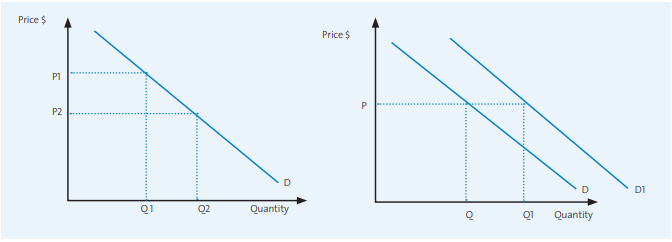
This two-panel diagram distinguishes a movement along a demand curve (caused by a change in the good’s own price) from a shift of the demand curve (caused by a change in a non-price determinant of demand). It visually clarifies that ceteris paribus analysis treats only price changes as movements along the same curve, while changes in tastes, income, expectations, or number of buyers shift the entire curve. Source
In real economies, many things can change at once, so applying the law requires careful interpretation.
When evaluating whether observed behaviour matches the law of demand, assume constant:
consumer preferences and tastes
income and wealth conditions
prices of related goods
expectations about future prices
number of buyers
If these conditions change, the simple inverse relationship can be obscured, even if the law of demand still describes the effect of price alone.
Interpreting the law in real markets
The law of demand is a model of typical behaviour, not a claim that every individual always buys less when price rises. Market demand reflects the combined behaviour of many buyers, so the downward slope is a systematic tendency.
Common misinterpretations to avoid
Confusing “demand” with “quantity demanded”: the law describes how quantity demanded responds to price (with other factors constant).
Treating the law as a moral claim about “fair prices”: it is a positive statement about predictable behavioural responses.
Assuming the law explains every price change: prices can move for many reasons; the law of demand is about how buyers react when price changes.
Practice Questions
(2 marks) State the law of demand and explain what it implies about the slope of the demand curve.
1 mark: States an inverse relationship between price and quantity demanded (ceteris paribus).
1 mark: Links inverse relationship to a downward-sloping demand curve.
(5 marks) Explain why the law of demand is described as a ceteris paribus relationship and discuss two reasons why quantity demanded typically falls when price rises.
1 mark: Explains ceteris paribus as holding other relevant factors constant to isolate the price effect.
2 marks: First valid reason explained (e.g., substitution towards relatively cheaper alternatives; purchasing power reduction; diminishing marginal benefit logic). (1 for identifying, 1 for explaining)
2 marks: Second valid reason explained as above. (1 for identifying, 1 for explaining)
FAQ
Yes, rare cases are discussed in economics, such as:
Giffen goods (an inferior good where a price rise can increase quantity demanded due to strong income effects)
Veblen goods (where higher prices may increase desirability as a status signal)
These are exceptions, not the typical pattern captured by most demand curves.
They use statistical methods to estimate demand while controlling for other factors.
Common approaches include regression models that hold constant income, preferences proxies, and related prices, aiming to isolate the effect of price on quantity purchased.
It is primarily a market-level relationship for a particular good or service.
Macroeconomic aggregates involve many markets at once, so observed economy-wide spending patterns may reflect multiple simultaneous changes, not just price changes in one market.
The law of demand gives the direction of change (inverse relationship).
Price elasticity of demand measures the strength of the response—how much quantity demanded changes for a given price change—without contradicting the basic downward-sloping tendency.
Real purchasing can involve:
bulk discounts and non-linear pricing
habits and switching costs
contracts or subscriptions that delay response to price changes
These frictions can make observed demand look uneven, even if the underlying inverse relationship remains the baseline prediction.