AP Syllabus focus: ‘Trade allows both parties to benefit by increasing total production and consumption possibilities beyond individual limits.’
Gains from trade explain why voluntary exchange can make every trading partner better off. By specialising and then trading, countries, firms, or individuals can reach consumption levels that would be unattainable if they had to produce everything themselves.
What “gains from trade” means in AP Macro
Gains from trade are the increases in consumption possibilities that occur when trading partners specialise and exchange, allowing each to consume beyond what it could produce on its own.
Gains from trade are about feasible consumption, not just producing more. Even if a country is highly productive, trade can still help it by letting it swap some output for goods that would be relatively costly for it to produce domestically.
Two key ideas embedded in the syllabus statement
Total production can rise: specialisation reallocates scarce resources toward activities where each producer is relatively more efficient.
Consumption can rise even more: trade lets each party choose a consumption bundle that lies beyond its individual production limit.
Why trade can benefit both sides
Trade is positive-sum when partners have different relative costs. Specialisation concentrates resources where they generate more output per unit of sacrificed alternative production, which can increase combined output across partners.
How both can “win” at once
Each partner exports goods it can produce at a lower relative cost (forgone alternatives are smaller).
Each partner imports goods that would require giving up a lot of other production if made domestically.
The exchange rate between exports and imports (the “deal”) allows both sides to end up with more than their own production would permit.
Viewing gains from trade using production limits
AP Macroeconomics often frames limits with a production possibilities mindset: with fixed resources and technology, production choices are constrained. Trade does not automatically change those constraints, but it can change what is consumable.
Production point vs consumption point
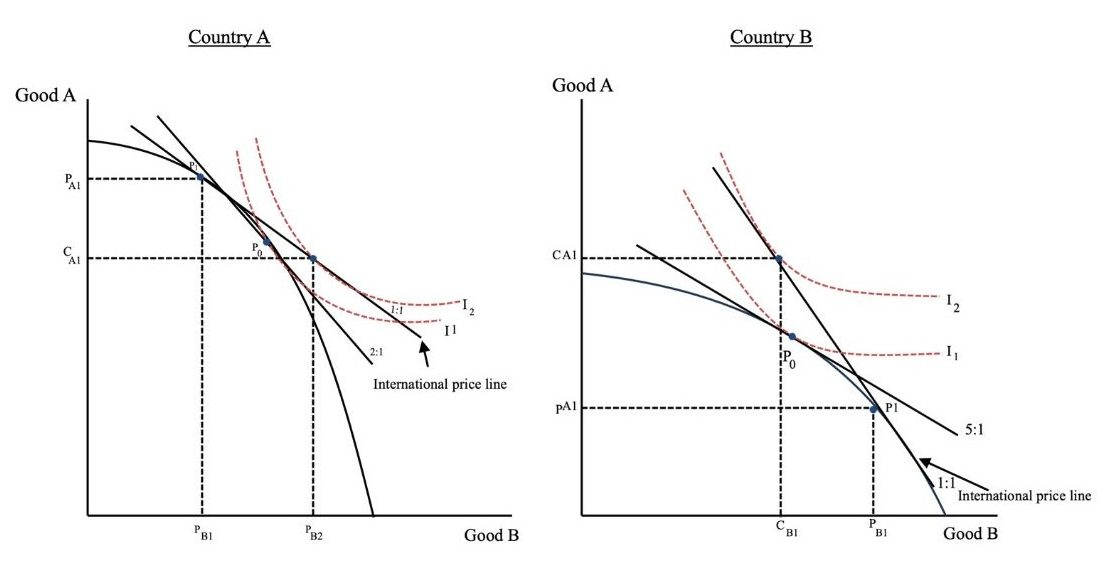
Two-country PPF setup illustrating how free trade changes an economy’s optimal production point (specialization) and can move its consumption point to a higher indifference curve. The international price line (terms of trade) enables each country to consume a bundle that is not attainable under autarky, clarifying why trade is positive-sum when relative prices differ. Source
Production point: what the economy chooses to make after specialising.
Consumption point: what the economy ends up consuming after accounting for exports and imports.
A country can produce at one point and consume at another because trade effectively “transforms” some domestic production into foreign-produced goods through exchange.
= consumption of good (units)
= domestic production of good (units)
= imports of good (units)
= exports of good (units)
This relationship highlights the core mechanism behind gains from trade: consumption can exceed production for imported goods, financed by exporting other goods.
What “beyond individual limits” means (and doesn’t mean)
“Beyond individual limits” means beyond what a single producer could achieve in isolation. In a production-constraint diagram, this is commonly shown as consumption occurring at a bundle that would be infeasible without trade.
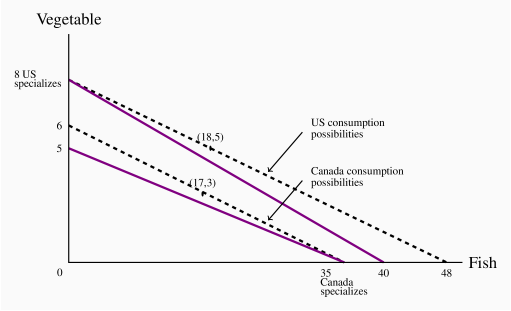
PPF/CPF diagram showing comparative advantage, specialization, and a post-trade consumption possibility frontier (CPF) lying outside the original production possibility frontier (PPF). The picture makes the gains-from-trade idea concrete: after specializing and trading at an agreed terms-of-trade line, the economy can reach higher consumption bundles than were feasible in isolation. Source
Important clarifications for AP answers
Trade can expand consumption possibilities even if the domestic production constraint is unchanged.
Trade gains do not require one side to become worse off; the gains come from better allocation and exchange.
A country does not need an absolute productivity edge to gain; what matters is whether trade allows it to avoid high-cost domestic production of some goods.
When gains from trade are likely to occur
Gains from trade are most straightforward when trade is voluntary and partners have different relative production costs, so exchange creates surplus value compared with self-sufficiency.
Conditions that support mutual gains
Different opportunity costs across trading partners (creating scope for beneficial specialisation).
Feasible trading price (an exchange rate that makes each partner prefer trading to not trading).
Low enough transaction and trade costs (shipping, information, contracting) so the net benefit remains positive.
Ability to shift resources toward specialisation (mobility of labour/capital across domestic industries).
How AP responses can describe gains precisely
To earn credit, explain gains in terms of higher attainable consumption and/or higher total output from specialisation, not merely “more trade happens.”
High-precision language to use
“Specialisation raises combined output.”
“Trade allows consumption beyond the domestic production constraint.”
“Both parties can end up with more of at least one good without giving up as much of the other.”
Common pitfalls to avoid
Saying trade gains require both countries to produce more of every good (they usually don’t).
Confusing gains from trade with economic growth (growth shifts productive capacity; trade changes attainable consumption given capacity).
Treating trade as automatically beneficial regardless of the terms or costs; AP expects the logic of why voluntary trade can be mutually beneficial.
Practice Questions
Question 1 (2 marks) Define “gains from trade” and explain, in one sentence, how trade can allow consumption beyond a country’s production limit.
1 mark: Correct definition: gains from trade are increased consumption possibilities from specialisation and exchange (or equivalent wording).
1 mark: Correct explanation: trade enables a country to consume a bundle unattainable in autarky/without trade because it can export one good to import another.
Question 2 (6 marks) Two countries can produce only goods X and Y. Explain how both countries can benefit from trading X and Y after specialising. In your answer, distinguish between the production point and the consumption point, and describe what it means to consume “beyond individual limits”.
1 mark: States that specialisation reallocates resources toward relatively lower-cost production (relative efficiency).
1 mark: Explains that combined/total output across both countries can increase due to specialisation.
1 mark: Distinguishes production point (what is produced) from consumption point (what is consumed after trade).
1 mark: Uses the idea that imports/exports allow consumption to differ from production (e.g., consuming more Y than produced by importing it).
1 mark: Correctly explains “beyond individual limits” as consuming a bundle not feasible without trade given the country’s own production constraint.
1 mark: States that both can be better off because the trading terms make each prefer trade to autarky (voluntary trade implies mutual benefit under the stated assumptions).
FAQ
Trade costs reduce net gains because some resources are used up moving, insuring, financing, or administering trade.
If trade costs are high enough, the attainable consumption improvement can disappear, making autarky preferable even when relative costs differ.
Yes. If its opportunity cost differs, it can still specialise in the activity where it is least inefficient.
Gains arise because trade lets it avoid producing goods where its domestic trade-off is especially unfavourable.
Dynamic gains are longer-run benefits such as learning-by-doing, technology diffusion, and increased innovation from larger markets.
They differ from static gains, which come from reallocating existing resources more efficiently at a point in time.
Even when a country gains overall, some workers or regions can lose if import-competing industries contract.
Outcomes depend on factor mobility, wage flexibility, and how quickly resources can shift into expanding export sectors.
If export prices rise relative to import prices, a country can obtain more imports per unit of exports, increasing its consumption possibilities.
If the terms of trade move against a country, it must export more to import the same amount, reducing gains.