AP Syllabus focus: ‘Changes in factors such as input prices shift the supply curve, affecting the quantity supplied at all prices.’
Supply depends on more than the market price of the good. When underlying production conditions change, firms’ costs and incentives change, shifting the entire supply curve and changing equilibrium outcomes.
Determinants of supply: the core idea
Determinants of supply (supply shifters): non-price factors that change the quantity supplied at every price, causing the supply curve to shift.
A determinant changes producers’ willingness and ability to sell, usually by changing production costs, profitability, or capacity. This matches the syllabus focus: when factors like input prices change, the supply curve shifts, so the quantity supplied changes at all prices, not just at one price.
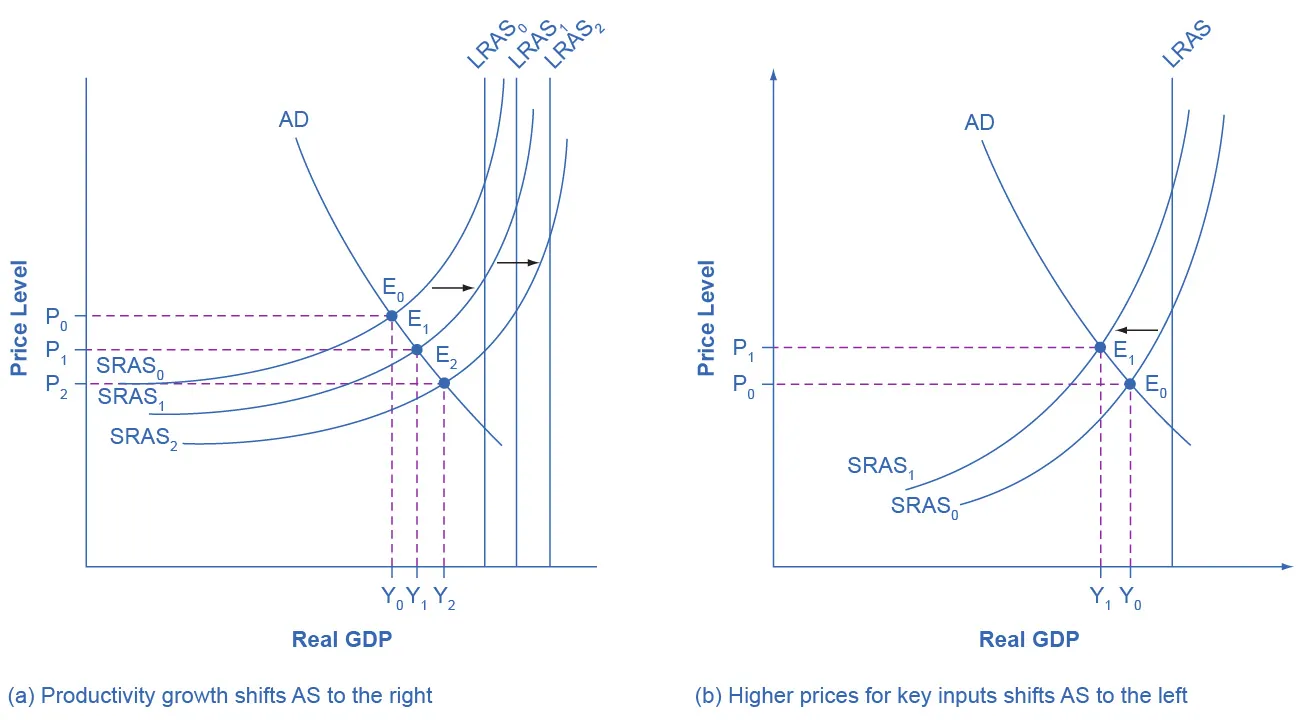
This diagram shows two classic supply-side shifters in one place: productivity gains shift the short-run aggregate supply curve (SRAS) to the right, while higher input prices shift SRAS to the left. The labeled equilibria illustrate that a supply shift changes equilibrium output and the price level simultaneously, not just quantity at one price. The visual reinforces the key AP idea that supply conditions change quantities supplied at every price level. Source
Shift vs. movement (common exam pitfall)
Movement along supply: caused only by a change in the good’s own price (quantity supplied changes; curve does not move).
Shift of supply: caused by a determinant (supply increases or decreases at every price).
Major determinants of supply (and direction of shift)
Input prices (costs of factors of production)
Input prices are a central determinant because they directly affect per-unit cost and profitability.
If input prices rise (e.g., wages, energy, raw materials, shipping):
Costs increase → firms supply less at each price → supply shifts left.
If input prices fall:
Costs decrease → firms supply more at each price → supply shifts right.
Use cost language precisely: higher costs reduce supply; lower costs increase supply.
Technology and productivity
Technology that improves productivity lowers the resources needed per unit.
Improved technology/productivity:
Unit costs fall and/or capacity rises → supply shifts right.
Technological setbacks or failures:
Unit costs rise → supply shifts left.
Frame this as “more output from the same inputs” or “same output with fewer inputs.”
Taxes, subsidies, and fees on producers
Government policies that change firms’ costs shift supply.
Per-unit tax (or higher licence/permit fees):
Raises marginal cost → supply shifts left.
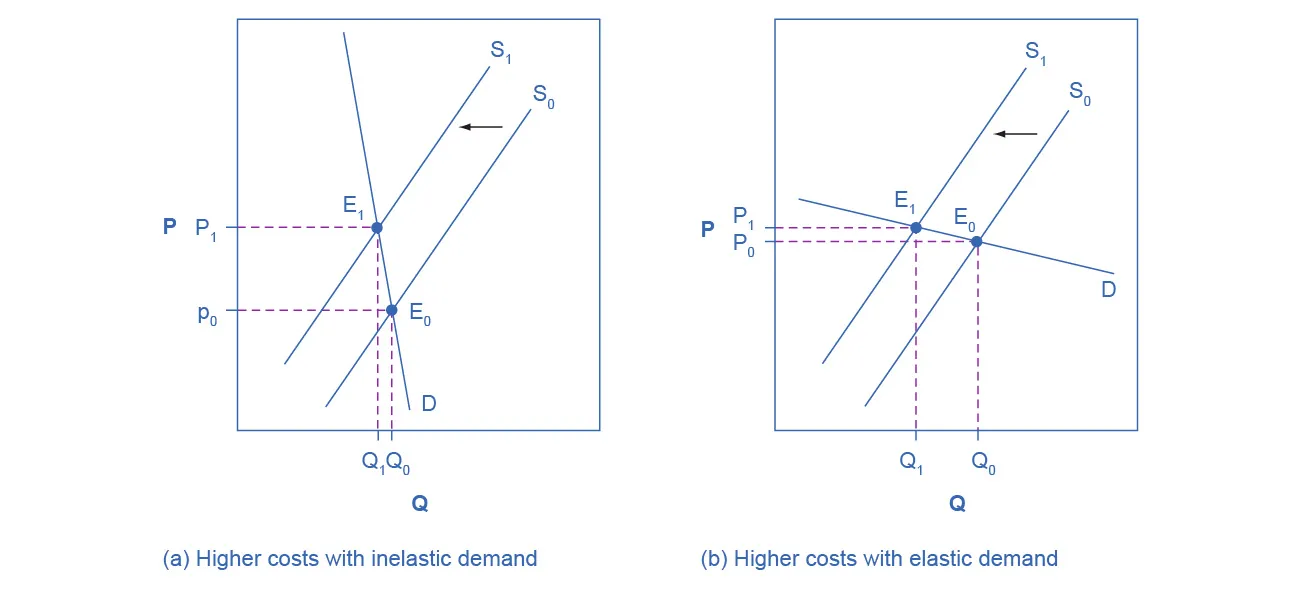
This figure illustrates a leftward shift of the supply curve from to caused by higher per-unit costs (such as a producer tax). The new intersection with demand shows a higher equilibrium price and a lower equilibrium quantity, emphasizing how cost shocks change market outcomes. It’s a clean visual for the exam distinction between a supply shift (entire curve moves) and a movement along an unchanged curve. Source
Subsidy:
Lowers effective marginal cost → supply shifts right.
In graphs, this is shown as a shift of the supply curve, not a new point on the old curve.
Number of sellers (market supply)
Market supply is the horizontal sum of individual firm supplies.
More firms enter the market:
Greater total capacity/output → supply shifts right.
Firms exit:
Reduced total capacity → supply shifts left.
This determinant is about the market as a whole, even if each firm’s supply is unchanged.
Prices of related goods in production (alternative products)
If the same resources can produce different goods, changes in relative profitability matter.
If the price of an alternative product rises (using similar inputs):
Firms reallocate resources away → supply of this good shifts left.
If the price of an alternative product falls:
Resources reallocate toward this good → supply shifts right.
This is a production-side substitution effect.
Expectations of future prices or conditions
Producer expectations can change current supply decisions.
If firms expect higher future prices:
They may hold inventories or delay sales → current supply shifts left.
If firms expect lower future prices:
They may sell more now → current supply shifts right.
Keep the logic tied to incentives over time, not consumer demand.
Regulations, shocks, and natural conditions
Non-market forces can change costs or feasible output.
Stricter regulation (higher compliance costs) → supply left.
Infrastructure improvements or streamlined rules → supply right.
Adverse natural events (storms, droughts) that disrupt production → supply left.
Favourable conditions that increase yields/output → supply right.
When describing these, state the mechanism (costs/capacity) and then the shift direction.
Practice Questions
(2 marks) Explain how an increase in the price of an input used to produce coffee affects the supply curve of coffee.
1 mark: States that higher input prices increase firms’ costs/prodution costs.
1 mark: Correctly explains supply shifts left/decreases (less supplied at every price).
(5 marks) A government removes a subsidy to domestic wheat farmers. Using supply analysis, explain the effect on the wheat market, including how equilibrium price and quantity change.
1 mark: Identifies subsidy removal increases producers’ costs/reduces profitability.
1 mark: States wheat supply decreases/shifts left.
1 mark: Explains equilibrium price rises.
1 mark: Explains equilibrium quantity falls.
1 mark: Uses correct “shift of supply” language (change in quantity supplied at all prices), not a movement along the curve.
FAQ
Ask whether the factor raises or lowers per-unit cost or changes capacity.
Costs up or capacity down → supply shifts left
Costs down or capacity up → supply shifts right
Then state “at every price” to show it is a shift.
Often not in the short run, because short-run supply decisions depend more on marginal/variable costs.
However, large fixed-cost changes can affect:
whether firms exit/enter (shifting market supply), especially in the long run
capacity decisions that later change supply
If domestic producers rely on imported inputs, a change in import input prices (or transport costs) changes domestic production costs.
Higher imported-input costs reduce domestic supply; lower imported-input costs increase it, even if domestic wages and technology are unchanged.
Technology is the method/knowledge used in production; productivity is the output produced per unit of input.
Technology improvements often raise productivity, but productivity can also change via:
better management
worker training
improved logistics
Both affect supply by changing unit costs and feasible output.
Yes. If firms expect future prices, regulations, or shortages, they may change present selling behaviour (e.g., building inventories or accelerating sales).
The key is that expectations change the incentive to supply now, shifting current supply without requiring today’s input prices to move.