AP Syllabus focus: ‘Inflation can create uncertainty and affect decision-making for consumers and businesses.’
Inflation matters not only because prices rise, but because it changes the reliability of price signals. When people and firms become unsure about future purchasing power, they alter spending, saving, borrowing, pricing, and investment choices.
How inflation creates uncertainty
Inflation becomes especially disruptive when it is variable (changes unpredictably) or unanticipated (different from what people expected). Uncertainty increases because decision-makers must guess future costs, revenues, and real (inflation-adjusted) returns.
Unanticipated inflation: inflation that is higher or lower than the inflation rate people built into their wage contracts, loans, and price plans.
When inflation is hard to forecast, households and firms devote time and resources to protecting themselves rather than producing goods and services.
Impact on individuals (households)
Purchasing power and budgeting
Inflation uncertainty makes it harder for households to plan real living standards.
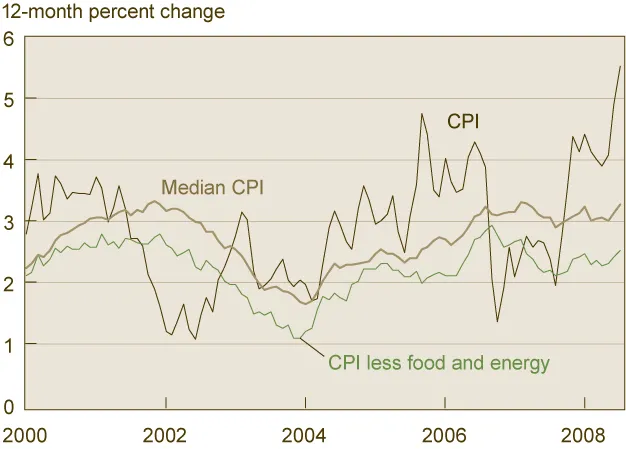
The chart compares multiple inflation measures (headline CPI, median CPI, and CPI excluding food and energy) to show that “inflation” can look different depending on which basket and method is used. This illustrates why households and firms can face genuine uncertainty: even well-known, widely used inflation indicators can diverge, complicating budgeting, wage bargaining, and long-term planning. Source
Budgets become less reliable: the same nominal income may buy fewer necessities than expected.
Precautionary behaviour rises: households may hold more liquid funds or buy durable goods sooner to avoid future price increases.
Perceived risk increases: consumers may delay big purchases (cars, appliances) if they fear income will not keep up with prices.
Saving, borrowing, and contract choices
Many household decisions involve future payments, so inflation uncertainty changes financial behaviour.
Saving decisions shift: people may prefer assets that seem to protect against inflation (or demand higher returns to save at all).
Borrowing decisions change: households may borrow less if they fear higher future nominal interest rates or unstable real repayment burdens.
Contract lengths shorten: renters, workers, and lenders may prefer shorter terms so they can renegotiate sooner.
Inflation uncertainty can also weaken confidence, reducing willingness to make long-term commitments (education plans, home purchases, or retirement contributions).
Impact on firms (businesses)
Pricing and menu costs
Firms must decide how often to update prices and wages when the overall price level is changing.
More frequent price changes raise administrative burdens (re-tagging, updating systems, renegotiating with buyers).
Greater risk of mispricing: if a firm sets prices assuming one inflation path and actual inflation differs, its real markup may become too high (losing sales) or too low (losing profit).
Planning, investment, and long-term projects
Uncertain inflation makes forecasting more error-prone, especially for long-lived investments.
Harder revenue forecasting: nominal sales may rise with inflation, but real demand may not.
Harder cost forecasting: input prices and wage demands may jump unexpectedly.
Lower long-run investment: firms may delay capital spending because the real profitability of projects becomes uncertain, reducing productive capacity expansion.
Financing and interest rates
Because loans are written in nominal terms, lenders and borrowers care about expected inflation when setting interest rates and evaluating borrowing costs.
= real (inflation-adjusted) interest rate, percent per year
= nominal interest rate, percent per year
= expected inflation rate, percent per year
When expected inflation () becomes less stable, firms face:
More volatile borrowing conditions: lenders may charge a higher nominal rate or tighten credit standards.
Higher required returns: firms may demand larger profit margins before investing, which can reduce hiring and expansion.
Economy-wide decision-making effects
Inflation uncertainty reduces the quality of price signals that guide resource allocation.
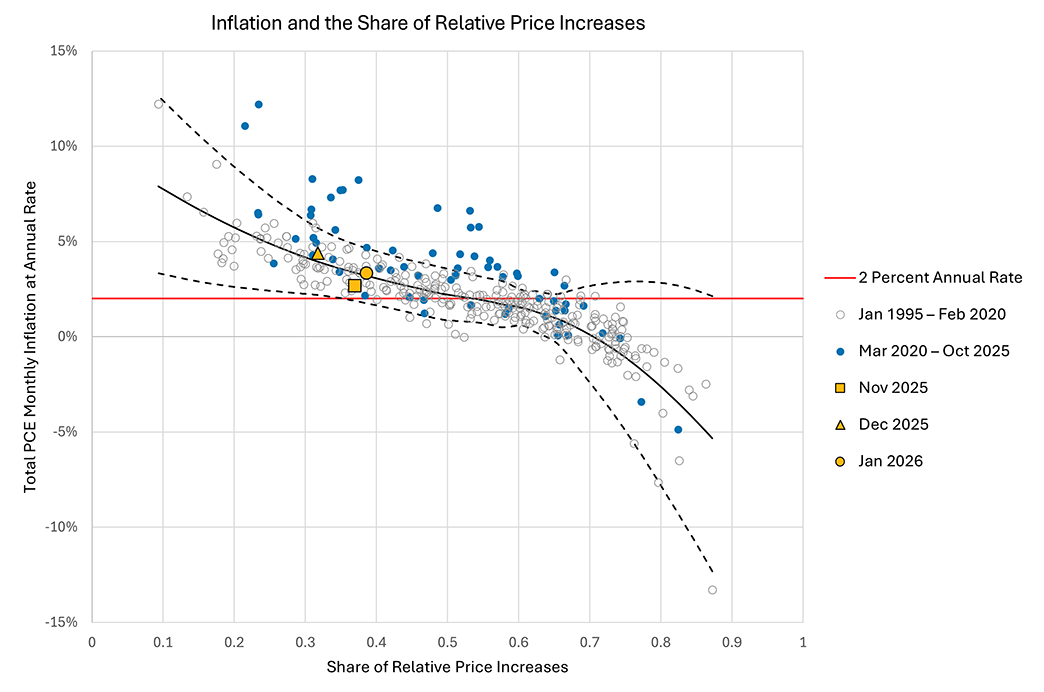
This scatterplot relates overall inflation to the share of goods/services with rising prices, showing that the same inflation rate can emerge from very different patterns of price changes across the economy. It reinforces the idea that when inflation is unstable, it becomes harder to interpret whether a price movement is a meaningful relative-price signal or part of a broader nominal trend. Source
Consumers struggle to tell whether a price increase reflects scarcity of a specific good or just overall inflation.
Firms struggle to distinguish changes in real demand from purely nominal changes, increasing forecasting errors.
Time and talent shift toward inflation-avoidance strategies (frequent repricing, financial hedging) rather than production and innovation.
Practice Questions
(2 marks) Explain one way inflation can create uncertainty for consumers.
Identifies a valid channel (e.g., budgets/purchasing power, delaying purchases, contract uncertainty) (1)
Explains how uncertainty affects the decision (1)
(6 marks) Using the Fisher relationship, explain how higher and less predictable expected inflation can affect a firm’s investment and pricing decisions.
States/uses (1)
Explains that higher tends to raise or makes harder to predict (1)
Links uncertainty about to delaying/reducing investment (2)
Links inflation uncertainty to more frequent price changes or mispricing risk (2)
FAQ
Predictable inflation can be planned for in wages, prices, and contracts. Uncertainty raises forecasting errors, making long-term decisions riskier and encouraging delays.
Firms may shift towards goods with:
faster inventory turnover
shorter production cycles
easier, more frequent repricing
It is an extra return lenders may require because future inflation is uncertain, which can push up borrowing costs even if average expected inflation is unchanged.
If firms update prices at different times and with different forecasts, identical goods can sell at different prices, increasing search time for consumers.
They may add indexation clauses, shorten contract duration, use adjustable-rate terms, or build in contingency margins for input-cost changes.