AP Syllabus focus: ‘Resource allocation answers three questions: what to produce, how to produce it, and who will consume it.’
Economics studies how societies use scarce resources. Every system—market-based, centrally planned, or mixed—must resolve the same three allocation questions, because choices about production and consumption always involve trade-offs.
Core idea: allocation is unavoidable under scarcity
Resource allocation: the process of deciding how scarce factors of production are used to produce goods and services, and how the resulting output is distributed among people.
Even when a society tries to avoid “choosing” (for example, by letting tradition decide), it is still answering the allocation questions implicitly.
The three basic allocation questions
1) What to produce?
This question is about the composition of output: which goods and services get produced, and in what quantities. Because resources are limited, producing more of one product usually means producing less of another.
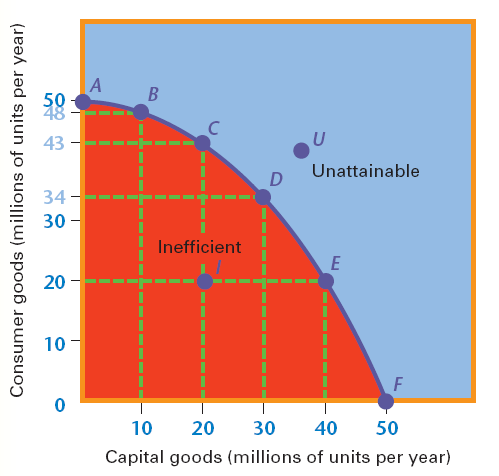
A production possibilities frontier (PPF) illustrating feasible output combinations and the trade-offs implied by scarcity. Points on the curve represent productive efficiency, points inside the curve represent underutilized resources (inefficiency), and points outside are unattainable with current resources and technology. This is the standard model for visualizing opportunity cost when society reallocates resources toward one good and away from another. Source
Key considerations include:
Consumer preferences: what households want and are willing to give up other things to obtain
Relative scarcity: which goods are more costly in terms of forgone alternatives
Social priorities: how much of society’s resources go to areas like health, education, defense, or infrastructure
Time horizon: balancing consumer goods now versus capital goods that raise future production possibilities
A central tension is efficiency vs. equity: “what to produce” may maximise total surplus but still conflict with distributional goals.
2) How to produce it?
This question concerns production methods: which technologies and input combinations (land, labor, capital, entrepreneurship) are used to make output.
It typically involves choices between:
Labor-intensive vs. capital-intensive production
High fixed cost technologies (automation) vs. low fixed cost methods (manual processes)
Standardisation (lower unit costs) vs. customisation (higher unit costs, more variety)
Sustainability and safety standards vs. lower-cost but riskier methods
“How to produce” is constrained by:
Available technology
Input availability and relative input prices
Legal rules (e.g., workplace regulation) and enforcement capacity
Organisational capacity and managerial skill
Because inputs are scarce, selecting a technique implies an opportunity cost: using an engineer on one project means not using them on another.
3) Who will consume it?
This question is about distribution of output: which individuals or groups receive goods and services, and in what amounts.
Common mechanisms that determine “who gets what” include:
Price and ability to pay (rationing by price)
Income and wealth (wages, profits, transfers, asset ownership)
Non-price rationing (queues, waiting lists, eligibility rules, lotteries)
Social and political rules (rights, entitlements, or priorities for certain groups)
This question highlights a major trade-off:
Equity (fairness or need-based distribution) versus
Incentives (rewards that encourage work, saving, innovation, and risk-taking)
Different societies choose different balances, but none can avoid choosing some rule for allocating scarce output.
How the questions fit together
The three questions are interdependent:
Choosing what to produce changes the demand for inputs and affects how production is organised.
Choosing how to produce affects costs, which influences quantities produced and prices, shaping who can consume.
Choosing who consumes affects incentives and purchasing power, influencing future demand and therefore what firms (or planners) decide to produce.
In practice, economies answer all three questions through a combination of institutions (laws, property rights, firms, governments) and incentives (rewards and penalties) that guide decisions.
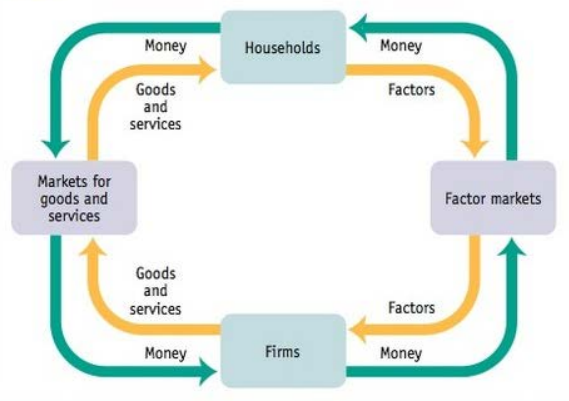
A simple circular-flow diagram showing households and firms interacting through product markets and factor markets. The figure emphasizes that real flows (goods/services and factor services) and money flows move in opposite directions, connecting production decisions to income and spending. It is a compact visual summary of how institutions and incentives coordinate “what, how, and who” in a market system. Source
Practice Questions
(2 marks) Explain two ways an economy might determine who will consume a scarce good.
1 mark: Identifies a valid method (e.g., rationing by price, queueing, lottery, eligibility criteria, means-testing).
1 mark: Explains how that method allocates consumption (e.g., “price allocates to those willing/able to pay”; “queues allocate to those willing/able to wait”).
(6 marks) A city has a limited supply of new public housing units. Using the three basic allocation questions, discuss how the city must decide what to produce, how to produce it, and who will consume it.
1 mark: Applies what to produce to the scenario (e.g., number/type/size/location of housing units).
1 mark: Explains the trade-off in what (e.g., more smaller units vs fewer larger units; housing vs other public services).
1 mark: Applies how to produce (e.g., construction method, labour vs machinery, contractor choice, building standards).
1 mark: Explains a constraint/trade-off in how (e.g., cost vs speed vs quality/sustainability).
1 mark: Applies who will consume (e.g., allocation via waiting list, income thresholds, priority groups, lottery).
1 mark: Discusses an equity/incentive implication of the chosen “who” rule (e.g., fairness vs work incentives; ability to pay vs need).
FAQ
Prices bundle information about scarcity and preferences.
Higher prices can signal producers to supply more (shaping what to produce), encourage cost-saving techniques (how to produce), and ration demand to those willing and able to pay (who consumes).
Non-price rationing includes:
Queues/waiting lists
Lotteries
Eligibility rules (age, residency, medical need)
Quantity limits per person
They are often used when charging market prices is politically unacceptable or when equity goals dominate.
Distribution changes purchasing power and therefore demand patterns.
If more income goes to lower-income households, spending may shift toward necessities; if more goes to higher-income households, demand may tilt toward luxury goods—altering what firms find profitable to produce.
They can shape production choices via:
Regulations (safety, emissions, zoning)
Taxes/subsidies that change relative costs
Procurement standards in government purchasing
Licensing and permitting requirements
These tools change incentives while leaving production decentralised.
Efficiency does not determine social priorities.
A society may efficiently produce goods that maximise total willingness to pay, yet still face disagreement if outcomes conflict with goals like basic needs provision, regional balance, cultural values, or environmental protection.