AP Syllabus focus: ‘Market supply is the sum of individual supply schedules, and the market supply curve slopes upward.’
Supply in competitive markets is easiest to understand by building from individual sellers to the whole market. This page explains how to aggregate sellers’ decisions and why the resulting market supply curve generally slopes upward.
Market Supply: Adding Up Individual Sellers
Individual supply describes how much a single producer is willing and able to sell at each possible price, holding other influences constant. The market outcome depends on how these individual plans combine.
Market supply: The relationship showing the total quantity supplied by all sellers in a market at each price, found by summing individual quantities supplied at that price.
Market Supply Schedules and Curves
A market supply schedule lists the total quantity supplied at various prices. A market supply curve graphs that schedule with price on the vertical axis and quantity on the horizontal axis.
Key idea: market supply is a horizontal sum, because quantities (not prices) add across sellers.
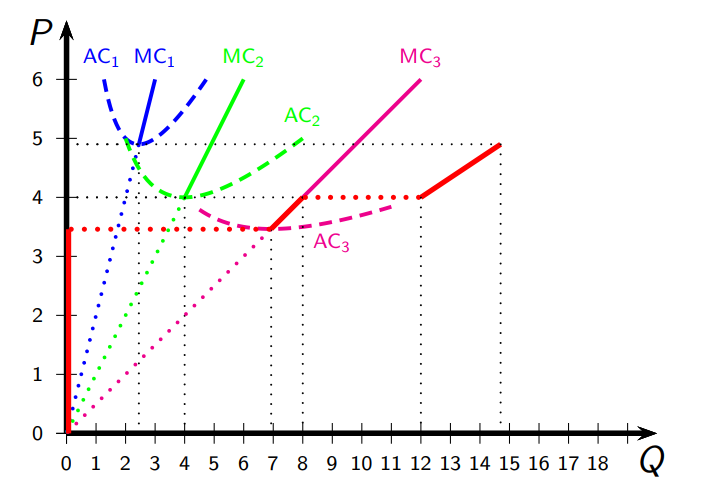
This figure shows how a short-run market supply curve can be built up from multiple firms’ supply decisions (here represented by marginal cost curves). At each price level, the quantities supplied by the individual firms are added horizontally to get total market quantity supplied, producing an overall upward-sloping market supply. Source
= total quantity supplied in the market (units of output per time period)
= quantity supplied by seller at the given price (units of output per time period)
= number of sellers in the market (count)
This aggregation is done at each price: for a given price, add each seller’s supplied quantity to get the market quantity supplied.
What “Sum of Individual Supply Schedules” Means Graphically
To construct the market supply curve from individual supply curves:
Pick a price level (e.g., ).
Read each seller’s quantity supplied at that price.
Add those quantities to get the market quantity at .
Repeat for other prices and connect the points to form the market supply curve.
If there are more sellers in the market (with similar cost conditions), the market supply at each price will typically be larger, making the market supply curve extend further to the right.
Why the Market Supply Curve Slopes Upward
The market supply curve generally slopes upward because, as price rises, sellers have a stronger incentive to produce and sell more output, and the market total reflects this across all sellers.
Increasing Marginal Cost and Rising Opportunity Cost
A central reason supply slopes upward is that producing additional units often becomes more costly at the margin:
Diminishing returns in the short run can make extra output require disproportionately more variable inputs.
Firms may need to use less efficient resources or add overtime, raising cost per additional unit.
The opportunity cost of allocating resources to this good rises as production expands (resources are pulled from their next-best uses).
When marginal cost rises, only higher prices make additional units worthwhile to supply, generating an upward slope.
Heterogeneous Sellers in the Market
Even if each seller has a different cost structure, the market supply still tends to slope upward because:
Lower-cost sellers supply earlier (at lower prices).
Higher-cost sellers require higher prices before supplying meaningful quantities.
As price increases, more sellers contribute, and existing sellers expand output, increasing total market quantity supplied.
Interpreting “Slopes Upward” Correctly
An upward-sloping market supply curve means:
A higher price is associated with a higher quantity supplied.
The relationship is a movement along the market supply curve when only the good’s own price changes and all else is held constant.
It does not mean supply is “rising” because of unrelated changes (like technology or input prices); those would change the quantities supplied at each price and would therefore be represented by a different market supply relationship.
Practice Questions
(2 marks) State what is meant by “market supply is the sum of individual supply schedules”.
1 mark: Recognises market supply combines all sellers’ quantities supplied at each price.
1 mark: States quantities are added across firms at the same price (horizontal summation).
(6 marks) Explain why the market supply curve in a competitive market typically slopes upward. In your answer, refer to costs and the role of different sellers.
1 mark: States higher prices provide incentive for greater quantity supplied.
2 marks: Explains rising marginal cost/opportunity cost (e.g., diminishing returns, less efficient inputs).
2 marks: Explains heterogeneity/entry of higher-cost sellers as price rises increases total quantity supplied.
1 mark: Links these points to an upward-sloping market supply curve (positive relationship between and ).
FAQ
If firms supply in discrete batches or have capacity limits, adding their quantities can create jumps at certain prices, producing a step-shaped aggregate curve.
No. Its shape depends on how individual marginal costs change with output and how varied sellers’ costs are, so it can be flatter or steeper at different quantities.
At low prices, firms may choose not to produce, so only a subset of sellers contributes to market quantity; more firms contribute as price rises.
More firms generally increase total quantity supplied at each price, making market supply larger. With fewer firms, total quantity at each price is smaller.
In unusual cases (e.g., strong capacity spillovers or backward-bending labour supply affecting production), sections could slope downward, but this is not the typical competitive-market pattern.