AP Syllabus focus: ‘Changes in production incentives, input conditions, or technology can shift the supply curve.’
Supply changes when producers’ underlying conditions change, not just when market price changes. This page explains the main determinants of supply that cause an entire supply curve to shift.
Supply shifts vs. movements along the curve
A change in supply means producers are willing and able to sell a different quantity at every price, so the entire curve shifts. This differs from a price-driven change in quantity supplied (a movement along the curve).
Change in supply (supply shift): A shift of the entire supply curve caused by a change in a non-price determinant, increasing or decreasing quantity supplied at every price.
A rightward shift is an increase in supply; a leftward shift is a decrease in supply.
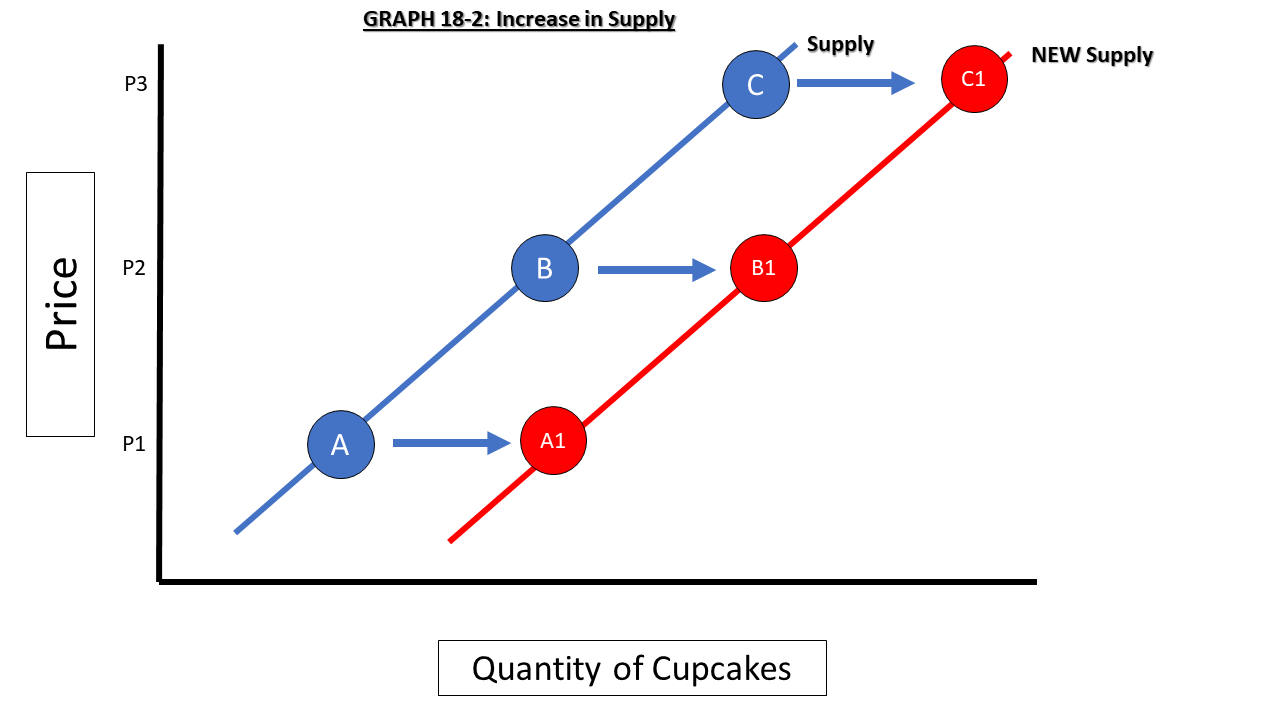
This graph illustrates an increase in supply as a rightward shift from the original supply curve to a new supply curve. At each price level, producers are now willing and able to sell a larger quantity, consistent with a non-price determinant (like lower input costs) improving profitability across all output levels. Source
Core determinants of supply (supply shifters)
The syllabus emphasises three broad categories that shift supply: production incentives, input conditions, and technology. Each works through costs, productivity, and profitability, which change how much firms choose to produce at each price.
1) Production incentives
Production incentives are factors that change the rewards or penalties from producing and selling a good. When incentives improve, supply tends to increase; when incentives worsen, supply tends to decrease.
Key incentive-related shifters include:
Taxes on producers

This supply-and-demand diagram shows the impact of a tax as a wedge between the price consumers pay and the price producers receive. The tax effectively shifts the supply curve upward (equivalently, reduces supply), leading to a higher consumer price, a lower producer price net of tax, and a lower equilibrium quantity traded. Source
Higher per-unit taxes raise marginal cost, shifting supply left.
Tax cuts reduce cost, shifting supply right.
Subsidies
A subsidy lowers effective production cost, shifting supply right.
Regulation and compliance rules
Stricter rules that raise costs (training, reporting, equipment) shift supply left.
Deregulation that reduces costs can shift supply right.
Legal environment and enforcement
Higher expected fines/penalties for selling (or producing) reduce the incentive to supply, shifting supply left.
2) Input conditions (resource costs and availability)
Input conditions describe the prices, availability, and reliability of the resources firms use. If inputs become cheaper or more available, firms can profitably supply more at each price.
Common input-related shifters:
Input prices (wages, rent, materials, energy)
Higher input prices increase costs and shift supply left.
Lower input prices reduce costs and shift supply right.
Availability of key inputs
Shortages of components (e.g., microchips) restrict production and shift supply left.
Expanded access to inputs (new suppliers, improved logistics) shifts supply right.
Natural conditions and disruptions
Droughts, storms, disease, or resource depletion can reduce agricultural or commodity output and shift supply left.
Improved growing conditions or resource discoveries can shift supply right.
3) Technology and productivity
Technology changes how efficiently inputs are turned into output. Better technology usually increases productivity (more output from the same inputs), lowering per-unit cost and shifting supply rightward.
Technology-driven supply increases can come from:
Process innovation (automation, improved production methods)
Productivity-enhancing equipment (faster machinery, better tools)
Information and coordination systems (inventory management, routing, forecasting)
Not all technological change raises supply: if a new mandated technology increases costs without improving output, supply could shift left.
How to describe a supply shift precisely
When writing or speaking, tie the shifter to costs and the direction of the shift:
“Costs rise” ⟶ supply shifts left ⟶ less supplied at each price.
“Costs fall” or “productivity rises” ⟶ supply shifts right ⟶ more supplied at each price.
Use clear ceteris paribus language: the shift statement assumes other determinants of supply are unchanged.
Practice Questions
The price of a key input used to produce bread rises. Explain the effect on the market supply of bread.
Identifies this as an increase in input costs (1).
States supply shifts left (or decreases) (1).
Explains firms supply less at every price because production is less profitable/higher marginal cost (1).
Explain the difference between a change in quantity supplied and a change in supply. Then identify two determinants that can cause a change in supply and state the direction of the shift for each.
Defines change in quantity supplied as movement along the supply curve due to a change in the good’s own price (1).
Defines change in supply as a shift of the entire supply curve due to a non-price determinant (1).
Determinant 1 identified (e.g., input prices, taxes, subsidy, regulation, technology) (1).
Correct direction of shift for determinant 1 with brief justification (1).
Determinant 2 identified (1).
Correct direction of shift for determinant 2 with brief justification (1).
FAQ
Supply shifts are more closely linked to changes in variable costs and marginal cost.
A rise in fixed cost may not shift supply in the short run, but can reduce entry/raise exit over time, decreasing supply.
Yes. If firms expect higher future prices, they may hold inventory back now, reducing current supply (left shift).
If they expect prices to fall, they may sell more now, increasing current supply (right shift).
Some shifters (like building new capacity) mainly affect long-run supply.
Short-run supply may not shift much if firms cannot quickly change inputs, even when incentives change.
They are often treated as productivity improvements.
If training raises output per worker-hour, it lowers unit cost and shifts supply right, even without new machines.
Entry increases market supply (right shift) because more sellers contribute output at each price.
Exit decreases market supply (left shift) because fewer sellers remain at each price.