AP Syllabus focus: ‘A change in a good’s own price causes quantity supplied to change in the same direction, creating a movement along the supply curve.’
Supply describes how sellers respond to prices. This page explains the law of supply and how a price change causes a movement along (not a shift of) the supply curve.
The Law of Supply
The law of supply states that, ceteris paribus, producers will offer more for sale when the price is higher and less when the price is lower.
Law of supply: Holding everything else constant, a higher price leads to a higher quantity supplied, and a lower price leads to a lower quantity supplied.
This relationship is typically positive because higher prices increase the potential revenue per unit, making production and sales more attractive.
Quantity supplied vs. supply
A common AP Microeconomics distinction is between quantity supplied and supply:
Quantity supplied refers to a specific amount sellers are willing and able to sell at a particular price (a single point on a curve).
Supply refers to the entire relationship between price and quantity supplied (the whole curve).
Movement Along the Supply Curve
A movement along the supply curve happens only when the good’s own price changes. This is exactly what the syllabus statement describes: when price changes, producers adjust quantity supplied in the same direction.
What causes movement?
If the good’s price rises: quantity supplied rises (move up/right along the curve).
If the good’s price falls: quantity supplied falls (move down/left along the curve).
This is a change in quantity supplied, not a change in supply.
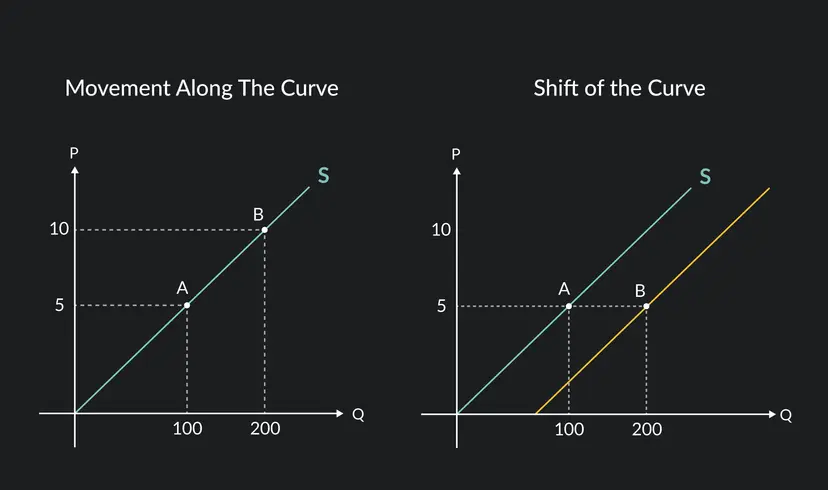
Side-by-side diagrams contrasting a movement along a single supply curve versus a shift of the entire supply curve. The movement panel highlights that a price change changes along the same curve, while the shift panel shows a new supply curve when a non-price determinant changes. Source
How to describe movement precisely (AP language)
When writing explanations, use “an increase/decrease in quantity supplied” for movements along the curve, and reserve “increase/decrease in supply” for curve shifts. Strong phrasing includes:
“As price increases, quantity supplied increases, shown by a movement up along the supply curve.”
“As price decreases, quantity supplied decreases, shown by a movement down along the supply curve.”
Reading a Supply Curve Graphically
On a standard graph:
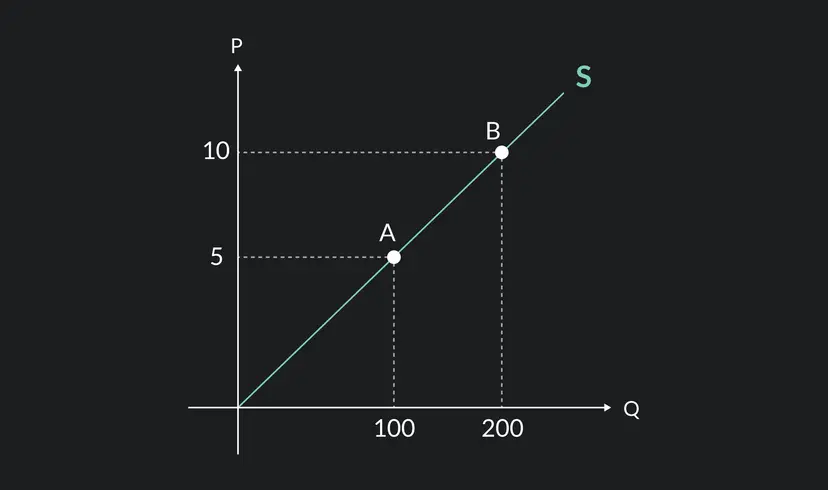
An upward-sloping supply curve with price on the vertical axis and quantity on the horizontal axis. The labeled points illustrate that each point on the curve represents a specific quantity supplied at a specific price, consistent with the law of supply. Source
The vertical axis is price.
The horizontal axis is quantity.
Each point on the curve is the quantity sellers would supply at that price.
A movement along the curve is traced by:
starting at an initial price and quantity on the curve,
changing price,
locating the new point on the same curve.
Direction matters
Because the law of supply is a direct relationship between price and quantity supplied:
Price leads to quantity supplied
Price leads to quantity supplied
The key is that the direction is the same (unlike demand, where it is opposite).
Common Pitfalls to Avoid
Confusing a movement with a shift
If the price of the good itself changes, you do not redraw the curve; you move to a different point on it.
A curve shift indicates that at every possible price, sellers would supply a different quantity—this is not what 2.2.1 is testing.
Forgetting ceteris paribus
The law of supply assumes other relevant conditions are unchanged. If other conditions change, the observed relationship between price and quantity supplied may not reflect a clean movement along a stable curve.
Using “supply increased” when you mean “quantity supplied increased”
On the AP exam, wording affects accuracy:
Correct for a price increase: “quantity supplied increases”
Incorrect if only price changed: “supply increases”
Practice Questions
Q1 (2 marks) State the law of supply and explain how a rise in a good’s own price is shown on a supply curve.
1 mark: States that price and quantity supplied move in the same direction (higher price higher quantity supplied; lower price lower quantity supplied), ceteris paribus.
1 mark: Explains it is shown as a movement up/right along the same supply curve (an increase in quantity supplied).
Q2 (5 marks) A market is initially at point A on an upward-sloping supply curve for coffee. The price of coffee increases from to . Using supply-curve reasoning, explain: (a) what change occurs (in correct AP terminology), (b) how it is represented on the graph, and (c) why it is not described as an increase in supply.
1 mark: Correct terminology: “quantity supplied increases” (not “supply increases”).
1 mark: Identifies price increase leads to movement to a higher quantity supplied (same direction).
1 mark: Graph representation: movement from A to a new point on the same curve (up/right).
1 mark: Explains “increase in supply” would require the entire curve to shift right.
1 mark: States that here only the good’s own price changed; therefore it is a movement along, not a shift.
FAQ
Yes, in limited cases. For example, if firms face hard capacity limits in the very short run, quantity supplied may not rise much when price rises.
In rare situations (e.g., contractual obligations), sellers may supply a fixed quantity regardless of price.
Look for what changed. If the prompt says “the price of the good rises/falls,” it indicates a movement along the existing curve.
If the prompt mentions “at every price” changing, that signals a shift (even if the word “shift” is not used).
“Willing” captures that sellers may be physically capable of producing but choose not to offer units for sale at low prices.
“Able” captures feasibility: having the capacity and means to supply the good.
Yes. A vertical segment can represent a fixed quantity supplied (perfectly inelastic over a range).
A horizontal segment can represent constant marginal cost (perfectly elastic over a range), where sellers supply any quantity at one price.
Not necessarily. It depends on how quickly sellers can adjust output offered for sale.
In some markets, quantity supplied can adjust rapidly (e.g., online sellers), while in others it adjusts slowly due to production lead times.