AP Syllabus focus: ‘Income elasticity of demand measures the percentage change in quantity demanded divided by the percentage change in income and identifies normal or inferior goods.’
Income changes are a major determinant of demand. Income elasticity of demand (YED) quantifies how strongly quantity demanded responds to income, helping classify goods as normal or inferior for forecasting and policy analysis.
Income Elasticity of Demand (YED)
Income elasticity of demand (YED) — the responsiveness of quantity demanded to a change in consumer income, measured as a percentage change.
YED isolates the effect of income on buying decisions, holding other determinants (such as tastes and prices) constant. Because it uses percentages, YED is unit-free and comparable across goods and markets.
Core equation and components
\text{Income Elasticity of Demand (YED)} = \dfrac{%\Delta Q_d}{%\Delta Y}
= Percentage change in quantity demanded
= Percentage change in income
Interpretation focuses on the sign and the magnitude:
Sign tells whether the good is normal or inferior.
Magnitude tells how sensitive demand is to income (small vs large proportional responses).
Normal and Inferior Goods
Normal good — a good for which demand increases when income increases (so YED is positive).
For normal goods, higher income shifts the entire demand curve right (increase in demand) at every price; lower income shifts it left.
Inferior good — a good for which demand decreases when income increases (so YED is negative).
For inferior goods, higher income shifts demand left, often because consumers switch toward higher-quality alternatives; lower income shifts demand right.
Using YED values to classify goods
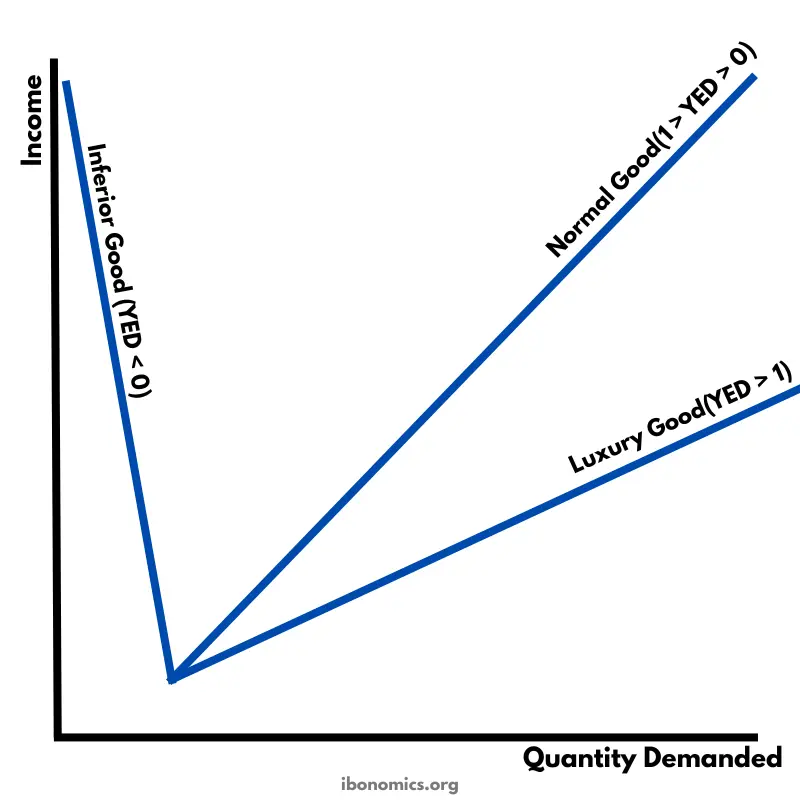
This diagram plots quantity demanded against income and shows the three standard YED cases: inferior goods (), normal/necessity goods (), and luxury goods (). The slope of each curve summarizes how strongly quantity demanded responds to income changes, linking the sign and magnitude of YED to observable behavior. It is especially helpful for quickly justifying a classification before translating it into a demand-curve shift on a price–quantity graph. Source
YED > 0: Normal good
If 0 < YED < 1, demand rises with income but proportionally less; often called a necessity in AP usage.
If YED > 1, demand rises more than proportionally; often called a luxury.
YED < 0: Inferior good
YED = 0 (or very close): demand is essentially income-insensitive over the relevant range
How income changes show up on a demand graph
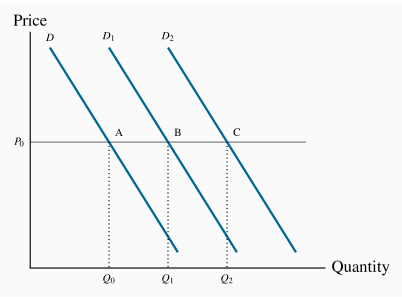
This figure shows an income increase shifting the demand curve rightward, with two possible shift sizes (a smaller shift vs a larger shift). The horizontal distance between the original and new demand curves at a given price represents how much quantity demanded changes when income changes, which connects to the magnitude of . A leftward shift under higher income would correspond to a negative YED (inferior good). Source
A change in income causes a shift of the demand curve (not a movement along the curve).
A change in the good’s own price causes a movement along the demand curve (not a shift).
For AP graphs and explanations, always state:
income increased or decreased,
whether the good is normal or inferior (based on YED sign),
the direction of the demand shift (right for normal with higher income; left for inferior with higher income),
the resulting change in equilibrium price and quantity depends on supply conditions (do not assume supply is perfectly elastic).
What can affect the size of YED (without changing the definition)
Even when a good is clearly normal or inferior, YED can differ across situations because “income responsiveness” depends on context:
Consumer income level: the same good can be inferior at low incomes but normal at higher incomes (classification can be range-dependent).
Time horizon: over longer periods, consumers may adjust spending patterns more fully, changing measured responsiveness.
Whether the good has close “upgrade” options: more opportunities to trade up can increase income sensitivity.
AP Microeconomics exam reminders (high-utility)
YED is about demand (buyers), not supply.
Use percent changes, not absolute changes.
Do not confuse inferior (income relationship) with “low quality” or “bad”; it is purely about how demand changes as income changes.
When asked to “identify normal or inferior,” use the sign of YED explicitly and link it to a demand shift.
Practice Questions
(2 marks) Define income elasticity of demand and state what the sign of YED implies about whether a good is normal or inferior.
1 mark: Correct definition: YED is (responsiveness of quantity demanded to income).
1 mark: Sign interpretation: YED normal; YED inferior.
(5 marks) A product has YED of .
(a) Identify the type of good. (1)
(b) If incomes rise, explain the change in demand for the product. (2)
(c) Explain what the magnitude suggests about responsiveness to income. (2)
(a) 1 mark: Inferior good (negative YED).
(b) 1 mark: Incomes rise causes demand to fall; 1 mark: demand curve shifts left (decrease in demand).
(c) 1 mark: Inelastic with respect to income (less than 1 in absolute value); 1 mark: quantity demanded changes proportionally less than income.
FAQ
In practice, analysts may use gross income, disposable income, or “real” (inflation-adjusted) income. The measured YED can differ depending on which income concept is used.
Yes. Over some income ranges, consumers “trade up,” making a good inferior; at other ranges, it may become normal if it becomes a standard purchase again.
Consumption norms, baseline income levels, availability of alternatives, and the share of income spent on the good can all change how strongly demand responds to income.
Common approaches include analysing household budget surveys or running econometric demand estimates using time-series or cross-sectional data to isolate income effects.
YED is an empirical elasticity linking income and quantity demanded for a good, while the income effect is a component of a price change’s impact on quantity demanded after adjusting purchasing power.