AP Syllabus focus: ‘Cross-price elasticity of demand measures how demand for one good responds to the price of another and identifies substitutes, complements, or unrelated goods.’
Cross-price elasticity connects markets by quantifying how a price change in one product affects demand for another. It helps classify relationships between goods and predict demand shifts when related prices move.
Cross-Price Elasticity of Demand (XED)
Cross-price elasticity of demand measures the responsiveness of quantity demanded of one good to a change in the price of another good.
Cross-price elasticity of demand (XED): The percentage change in quantity demanded of good X divided by the percentage change in the price of good Y.
XED is especially useful because many real-world demand changes come from outside the market itself (for example, a rival’s price change), not from changes in the good’s own price.
Formula and notation
The sign of XED (positive, negative, or near zero) is central to interpretation.
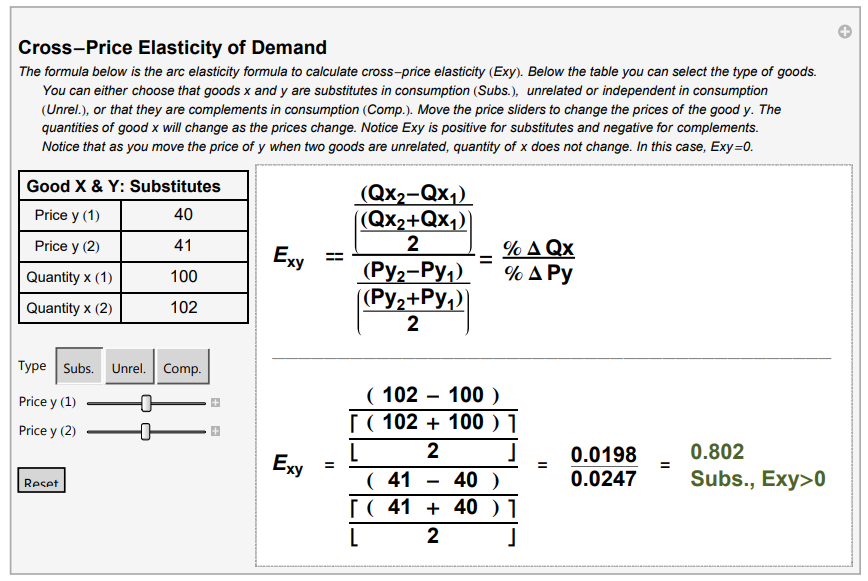
A worked, labeled cross-price elasticity setup showing two observed prices for good and the corresponding quantities demanded of good , then computing using an arc-elasticity approach. The visual reinforces that the sign of is the key classifier: positive for substitutes, negative for complements, and approximately zero for unrelated goods. It’s a helpful bridge between the definition ( over ) and how real data are plugged into the calculation. Source
\text{XED}_{x,y} = \dfrac{%\Delta Q_d(x)}{%\Delta P(y)}
= Cross-price elasticity of demand between goods and (unitless)
= Percentage change in quantity demanded of good
= Percentage change in price of good
When using the formula, keep the direction clear: the numerator is always the quantity demanded of the good you are analysing, while the denominator is the price of the related good.
Interpreting XED: Substitutes, Complements, Unrelated Goods
XED identifies whether two goods are substitutes, complements, or unrelated based on the sign (and, secondarily, the size) of the elasticity.

A three-panel diagram that contrasts substitutes, complements, and independent goods by showing how the demand for good responds as the price of good changes. The panels make the sign logic visually memorable: substitutes imply , complements imply , and unrelated goods imply . This is ideal for quick interpretation practice before moving to numerical calculations. Source
Substitutes (XED > 0)
If two goods are substitutes, a higher price for one increases demand for the other.
Substitutes: Goods that serve similar purposes, so an increase in the price of one leads to an increase in demand for the other.
Key interpretation points:
Positive XED means the goods “compete” in consumption.
Larger positive values generally indicate closer substitutes (consumers switch more readily).
Complements (XED < 0)
If two goods are complements, a higher price for one reduces demand for the other because they are used together.
Complements: Goods that are consumed jointly, so an increase in the price of one leads to a decrease in demand for the other.
Key interpretation points:
Negative XED indicates linked consumption.
More negative values typically suggest a stronger joint relationship.
Unrelated goods (XED ≈ 0)
If goods are unrelated, a price change in one has little to no effect on demand for the other.
XED close to zero reflects weak or no consumption connection.
“Near zero” is common when products are in very different categories or when consumers do not view them as linked choices.
How XED Shows Up on Demand Graphs
In AP Microeconomics terms, a change in the price of a related good causes a shift of the entire demand curve for the good you are analysing (not a movement along its curve).
If rises and goods are substitutes: demand for shifts right (increases).
If rises and goods are complements: demand for shifts left (decreases).
If goods are unrelated: little to no shift.
Common Pitfalls and Best Practices
Sign mistakes: Always interpret the sign using the substitute/complement logic, not intuition about “good” or “bad” outcomes.
Direction matters: is not the same as in real data (measurement and consumer behaviour can make them differ).
Ceteris paribus: XED is a comparative-static idea; interpretation assumes other demand determinants are held constant.
Relationship can vary by context: Goods may be substitutes for some consumers and unrelated for others; market-level XED reflects the aggregate pattern.
Practice Questions
(2 marks) Define cross-price elasticity of demand and state what the sign of XED indicates about two goods.
1 mark: Correct definition (percentage change in of one good over percentage change in price of another).
1 mark: Correct sign interpretation (positive = substitutes; negative = complements; zero/near zero = unrelated).
(6 marks) Explain how cross-price elasticity of demand can be used to identify whether two goods are substitutes or complements, and describe how a rise in the price of good Y affects the demand curve for good X in each case.
1 mark: States XED measures responsiveness of demand for to price of .
2 marks: Explains substitutes with XED 0 and correct reasoning (price rise in increases demand for ).
2 marks: Explains complements with XED 0 and correct reasoning (price rise in decreases demand for ).
1 mark: Correctly links to demand-curve shifts for (right for substitutes, left for complements).
FAQ
XED can reveal demand linkages that industry categories miss.
A firm can test which products have meaningfully positive XED with its own product, indicating true switching behaviour rather than superficial similarity.
Consumers may face switching frictions (habits, contracts, platform lock-in) that weaken observed responsiveness.
Also, if only a small share of buyers view the goods as alternatives, aggregate XED can be near zero.
Yes. New technology, improved compatibility, or standardisation can make goods closer substitutes or stronger complements.
Brand differentiation, bundling, or ecosystem strategies can reduce substitutability and push XED toward zero.
One product may be a niche alternative while the other is a “default” option.
Price changes in the default can push many consumers to the niche, but price changes in the niche may not pull many away from the default.
A large positive XED suggests consumers compare the goods directly and switch readily.
A large negative XED suggests strong joint usage, such as required pairing, tight compatibility, or a common consumption occasion.