

AP Syllabus focus: ‘A vector can be modeled as the resultant of two perpendicular components.’
Two-dimensional physics becomes manageable when you replace a single slanted vector with two perpendicular “shadow” vectors. This page explains resultants and perpendicular components, and how they encode the same physical information.
Resultant vectors and perpendicular components
Core idea: one vector, two perpendicular parts
Resultant vector: the single vector that represents the combined effect of two or more vectors added together.
In two dimensions, many vectors point neither purely horizontal nor purely vertical. A powerful model is to represent one vector as the resultant of two perpendicular components (usually an -component and a -component). The components add to reproduce the original vector exactly.
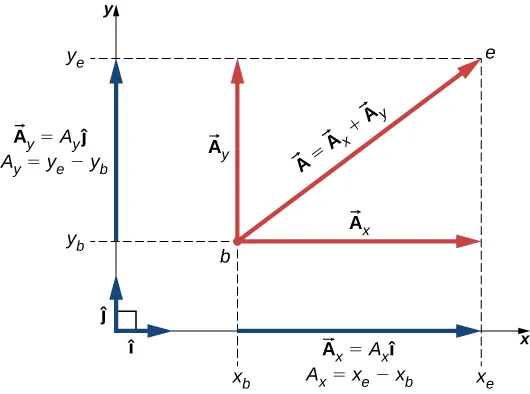
A 2D vector can be represented as the diagonal of a rectangle whose sides are its perpendicular components along the - and -axes. This diagram emphasizes that the component vectors are orthogonal projections and that adding them head-to-tail reconstructs the original vector. Source
Component: a vector that lies along a chosen axis and, when added tip-to-tail with a perpendicular component, recreates the original vector.
What it means physically
The original vector and its two perpendicular components describe the same physical quantity (for example, a displacement).
The components are not “extra vectors”; they are a different representation of the same vector.
Because the components are perpendicular, they can be treated independently in calculations and then recombined.
How to represent a vector as perpendicular components
Vector picture (conceptual steps)
Choose two perpendicular directions (often right and up).
Draw the original vector.
Construct a right triangle where:
one leg is the horizontal component
the other leg is the vertical component
the hypotenuse is the original vector (the resultant of the two components)
This works because perpendicular components form a right triangle, and the original vector is the diagonal that “results” from adding the legs.
Component notation (algebra-friendly)
Write the vector as .
Write its components as and (these are signed values that indicate direction along each axis).
Think of as “made of” an -part plus a -part.
A key benefit is that vector addition becomes component-by-component addition.
= x-component of resultant, in the vector’s unit
= x-components being added, in the vector’s unit
= y-component of resultant, in the vector’s unit
= y-components being added, in the vector’s unit
Reconstructing the resultant from perpendicular components
Magnitude from perpendicular components
When a vector is the resultant of two perpendicular components, its magnitude comes from the Pythagorean relationship. This is the algebraic link between “two legs” and “one diagonal.”
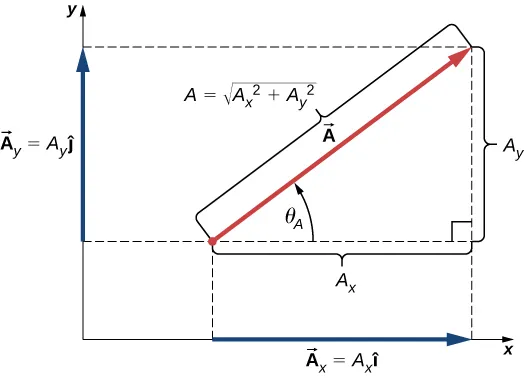
The vector and its perpendicular components form a right triangle, so the magnitude of the resultant corresponds to the triangle’s hypotenuse. The diagram makes the geometric meaning of transparent: the components are the legs and the original vector is the diagonal. Source
= magnitude of the resultant vector, in the vector’s unit
= x-component of the vector, in the vector’s unit
= y-component of the vector, in the vector’s unit
Direction and signs (qualitative)
The sign of a component tells you which way it points along that axis (positive vs negative direction).
A zero component means the vector has no “amount” in that direction.
The pair determines which quadrant the vector lies in; the direction must be consistent with both signs.
Common pitfalls to avoid (still within this model)
Mixing up magnitude with component: a component is not automatically positive; it can be negative.
Treating components as scalars with no direction: components are directional along an axis, even though they are written as signed numbers.
Forgetting that only perpendicular components form a right triangle used for the Pythagorean relationship.
Practice Questions
Q1 (1–3 marks) A displacement has components and . Determine the magnitude of the displacement.
Uses (1)
Substitutes correctly: (1)
Evaluates to with unit (1)
Q2 (4–6 marks) Two velocities act on an object: has components and has components . (a) Find the components of the resultant velocity . (b) Find the magnitude of .
(a) (1)
(a) (1)
States resultant components as (1)
(b) Uses (1)
Substitutes: (1)
with unit (1)
FAQ
Perpendicular components create a right triangle, so the geometry is uniquely determined and algebraically simple.
If components are not perpendicular, you cannot use $R=\sqrt{R_x^2+R_y^2}$; you would need other relationships and additional angle information.
They are unique only after you fix the two perpendicular axes.
If you rotate the axes, the numerical values of the components change, but the original vector (its magnitude and direction in space) does not.
A negative component means the vector points opposite the chosen positive axis direction in that dimension.
For example, $A_y<0$ means the vector has a downward contribution if “up” is defined as positive $y$.
No, not for perpendicular components. Each component magnitude is at most equal to the vector magnitude.
Geometrically, each leg of a right triangle is shorter than the hypotenuse (unless the other leg is zero, when one component equals the magnitude).
Use two checks:
Sign check: do the signs match the intended overall direction (quadrant)?
Size check: $\sqrt{R_x^2+R_y^2}$ should be larger than either $|R_x|$ or $|R_y|$ unless one component is zero.
