

AP Syllabus focus: ‘A system’s center-of-mass acceleration is proportional to net force and points in the same direction.’
Newton’s second law connects interactions (forces) to motion (acceleration). For AP Physics 1, the key idea is that net force determines a system’s center-of-mass acceleration in both magnitude and direction.
Core idea: force sets acceleration
Newton’s second law is a quantitative rule for predicting acceleration from the forces acting on a chosen system. It directly encodes the syllabus statement that the acceleration is proportional to net force and points in the same direction.
Center-of-mass acceleration (what acceleration means for a system)
Center-of-mass acceleration: The acceleration of the single point that represents the average translational motion of a system’s mass; it describes how the system moves overall.
This matters because a “system” might contain multiple objects; Newton’s second law is applied to the system’s overall translational motion, not to any internal motion within it.
Newton’s second law (algebraic form)
In AP Physics 1 Algebra, Newton’s second law is used as a vector relationship between net force and acceleration, with mass as the proportionality constant.
= net force on the system (newtons, N)
= inertial mass of the system (kilograms, kg)
= acceleration of the system’s center of mass (m/s^2)
Because this is a vector equation:
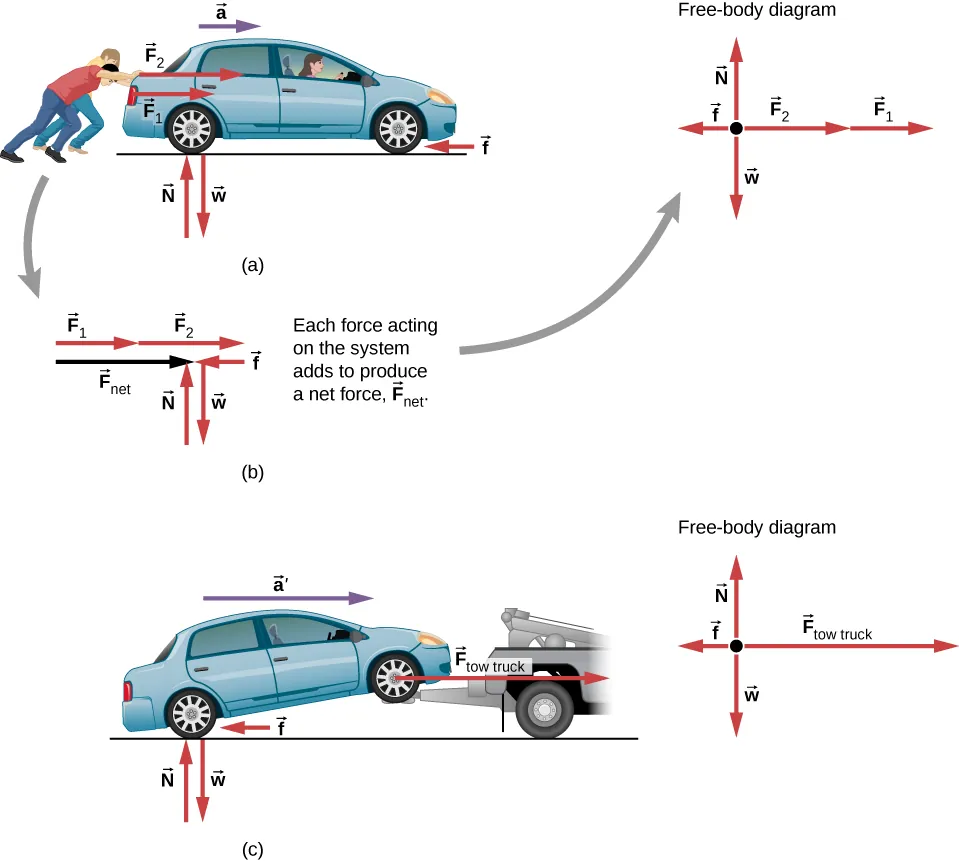
Free-body diagrams for a car being pushed show multiple external forces (pushes, friction, normal force, and weight) and how they combine into a single net force vector. The diagram also highlights that the acceleration vector is collinear with the net force, illustrating the vector meaning of . Source
The acceleration vector must be collinear with the net force vector.
If the net force changes direction, the acceleration changes direction accordingly.
Multiple forces combine to a single net force; that net force alone sets the acceleration.
Proportionality and scaling
From the law above:
For a fixed mass, doubling the net force doubles the acceleration magnitude.
For a fixed net force, doubling the mass halves the acceleration magnitude.
In general, acceleration magnitude depends on the ratio “net force per mass.”
Direction: “points in the same direction”
“Acceleration points in the same direction as net force” means:
If the net force points right, acceleration points right (even if the object is moving left at that instant).
If the net force points upward, acceleration points upward (even if the object’s velocity is horizontal at that instant).
If the net force has components in both and , then the acceleration also has components in both and in the same proportions.
Using components (how vectors become solvable algebra)
To apply the law in two dimensions, treat it as two independent component equations:
In the -direction: net force component produces the -acceleration.
In the -direction: net force component produces the -acceleration.
Key practices:
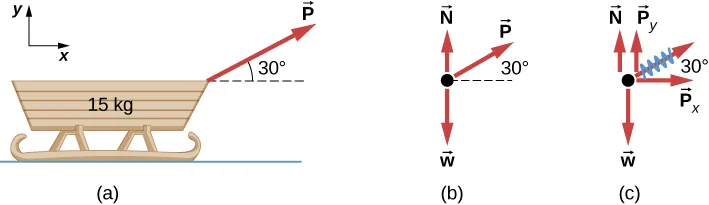
A pulled-sled free-body diagram is shown first with the original applied force vector, then with that applied force replaced by its components and . This helps students see how choosing axes and resolving forces into components turns the vector law into algebraic equations without ever “splitting” mass. Source
Choose axes that make the acceleration direction easy to represent (often aligned with expected motion).
Add force components with signs (+/−) based on the chosen axes.
The mass is a scalar; it does not have direction and does not get “split” into components.
Units and physical meaning
The newton is defined so that produces of acceleration on .
Mass measures inertia: larger mass means a smaller acceleration for the same net force.
Common interpretation checks:
If your computed acceleration points opposite your computed net force, a sign or component error occurred.
If you add a force to a system and your acceleration decreases without changing mass, the net force you used is likely not the true vector sum.
Practice Questions
Q1 (2 marks): A system has mass and experiences a net force of to the left. State the magnitude and direction of the acceleration.
Uses to obtain (1)
Correct direction: to the left, same as net force (1)
Q2 (5 marks): A trolley of mass experiences two horizontal forces: east and west, and one vertical force of upward.
(a) Determine the net force components. (2)
(b) Determine the acceleration components. (2)
(c) State the direction of the acceleration relative to east. (1)
(a) Net horizontal component: east (1); net vertical component: up (1)
(b) east (1); up (1)
(c) Direction described consistently with components (e.g. “upwards and eastwards, steeper upwards than eastwards”) (1)
FAQ
No. Newton’s second law links acceleration to net force, not to velocity.
Acceleration can oppose velocity (slowing down) or be perpendicular to velocity (changing direction without changing speed).
Check that your acceleration components have the same signs as your net force components.
Also ensure the acceleration vector “leans” more toward the axis with the larger net-force-per-mass component.
It means mass measures resistance to acceleration.
For the same net force, a larger mass produces a smaller acceleration in exact inverse proportion.
Typically by measuring acceleration (e.g. motion sensor) while varying applied net force or mass.
A linear relationship between net force and acceleration supports the law, with slope related to mass.
The simple form $\sum \vec{F}=m\vec{a}$ assumes constant mass.
If mass changes (e.g. fuel burn), a more general momentum-based approach is needed; AP Physics 1 usually treats such cases only conceptually.
