

AP Syllabus focus: ‘Unbalanced forces mean the net force on a system is not zero.’
Unbalanced forces are the gateway from “nothing changes” to “motion changes.” This page focuses on recognising when forces do not cancel, and what that implies for an object or system’s motion.
Core idea: when forces don’t cancel
In AP Physics 1, the word unbalanced is a statement about the net force: at least one direction has a leftover, non-cancelled force.
Net force: The single force that represents the combined effect of all forces acting on a system; it is the vector sum of those forces.
A system can have many forces acting on it simultaneously (weight, normal, tension, friction, applied pushes).
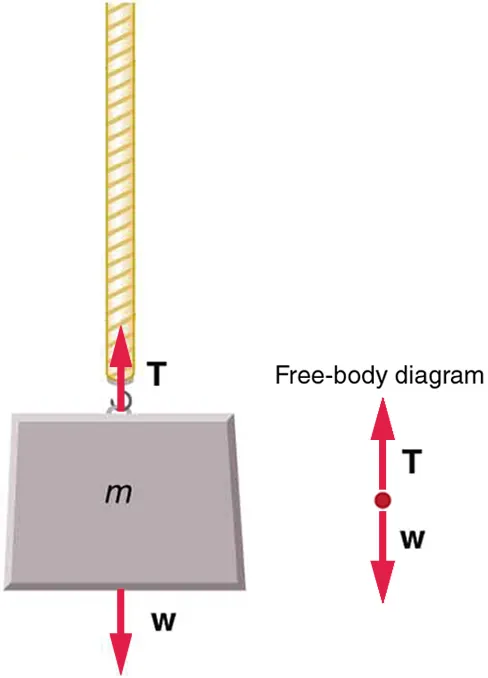
A hanging mass has two main external forces: tension upward and weight downward. The free-body diagram isolates the object and shows these forces as vectors so you can determine whether they cancel (net force zero) or leave a leftover (net force nonzero). Source
Those forces may partially or fully cancel, depending on direction and magnitude.
= net force on the system, in newtons (N)
= each individual force acting on the system, in newtons (N)
Because forces are vectors, “adding forces” means combining components in perpendicular directions, not just adding magnitudes.
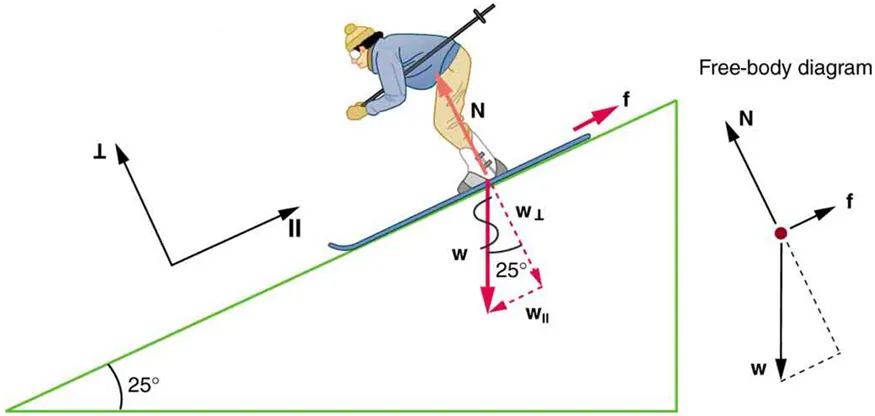
On an incline, the weight force can be resolved into perpendicular components: into the surface and down the slope. Comparing components along chosen axes makes it clear which directions are balanced and which direction has a nonzero net force (and therefore acceleration). Source
What “unbalanced” means (and what it doesn’t)
Identifying unbalanced forces
Forces are unbalanced if the net force is not zero.
Unbalanced forces: A situation in which the net force on a system is not zero ().
Practical checks:
If, in any chosen axis, the sum of force components is nonzero, forces are unbalanced in that axis.
Balanced in one axis does not guarantee balanced overall (e.g., vertical forces cancel while horizontal forces do not).
Motion changes caused by unbalanced force
A nonzero net force implies the motion is not steady in velocity. In algebra-based AP Physics 1 language, “motion changes” includes:
a change in speed (speeding up or slowing down),
a change in direction (turning),
or both at once.
Key interpretation statements you should be able to justify from a free-body diagram:
If , the system’s velocity will not remain constant.
The direction of the motion change matches the direction of (the net force points toward how the velocity vector is being “pulled”).
Using components to decide if forces cancel
In AP problems, you usually choose axes so that one axis is along the expected motion change. Then you compare positive and negative components.
Common patterns:
Straight-line speeding up: net force points in the direction of motion.
Straight-line slowing down: net force points opposite the direction of motion.
Turning at (possibly) constant speed: net force points toward the inside of the turn (velocity direction changes even if speed doesn’t).
Common reasoning pitfalls (high-frequency AP errors)
Treating “moving” as proof of unbalanced forces. An object can move at constant velocity with .
Adding force magnitudes without directions. Opposite-direction forces must subtract as vectors.
Concluding “forces are balanced” because two forces look equal, while ignoring a third force or a component.
Mixing up “largest force” with “net force.” A small leftover difference between large opposing forces can still be the net force.
Practice Questions
A cart on a horizontal track experiences a force to the right and a frictional force to the left. Is the force on the cart balanced or unbalanced? Describe the cart’s subsequent motion.
1 mark: States so forces are balanced.
1 mark: States the cart continues at constant velocity (could be at rest or moving steadily).
A puck moves east at constant speed. Three horizontal forces act: east, west, and north.
(a) Determine the net force vector (magnitude and direction). (3 marks)
(b) State qualitatively how the puck’s velocity will change immediately after these forces act. (2 marks)
(a)
1 mark: नेट components: east, north.
1 mark: Magnitude .
1 mark: Direction northeast (or angle north of east).
(b)
1 mark: States velocity direction changes toward the net force (towards NE).
1 mark: States speed need not remain constant (it begins to increase due to a component along motion, and direction turns).
FAQ
Balanced forces mean $\vec{F}_{\text{net}}=0$, so velocity is constant, not necessarily zero.
A high speed can persist without any net force if forces cancel (e.g., negligible friction).
A brief unbalanced force produces a brief change in velocity.
Qualitatively: the velocity vector “kicks” in the direction of $\vec{F}_{\text{net}}$, even if forces later become balanced.
Force balance is evaluated within a chosen frame, but in AP Physics 1 you typically use inertial frames.
In an inertial frame, $\vec{F}_{\text{net}}=0$ corresponds to constant velocity.
“Unequal” is incomplete unless you specify direction and which forces you’re comparing.
“Forces don’t cancel” means the vector sum is nonzero: $\sum \vec{F}_i \ne \vec{0}$.
Resolve each force into $x$- and $y$-components, then add components in each direction.
If either $\sum F_x \ne 0$ or $\sum F_y \ne 0$, the forces are unbalanced overall.
