

AP Syllabus focus: ‘A system’s center-of-mass velocity changes only when a nonzero net external force acts on it.’
Velocity changes are caused by interactions across a system boundary. This page focuses on how to connect net external force to changes in a system’s center-of-mass velocity, using system-based free-body reasoning.
Core idea: only external forces can change a system’s velocity
When you treat one object or many objects as a single system, the motion you track is the motion of the system’s center of mass. Internal pushes and pulls can change how parts move relative to each other, but they cannot change the system’s overall velocity by themselves.
Key terms for system thinking
External force: a force on the system exerted by an object outside the system boundary.
Choose the system boundary first, then decide which forces cross it (external) and which occur between objects inside it (internal).
A useful velocity to track is the system’s center-of-mass velocity.
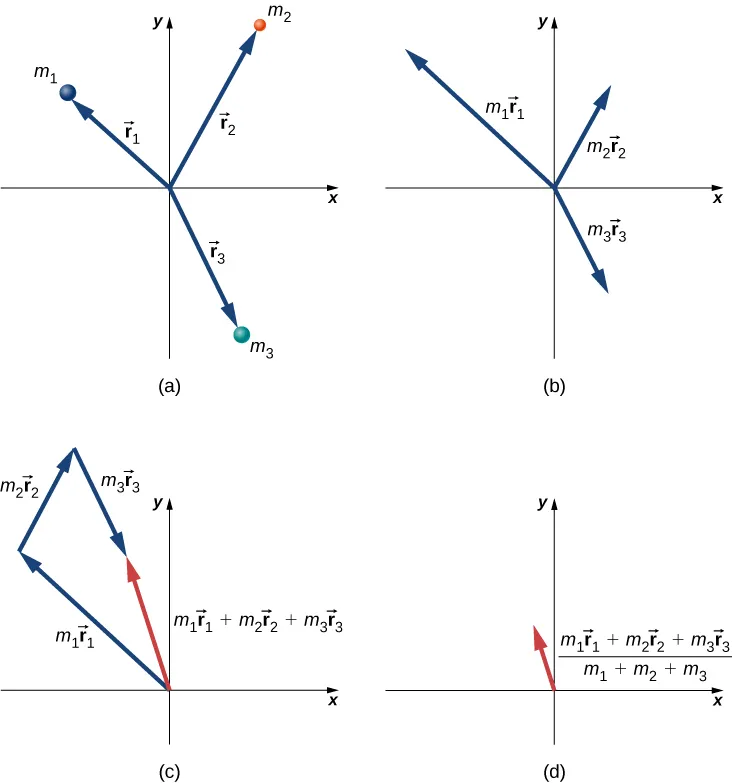
Vector construction for the center of mass of several particles: each position vector is weighted by mass (), summed, and then divided by total mass to locate . This makes the “mass-weighted average position” idea concrete, which is the basis for discussing the corresponding center-of-mass velocity. Source
Center-of-mass velocity: the velocity of the point representing the system’s mass-weighted average position; it describes the system’s overall translational motion.
Identifying the net external force
The net external force is the vector sum of all external forces on the system.
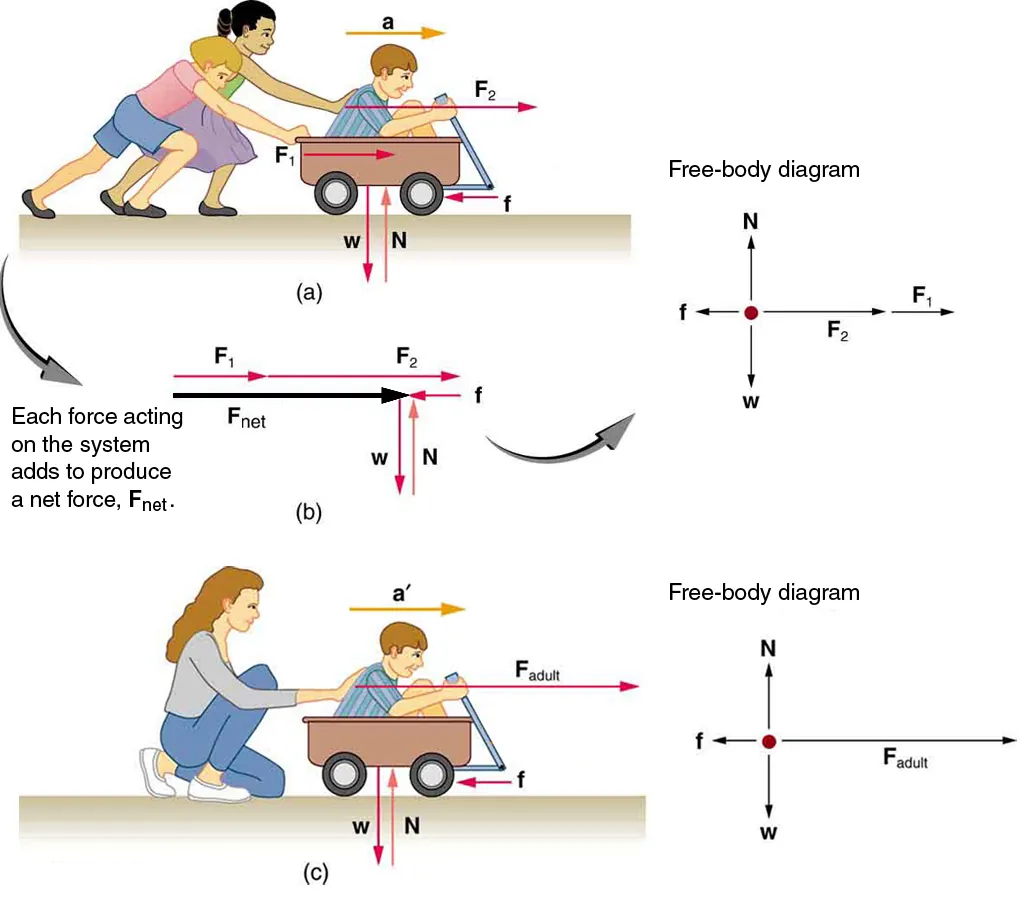
A system-level free-body diagram: the entire system is represented by a single point (the center of mass), and only external forces are drawn acting on it. The vectors can then be added to obtain the net external force, which determines the direction of the system’s acceleration (). Source
Practically, that means:
Draw a free-body diagram for the entire system (not for each object).
Include only forces exerted by the environment on the system.
Exclude internal forces (forces between objects inside the system), because they occur in action-reaction pairs within the boundary.
Why internal forces do not change the system’s velocity
Internal forces can be large (e.g., tension between two blocks in a system), but they appear in equal and opposite pairs on different parts of the system. When you add forces for the system as a whole, those internal pairs cancel, leaving only external forces to determine whether the system’s center-of-mass velocity changes.
Linking net external force to changing velocity
If the net external force is zero, the center-of-mass velocity is constant (it may be zero or nonzero).
If the net external force is not zero, the center-of-mass velocity must change in the direction of that net external force.
The quantitative link is Newton’s second law applied to a system:
= net external force on the system, in newtons
= total mass of the system, in kilograms
= center-of-mass acceleration, in m/s
= change in center-of-mass velocity over time interval, in m/s
= time interval, in seconds
This equation is a direct statement of the syllabus focus: a change in requires , which requires .
Direction and components
Because forces are vectors:
A nonzero net external force in one direction changes the center-of-mass velocity component in that direction.
It is possible for forces to balance in one axis (no change in that velocity component) while remaining unbalanced in another axis (velocity changes there).
Common modelling moves and pitfalls
Choosing a good system
Pick a boundary that makes the external forces simple.
If two objects pull on each other with tension, including both objects often removes tension from the external-force list.
If friction from the floor matters, the floor is usually outside the system, so friction is external (unless you intentionally include the floor too).
Interpreting “no net external force”
“No net external force” does not mean “no forces.” It means:
External forces can be present but add to zero as vectors.
With , the system’s center-of-mass velocity stays constant, even if internal forces cause spinning, stretching, or separation of parts.
Practice Questions
Q1 (1–3 marks) A cart moves to the right on a level, nearly frictionless track. After a push, no horizontal forces act on the cart-system. Describe what happens to its horizontal velocity.
States that net external horizontal force is zero (1)
Concludes horizontal acceleration is zero (1)
Concludes horizontal velocity remains constant (same speed and direction) (1)
Q2 (4–6 marks) Two blocks, and , are connected by a light string and pulled to the right by an external force applied to on a frictionless surface. Treat both blocks as one system. (a) Identify which forces are external to the two-block system. (2) (b) Determine the system’s acceleration in terms of , , and . (2) (c) Explain briefly why the string tension does not affect the acceleration found in (b). (1)
(a) Correctly identifies as external; weight and normal forces are external but cancel vertically / are not in the horizontal net (any clear statement) (2)
(b) Uses and obtains (2)
(c) States tension is internal to the chosen system and cancels in the system force sum (1)
FAQ
Friction is external if it comes from a surface outside your boundary.
If you include both sliding objects inside the boundary, the friction between them becomes internal.
Yes. If the net external force is nonzero during any time interval, $v_{\text{cm}}$ changes during that interval.
Later cancellation does not undo an earlier change unless forces reverse it.
Only with care. For variable-mass situations (e.g., leaking material), you must account for momentum carried across the boundary.
AP Physics 1 typically avoids full variable-mass derivations.
Not necessarily. A net external force can change direction without changing speed (e.g., turning).
Speed changes only if there is a component of net external force along the velocity.
It lets you predict the system’s overall motion from external forces alone.
Internal forces can redistribute motion among parts, while $v_{\text{cm}}$ responds only to the external net.
