

AP Syllabus focus: ‘The magnitude of the force exerted by an ideal spring is given by Hooke’s law.’
Hooke’s law connects how much an ideal spring is stretched or compressed to the force it exerts. In AP Physics 1, it provides a simple linear model for spring forces in many translational dynamics situations.
What Hooke’s Law States
Hooke’s law says the magnitude of the spring force increases in direct proportion to the spring’s displacement from its relaxed (unstretched) length, as long as the spring remains in its linear range.
Spring constant (k): A measure of a spring’s stiffness; the proportionality constant relating spring-force magnitude to displacement, with units of N/m.
A larger spring constant means a stiffer spring: it produces more force for the same displacement.
= magnitude of the force the spring exerts on the attached object (newtons, N)
= spring constant (newtons per metre, N/m)
= displacement from the relaxed length; extension or compression magnitude (metres, m)
Hooke’s law is often written with a negative sign, , to show direction, but the syllabus emphasis here is on the magnitude relationship.
Displacement, Direction, and Sign Conventions
In 1D problems, you choose a positive axis and then assign a sign to the spring force using your coordinate choice.
If you use , then:
is a signed displacement from equilibrium.
The negative sign encodes that the spring force points opposite the displacement (a restoring tendency).
If you use , then:
is treated as a magnitude, and you assign the force direction separately based on whether the spring is stretched or compressed.
Displacement from relaxed length (x): The amount a spring is extended or compressed compared with its relaxed length; measured along the spring’s line of action.
Graphical Meaning (Force–Displacement)
Hooke’s law implies a straight-line relationship between spring-force magnitude and displacement magnitude.
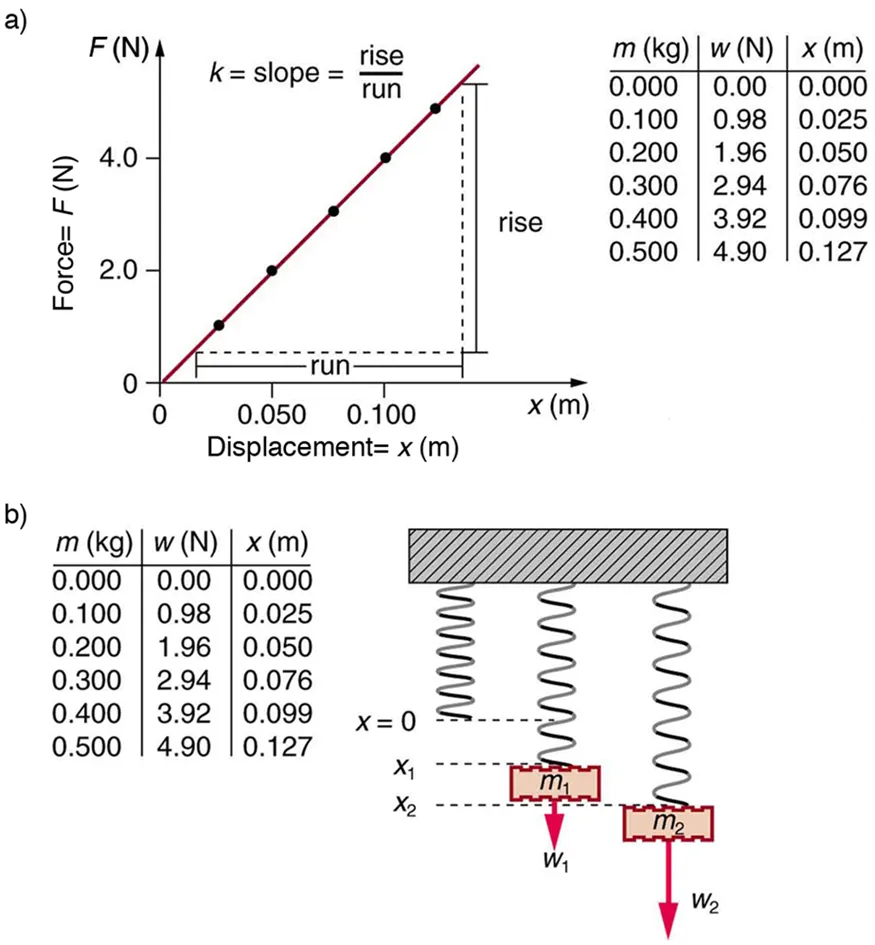
Force magnitude vs. displacement for an ideal Hooke’s-law spring forms a straight line through the origin, so the proportionality constant is the slope: . The accompanying hanging-mass setup illustrates how measured weight (force) and extension data generate the linear plot used to determine . Source
A graph of vs. is linear and passes through the origin (ideal behaviour).
The slope of the line is (units N/m), so you can determine experimentally from force and displacement data.
If the graph noticeably curves, the spring is no longer behaving ideally; Hooke’s law is not a good quantitative model there.
Using Hooke’s Law in Dynamics Setups
When a spring is part of a force analysis, the spring force acts along the spring and should be treated like any other external force on the chosen object.
Identify the object whose forces you are summing.
Determine the spring’s displacement from its relaxed length (watch units: cm to m).
Use for magnitude, then apply the correct direction in your free-body reasoning.
Combine with Newton’s second law algebraically when needed: the spring force may oppose or reinforce other forces depending on geometry and displacement direction.
The key modelling step is that the spring force depends on how far the spring is displaced, not on the object’s mass or speed.
Limits and Common Pitfalls
Hooke’s law is a model with a restricted domain.
Valid only within the spring’s linear (elastic) range; beyond that, is not proportional to and permanent deformation can occur.
is not the spring’s total length; it is the change from relaxed length.
Confusing direction: is always positive; the sign comes from your axis choice, not from .
Using the wrong units: in N/m requires in metres.
Practice Questions
(2 marks) A spring has spring constant . It is stretched by . Calculate the magnitude of the spring force.
Uses Hooke’s law (1)
(1)
(5 marks) A student hangs different masses from a vertical spring and measures the extension . The spring behaves linearly. Explain how the student can determine from a graph, and state two checks to improve reliability.
States to plot force (weight) against extension (1)
States the graph should be a straight line through the origin for ideal behaviour (1)
Identifies gradient as with units N/m (1)
Reliability check: repeat readings and average (1)
Reliability check: use a range of masses within the linear range / identify anomalies (1)
FAQ
Some springs show slight nonlinearity (e.g., coil contact, internal friction) while still being broadly elastic.
If the $F$–$x$ graph is not a straight line, treat $k$ as not constant.
Measure the spring length with no load and no compression as your reference.
If a spring is pre-stretched, you must redefine $x$ relative to that chosen reference length.
They have the same stiffness in the linear range: equal force is needed for equal displacement.
Their maximum usable extension (linear range) can still differ.
No. $k$ is a property of the spring’s material and geometry.
Gravity and mass change the equilibrium position, not the proportionality constant.
Temperature can change material stiffness slightly, shifting $k$.
For precise work, keep conditions consistent and avoid heating from repeated rapid stretching.
