

AP Syllabus focus: ‘A spring’s force is always directed toward the equilibrium position of the spring–object system.’
Ideal springs produce forces that oppose deformation. This page clarifies how to determine the direction of the spring force, what equilibrium position means, and how to use sign conventions consistently in algebra-based solutions.
Core idea: spring force is a restoring force
When a spring is stretched or compressed, it exerts a force on the attached object that acts to return the system to its natural, relaxed configuration. This is why the spring force is often called a restoring force.
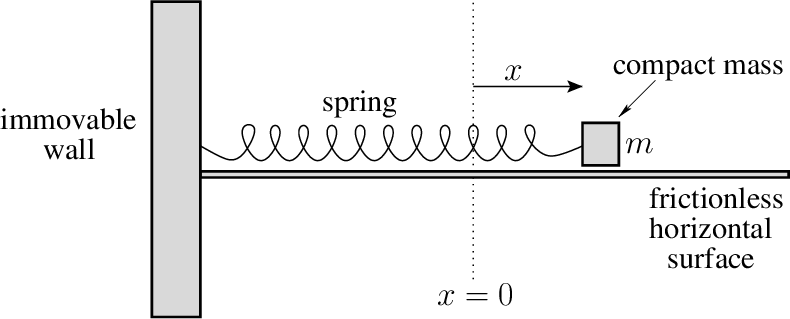
A standard horizontal mass–spring setup (mass attached to a spring anchored to a wall) used to define displacement and equilibrium. When the mass is displaced from equilibrium, the spring exerts a restoring force pointing back toward the equilibrium position, consistent with . Source
If the object is pulled to the right (spring stretched), the spring pulls left.
If the object is pushed to the right (spring compressed), the spring pushes left.
In both cases, the spring force points toward where the system would settle if released.
Equilibrium position for a spring–object system
The “equilibrium position” is not always the spring’s unstretched length; it depends on all forces acting in the situation (for example, other applied forces or constraints).
Equilibrium position: the position where the net force on the object is zero, so the object would remain at rest if placed there (in an inertial frame).
In one-dimensional spring problems, equilibrium is the reference point you measure displacement from, because the spring’s force direction is defined relative to that point.
Displacement and sign convention (direction comes from the sign)
To decide the spring-force direction cleanly, define a coordinate axis and define the displacement from equilibrium with a sign.
Displacement from equilibrium (): the signed distance of the object from the equilibrium position, measured along the chosen axis.
After choosing positive direction, the spring force must always point opposite to (toward equilibrium). That “opposite direction” idea is what the minus sign represents.
Hooke’s law with direction (the minus sign matters)
Hooke’s law is the algebraic statement that the spring force is proportional to deformation and directed back toward equilibrium.
= spring force on the object (N)
= spring constant (N/m)
= displacement from equilibrium (m)
A consistent interpretation is:
If (object displaced in the + direction), then (force points in the − direction).
If , then (force points in the + direction).
Recognising “toward equilibrium” in diagrams and words
When reading a diagram or statement, translate it into “where is equilibrium, and which side of it is the object on?”
Identify the equilibrium position (often marked, or implied by “relaxed spring” or “system at rest”).
Determine whether the spring is stretched or compressed relative to equilibrium.
The spring force on the object points from the current position back toward equilibrium.
Common pitfalls
Confusing magnitude with direction: gives the size only if is treated as a magnitude; direction must still be assigned toward equilibrium.
Mixing reference points: if you measure from the spring’s natural length in a situation where equilibrium is shifted, your force direction/signs can become inconsistent.
Forgetting the spring force acts along the spring: the force direction is along the spring’s axis, toward equilibrium, not “in the direction of motion.”
Language cues that imply direction
“Restoring” or “returning” force: points toward equilibrium.
“Displaced to the right/left”: sets the sign of once axes are chosen.
“Stretched” vs “compressed”: tells you the force pulls back or pushes back toward equilibrium.
Practice Questions
(1–3 marks) A block on a frictionless horizontal surface is attached to a spring. The equilibrium position is marked. The block is displaced a distance to the right of equilibrium and released from rest. State the direction of the spring force on the block at the instant of release.
Spring force acts towards equilibrium (1)
Therefore it acts to the left / negative direction (1)
(4–6 marks) A student chooses the positive -direction to the right and defines at the equilibrium position of a spring–block system.
(a) Write an expression for the spring force in terms of and .
(b) Explain, using the sign of , how your expression guarantees the force is always directed toward equilibrium.
(c) If the block is at , state the sign (positive/negative) of .
(a) (2: correct form and correct sign)
(b) Explains and , so force opposite displacement, towards equilibrium (2)
(c) For , (1)
FAQ
No. It points opposite to the displacement from equilibrium, not necessarily opposite to velocity.
At equilibrium, velocity can be non-zero while spring force is zero.
Equilibrium can be shifted by other forces or constraints.
You then define $x=0$ at that shifted equilibrium, and the spring force still points toward that position.
A stretched spring pulls its ends together; a compressed spring pushes its ends apart.
In both cases the force on the object is toward equilibrium along the spring’s axis.
It encodes direction: the force is opposite the sign of $x$.
Without it, the formula would not guarantee “toward equilibrium” for both stretching and compression.
Yes. Equilibrium is defined by net force zero, not by the object’s current motion.
The object can pass through equilibrium with maximum speed while $F_{\text{spring}}=0$.
