

AP Syllabus focus: ‘An ideal spring has negligible mass and exerts a force proportional to how far it is stretched or compressed.’
Ideal springs are a powerful model for describing elastic interactions in many AP Physics 1 situations. This page focuses on what “ideal” means and how stretching or compressing relates to the spring’s force.
Ideal springs as a physics model
What “ideal” assumes
In AP Physics 1, an ideal spring is treated as a simple, predictable interaction that lets you connect deformation to force without worrying about complex material behaviour.
Negligible mass: the spring’s mass is small enough to ignore in translational dynamics.
Linear response: the spring’s force changes in direct proportion to how far it is stretched or compressed.
Elastic behaviour: when released, the spring returns to its original (unstretched) length.
These assumptions are modelling choices. They are appropriate when deformations are not too large and the spring is not permanently changed.
Key language: deformation and equilibrium length
Extension (or compression): The change in a spring’s length compared with its natural (unstretched) length.
A positive extension typically means “stretched longer than natural length,” while compression means “shorter than natural length.” Your sign convention should match your chosen axis.
Between measuring the spring’s length and describing the change from its natural length, you can translate a physical stretch into a variable used in force equations.
Proportional force: what changes when you stretch more
Force depends on “how far,” not “how long”
The specification’s “proportional to how far it is stretched or compressed” means the spring interaction depends on deformation (extension/compression), not directly on the spring’s total length.
Doubling the extension doubles the spring-force magnitude.
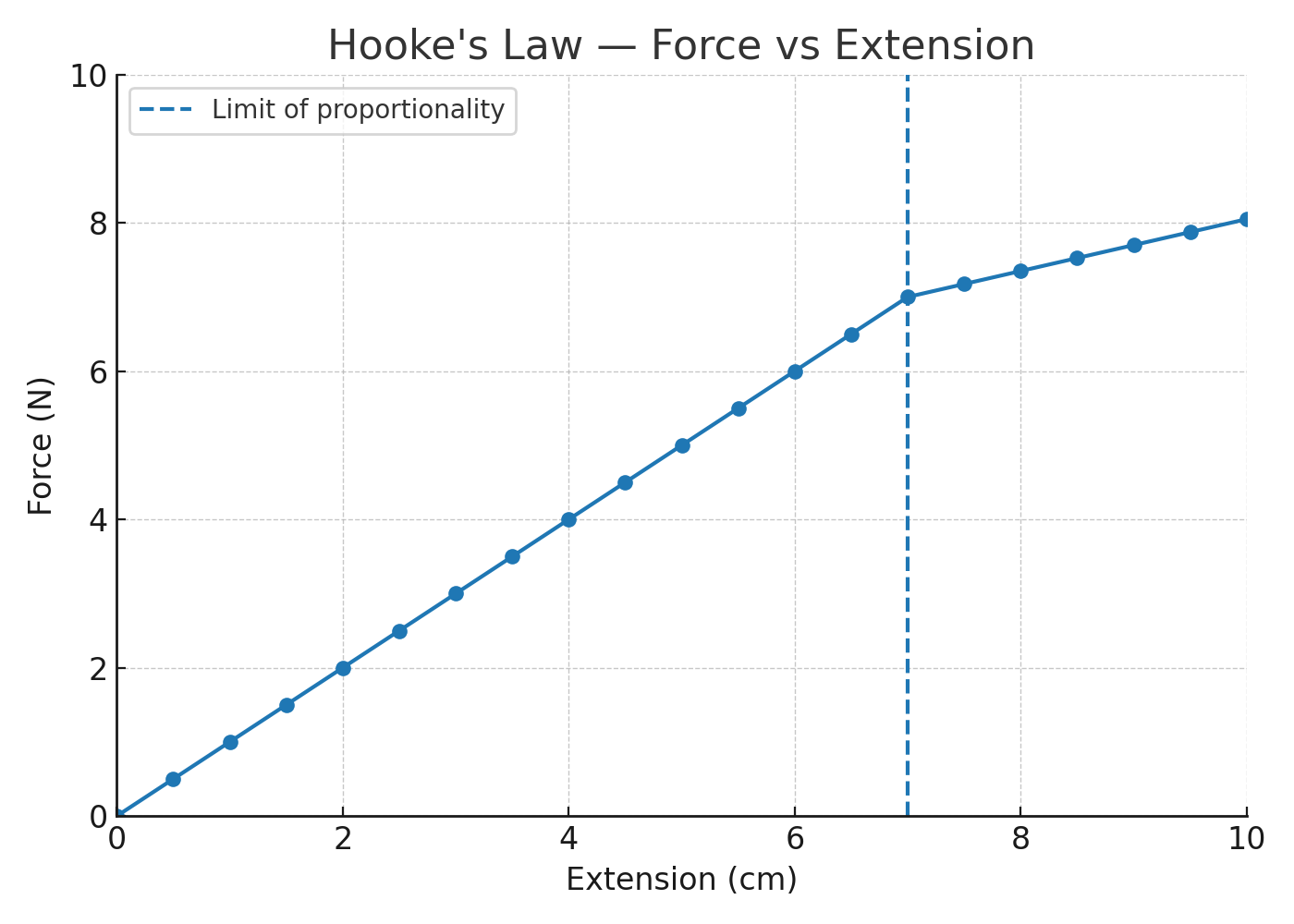
Force–extension graph for a spring: the initial straight-line region illustrates Hooke’s law, where force is proportional to extension. The slope of the linear region corresponds to the spring constant , and the marked “limit of proportionality” shows where the ideal-spring model begins to fail. Source
Zero extension corresponds to zero spring-force magnitude (in the ideal model).
Stretching and compressing behave symmetrically: the same size deformation produces the same size force.
The constant of proportionality
Spring constant: A measure of stiffness that sets how much force is produced per unit extension; larger values mean a stiffer spring.
The spring constant depends on the spring’s construction and material, but in the ideal model it stays constant over the range of motion you are considering.
Expressing the ideal-spring relationship mathematically
A proportional relationship is most useful when written as an equation for the spring force magnitude.
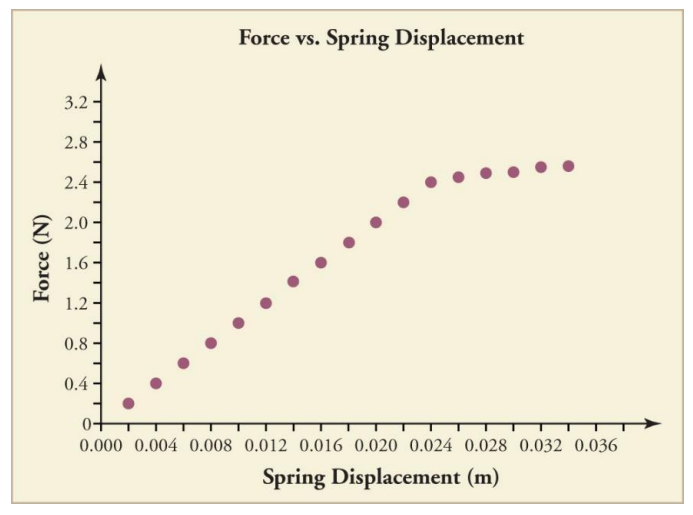
Graph of force versus displacement for an ideal spring from the OpenStax AP Physics lab manual. The straight-line trend visually encodes the proportional relationship used in , with the slope representing the spring’s stiffness. Source
= spring constant (N/m)
= extension or compression from natural length (m)
The direction of the spring force is determined by the physical situation and your sign convention: the spring’s force acts to reduce the deformation (it resists being stretched or compressed).
Using the ideal-spring idea in diagrams and reasoning
Interactions and forces to include
When a spring is attached to an object, the spring’s force is an external force on that object (part of the environment’s interaction).
Draw a single force from the spring on the object, labelled clearly (for example, “spring”).
Use the extension/compression to determine the force’s magnitude from the proportional relationship.
Assign the force direction based on whether the spring is stretched or compressed relative to its natural length.
Common modelling checks
Confirm you are using SI units (metres for deformation).
Ensure the spring is treated as massless when writing the object’s translational dynamics.
Verify the deformation is reasonable for a linear model; if the spring is drastically deformed, the “ideal” assumption may fail.
Practice Questions
(2 marks) A spring has spring constant . It is stretched by . State the magnitude of the spring force.
Uses (1)
Calculates (1)
(5 marks) A student hangs a mass from a vertical ideal spring and measures the spring’s natural length and stretched length. The natural length is . With the mass attached and at rest, the spring length is . The spring constant is . (a) Determine the extension of the spring. (1) (b) Determine the magnitude of the spring force. (2) (c) Explain, using the ideal-spring model, how the spring force would change if the extension were doubled. (2)
(a) (1)
(b) Uses (1)
(b) (1)
(c) States proportionality: (1)
(c) Doubling doubles (1)
FAQ
Measure force and extension for several loads and check whether a plot of force against extension is a straight line through the origin.
Small deviations at very low loads can come from hooks, slack, or measurement uncertainty.
A massive spring would mean different parts of the spring could accelerate differently, so the force could vary along its length.
The ideal model avoids needing to track the spring’s own kinetic energy and internal dynamics.
Very large deformations can cause material nonlinearity, coil contact, or permanent deformation.
Once the spring is altered, the same extension may no longer correspond to the same force.
It depends on convention. Many students use $x$ as a positive magnitude and assign direction separately.
If you use a signed $x$, your force direction must be consistent with your axis choice.
$k$ still represents stiffness in N/m, but its numerical value depends strongly on geometry (wire thickness, coil diameter, number of coils) and material properties.
Two springs made of the same material can have very different $k$ values.
