

AP Syllabus focus: 'When a charged object moves between two locations with different electric potentials, the object-field system has a change in electric potential energy.'
This topic connects a charge’s location to stored energy in an electric interaction. The key idea is that moving a charged object between points at different potentials changes the energy associated with that interaction.
Connecting potential and energy
Electric potential energy describes the stored energy associated with the position of a charged object in an electric interaction.
Electric potential energy: Energy associated with the position of a charged object in an electric environment; in AP Physics 2, it is treated as energy of the object-field system.
Electric potential energy does not belong to the charge alone. It depends on both the charge and where it is located relative to other charges that create the electric environment.
Electric potential difference compares two locations and tells how electric potential changes from one point to another.
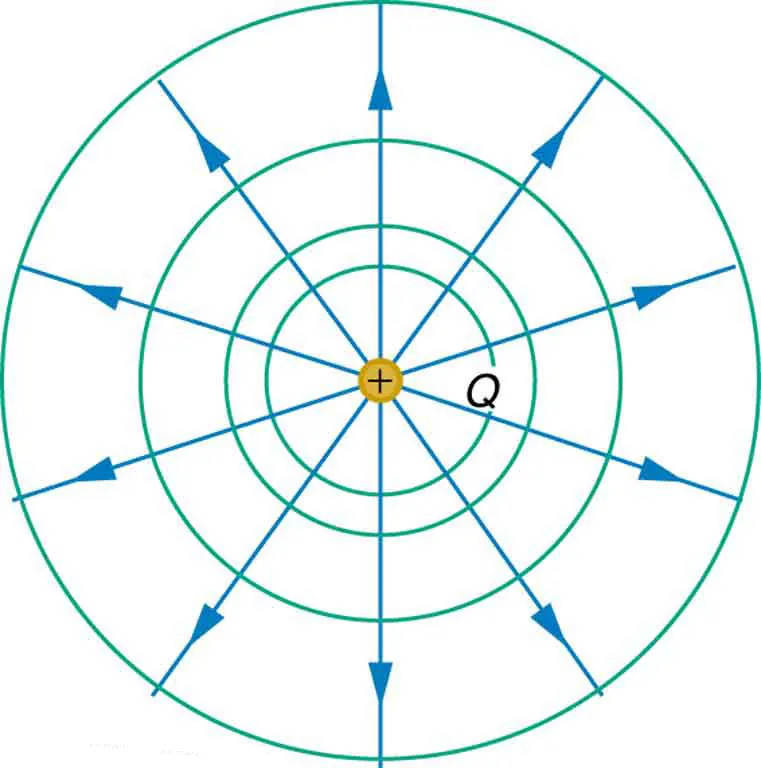
Equipotential lines (green) show sets of points with the same electric potential, while electric field lines (blue) indicate the direction a positive test charge would accelerate. The perpendicular relationship illustrates that motion along an equipotential produces no change in potential (so ), whereas motion across equipotentials changes and can change the system’s electric potential energy. Source
Electric potential difference: The difference in electric potential between two locations, measured in volts, that determines the change in electric potential energy per unit charge.
If a charged object moves from an initial location to a final location, the potential difference between those two points determines how the system’s electric potential energy changes. In this subsubtopic, the focus is on the change in energy caused by motion between locations with different electric potentials.
The key relationship
The essential algebraic relationship for this topic connects charge, potential difference, and change in electric potential energy.
= change in electric potential energy of the object-field system, J
= charge of the moving object, C
= electric potential difference between the final and initial locations, V
= electric potential at the final location, V
= electric potential at the initial location, V
This equation is algebraic, so the sign matters. A positive value of means the object-field system has gained electric potential energy. A negative value means the system has lost electric potential energy. If the initial and final locations have the same electric potential, then , so there is no change in electric potential energy.
Interpreting positive and negative changes
When using , the signs carry the physics. You determine whether electric potential energy increases or decreases by combining the sign of the charge with the sign of the potential difference.
If and , then .
If and , then .
If and , then .
If and , then .
A common mistake is to assume that moving to a higher electric potential always means a higher electric potential energy. That is only true for a positive charge.
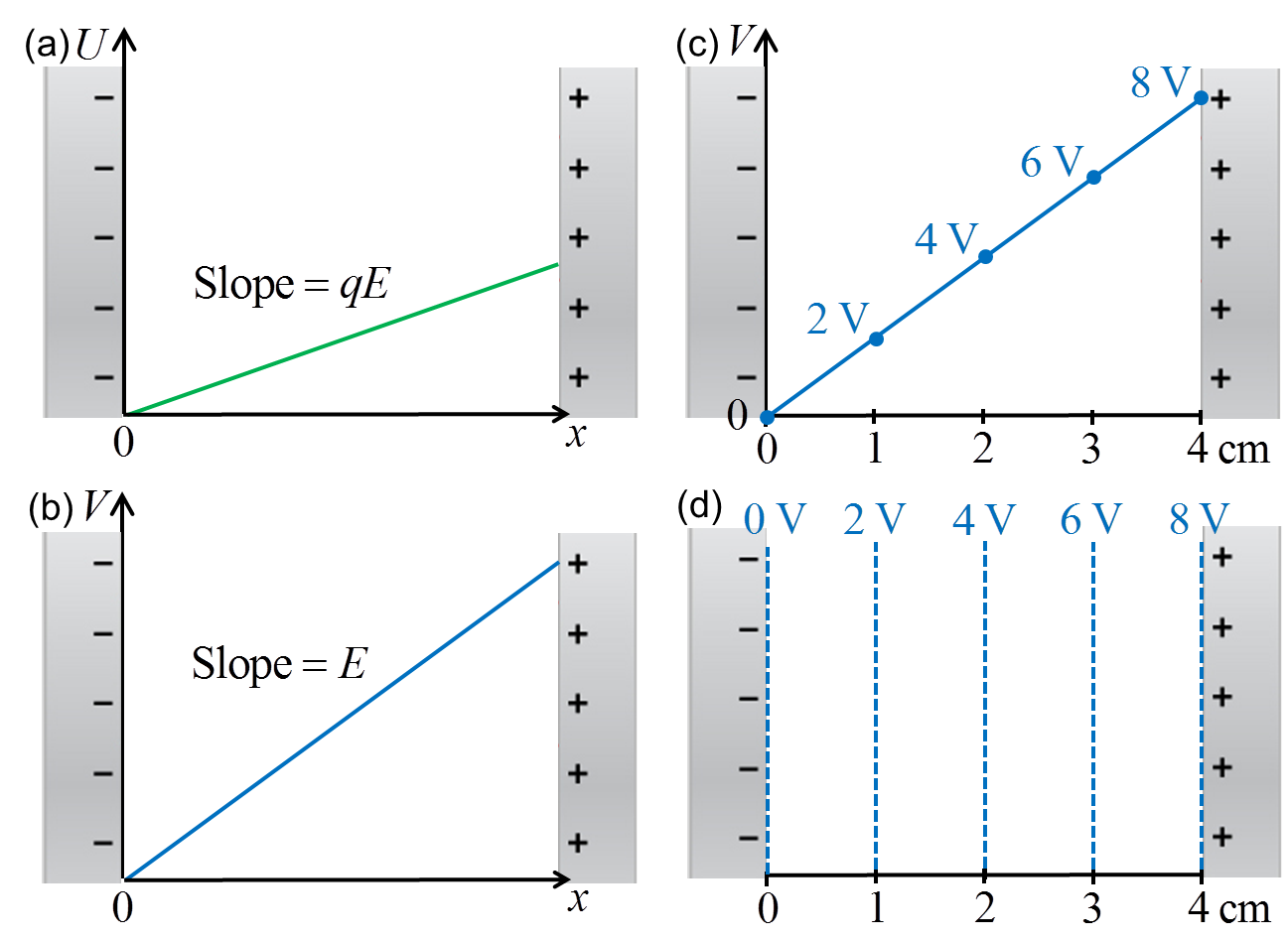
These paired graphs distinguish electric potential (set by the source charges/field) from electric potential energy (which depends on the moving charge). The figure highlights that reversing the sign of flips the slope of while leaving unchanged, making the sign logic in visually concrete. Source
Higher potential does not always mean higher energy
Electric potential is defined relative to a positive test charge. Because of that convention, a negative charge behaves oppositely when you relate potential to electric potential energy. A move to a higher electric potential increases the electric potential energy of a positive charge, but decreases the electric potential energy of a negative charge.
This is why the sign of the charge must always be included in the reasoning. The potential difference tells you something about the locations, but the charge tells you how strongly and in what sign the electric potential energy changes.
Why AP Physics uses the object-field system language
Electric potential energy is not treated as a property carried only by the object. Instead, it belongs to the object-field system. That means the charged object and the electric environment around it must be considered together.
When the object moves, the system configuration changes. Even if the surrounding source charges stay fixed, the interaction has changed because the object is now at a different location in the electric potential landscape. As a result, the electric potential energy of the system can change.
This language matters because it prevents a misleading idea. The charge does not simply “have” electric potential energy by itself at one point in space. The energy depends on the interaction between the object and the electric field environment represented by the electric potential.
What to pay attention to in problems
When answering questions about this relationship, focus on the following:
Identify the sign of the charge before doing any algebra.
Write the potential difference as unless the problem defines it differently.
Use the full signed equation: .
Keep units consistent: coulombs, volts, and joules.
Do not confuse electric potential with electric potential energy.
Remember that potential is a property of location, while potential energy change also depends on charge.
State whether the system’s electric potential energy increases or decreases.
Interpret the sign of your final answer in words, not just with a number.
Common mistakes
Students often reverse the order in , drop the sign of the charge, or mix up volts and joules. Another common error is treating a larger numerical potential as automatically meaning a larger electric potential energy. In this topic, the main quantity is the change in electric potential energy, and that change must be interpreted using both the potential difference and the sign of the moving charge.
Practice Questions
(2 marks)
A particle with charge moves from a point at to a point at . Determine the change in electric potential energy of the object-field system and state whether it increases or decreases.
1 mark for calculating
1 mark for calculating and stating that the electric potential energy increases
(5 marks)
A dust particle with charge moves from point at to point at .
(a) Calculate the potential difference .
(b) Calculate the change in electric potential energy of the object-field system.
(c) State whether the electric potential energy increases or decreases.
(d) Without repeating the full calculation, state how the answer to part (b) would change if the particle had charge instead.
1 mark for
1 mark for using
1 mark for
1 mark for stating that the electric potential energy increases
1 mark for stating that with a negative charge the change would be
FAQ
Electric potential is measured relative to a chosen zero level, not from an absolute minimum value.
If the chosen reference point is assigned $0\ V$, then locations where a positive test charge would have lower electric potential than that reference can be assigned negative values. The negative sign does not mean the physics is broken; it only describes the location relative to the chosen reference.
A volt measures electric potential, which is energy per unit charge.
The unit relationship is $1\ V = 1\ J/C$. That means a volt is not itself an energy. To find an energy change, you must multiply the potential difference by charge: $ \Delta U = q\Delta V $.
Changing the reference level shifts all potential values by the same constant amount.
That does not change the potential difference between two points, so it does not change $ \Delta U $. Physical predictions stay the same because the energy change depends on differences, not on the arbitrary zero level.
In this AP Physics 2 treatment, the change is found from $ \Delta U = q\Delta V $.
If the object’s net charge is zero, then $q=0$, so the calculated change in electric potential energy is zero even if the two locations have different electric potentials. The potential difference matters only when charge is present.
The important quantity is the difference between the two potentials, not how large each value is by itself.
Also, the energy change depends on both factors in $ \Delta U = q\Delta V $. So a small charge or a small potential difference can produce a small change in electric potential energy even when the listed potentials look numerically large.
