

AP Syllabus focus: 'Movement of a charged object between two points with different electric potentials produces a change in kinetic energy consistent with conservation of energy.'
When a charged particle moves through a potential difference, energy is not created or destroyed. Instead, energy shifts between electric potential energy and kinetic energy, changing the particle’s motion.
Energy Conservation in Electric Motion
A charged object moving through a region with different electric potentials can speed up or slow down because energy is transferred between electric potential energy and kinetic energy. If no other external work changes the total energy of the object-field system, the total remains constant.
When the object moves between two points, the important quantity is the difference in potential between the starting and ending locations.
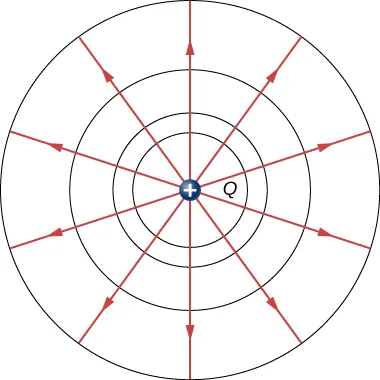
Equipotential lines mark locations of equal electric potential , while electric field lines indicate the direction a positive test charge would be pushed. Moving along an equipotential corresponds to , so no work is done by the electric force; moving across equipotentials corresponds to nonzero and therefore a change in energy. Source
Electric potential difference: The change in electric potential energy per unit charge between two points.
A larger potential difference means a larger potential-energy change for each coulomb of charge. The sign of the charge still matters, so the same potential difference can affect positive and negative objects in opposite ways.
= change in kinetic energy of the charged object, J
= change in electric potential energy of the object-field system, J
= charge of the object, C
= electric potential at the final point minus electric potential at the initial point, V
This relationship shows that any decrease in electric potential energy becomes an equal increase in kinetic energy, and any increase in potential energy comes from kinetic energy.
Reading the Signs Correctly
To use conservation of energy well, keep track of three signs: the sign of the charge, the sign of , and the sign of the energy change.
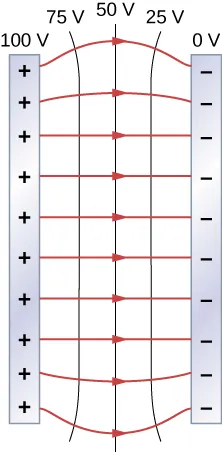
Parallel plates create an approximately uniform electric field between them, and the labeled equipotential lines show how changes from one plate to the other. Because the potential changes systematically across the gap, you can determine the sign of from direction of motion and then apply to predict speeding up or slowing down for positive vs. negative charges. Source
For a positive charge moving to a lower electric potential, is negative. Its potential energy decreases, so its kinetic energy increases.
For a positive charge moving to a higher electric potential, potential energy increases and kinetic energy decreases.
For a negative charge moving to a higher electric potential, is negative, so the kinetic energy increases.
For a negative charge moving to a lower electric potential, the kinetic energy decreases.
This is why you should not decide whether an object speeds up by looking only at whether the potential gets larger or smaller. You must also consider whether the charge is positive or negative.
Connecting Energy Change to Motion
A change in kinetic energy means a change in speed. If kinetic energy increases, the object speeds up. If kinetic energy decreases, the object slows down.
The amount of energy transferred depends on:
the magnitude of the charge
the size of the potential difference
the direction of motion relative to higher and lower potential
The energy transfer does not depend directly on the mass of the object. However, mass still affects how much the speed changes. The same kinetic-energy change causes a larger speed change for a smaller mass and a smaller speed change for a larger mass.
If a charge is released from rest, its later motion is determined by whether the electric potential energy decreases enough to produce kinetic energy. If the object is already moving, the potential difference can either add to its motion or oppose it. Conservation of energy works in both cases: existing kinetic energy combines with the energy transfer from the electric interaction to determine the later speed.
A Reliable Problem-Solving Process
When analyzing a moving charged object, use a consistent sequence:
Identify the charge, including its sign.
Determine the initial and final electric potentials.
Find whether the object's electric potential energy increases or decreases.
Use conservation of energy to determine whether kinetic energy increases or decreases.
If needed, relate the kinetic-energy change to the object's speed.
This method helps prevent one of the most common mistakes in this topic: mixing up electric potential with electric potential energy. Electric potential is a property of location in the electric field. Electric potential energy belongs to the object-field system and depends on both the location and the object's charge.
What Conservation of Energy Means Physically
The moving charge does not create kinetic energy from nothing. The energy comes from the electric interaction associated with the difference in potential between the two points. As the charge moves, the total energy of the system stays consistent with conservation of energy; only its form changes.
This idea is especially useful because it lets you predict motion without tracking the electric force at every point along the path.
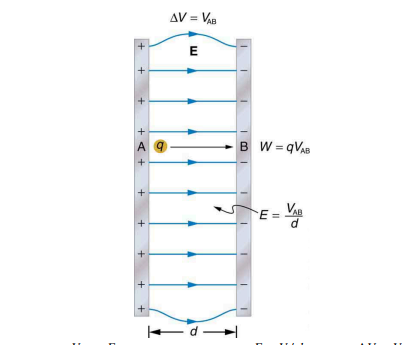
For parallel conducting plates, the electric field magnitude is approximately constant between the plates and relates to the potential difference by . This lets you connect a spatial model (plate separation ) to an energy model (potential difference ) when checking signs and magnitudes in conservation-of-energy problems. Source
If you know the charge and the potential difference between the initial and final positions, you can determine the energy change directly.
Because the analysis compares initial and final states, it often provides a faster route than a force-based approach. On AP problems, this is especially useful when the question asks how a particle’s speed changes after crossing a known potential difference.
Common Errors to Avoid
Ignoring the sign of charge: negative charges behave oppositely to positive charges for the same change in potential.
Treating volts as joules: volts are joules per coulomb, so charge must be included to find an energy change.
Assuming lower potential always means less potential energy: that is only true for a positive charge.
Forgetting the system viewpoint: the change is in the energy of the charged object-field system, not just the particle alone.
Equating force direction with energy change without checking endpoints: conservation of energy is based on the change between initial and final potentials.
Practice Questions
(2 marks)
A proton moves from point at to point at . State whether its kinetic energy increases or decreases, and briefly explain why.
1 mark for stating that the kinetic energy increases.
1 mark for explaining that a positive charge moving to a lower potential has a decrease in electric potential energy, so kinetic energy increases by conservation of energy.
A particle with charge and mass moves from point at to point at . At point , its speed is . Ignore all non-electric forces.
(a) Calculate the change in electric potential energy of the particle-field system.
(b) Determine the change in kinetic energy of the particle.
(c) Calculate the speed of the particle at point .
(a) 1 mark for finding .
(a) 1 mark for calculating .
(b) 1 mark for stating .
(c) 1 mark for finding initial kinetic energy and final kinetic energy .
(c) 1 mark for calculating .
FAQ
For electric forces in electrostatics, the energy transfer depends on the potential difference between the starting and ending points, not on the route taken between them.
That means a particle following two different paths between the same two potentials will have the same change in electric potential energy, so the same predicted change in kinetic energy, as long as no other forces do additional work.
A negative kinetic energy is not physically possible. It means the particle does not actually have enough energy to reach the stated final point.
In that situation, the particle would slow to zero speed before getting there and then reverse direction. On an exam, this usually means the particle cannot reach the final location without extra energy from some outside source.
Electric potential can be measured relative to any chosen zero reference. Shifting every potential in a problem by the same amount changes neither the physics nor the motion.
What matters for energy transfer is $\Delta V$, not the absolute value of $V$. Since $\Delta K = -q\Delta V$, the predicted change in kinetic energy stays the same no matter where the zero of potential is chosen.
An electron-volt is a unit of energy. One electron-volt is the energy change of a charge with magnitude $e$ moving through a potential difference of $1\ V$.
Numerically, $1\ eV = 1.60\times10^{-19}\ J$.
This unit is useful because the energies of electrons, protons, and ions are often very small in joules. Using electron-volts makes those energy changes easier to describe and compare.
Yes, but only if something besides the electric interaction also affects the energy balance.
For example, an external agent or another force could do work that exactly cancels the electric energy change. In a purely electric situation with no other work added or removed, moving between different potentials means the kinetic energy must change in a way consistent with conservation of energy.
