

AP Syllabus focus: 'The ideal gas model assumes random atomic velocities, negligible atomic volumes, elastic collisions, and forces only during collisions.'
The ideal gas model is a simplified particle description that helps explain gas behavior. Understanding its assumptions is essential because every later prediction about gases depends on them.
Modeling a gas
A gas contains an enormous number of particles moving continuously.
Because tracking every atom separately is impossible, physicists use a model that keeps the dominant features of gas behavior and ignores details that usually have only a small effect.
Although the syllabus refers to atoms, the same model is often applied to small molecules when they behave in the same simplified way.
Ideal gas: A model of a gas in which particles move randomly, have negligible volume, undergo elastic collisions, and exert forces on one another only during collisions.
An ideal gas is therefore not a special kind of substance. It is an approximation used when real particles are far enough apart and weakly interacting enough that the model gives a very good description.
Core assumptions of the ideal gas model
Random atomic velocities
In an ideal gas, atoms move with random velocities. This means there is no preferred direction of motion for the gas as a whole, even though each individual atom has its own speed and direction at any instant.
Random does not mean that all atoms have the same speed.
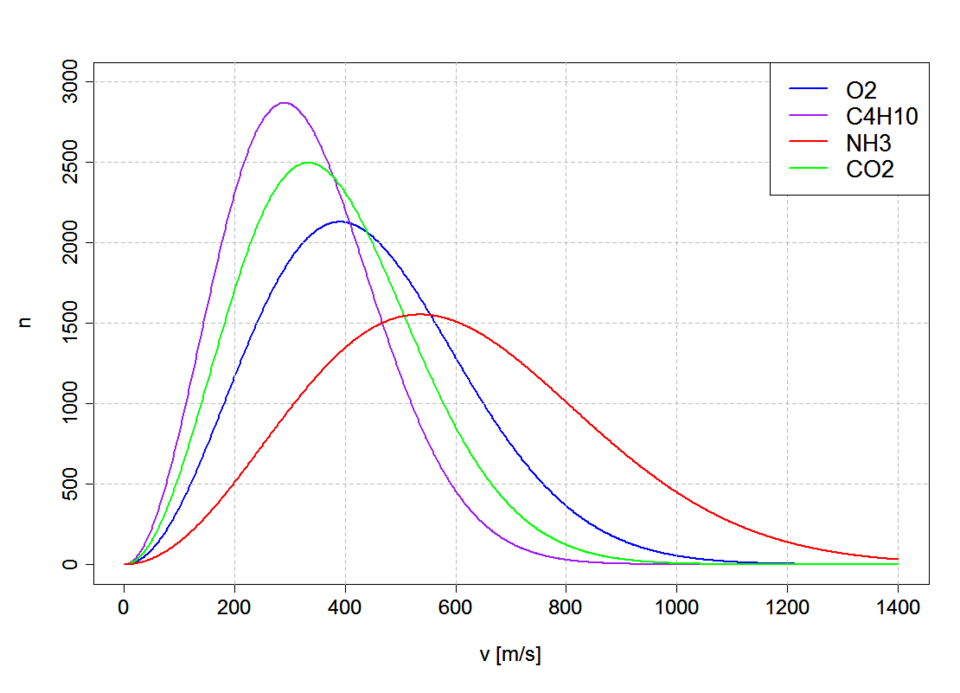
Maxwell–Boltzmann speed distributions for several gases at the same temperature (293.15 K). The curves show that particle speeds are spread over a range, with a most-probable speed and a long high-speed tail, so “random motion” does not imply identical speeds. Source
Instead, atoms move in many directions and continually change speed and direction as collisions occur. The motion is disordered rather than patterned.
This assumption is important because it makes the gas behave the same in every direction when there is no overall flow. Without random motion, one side of a container could behave differently from another for reasons unrelated to the gas’s overall state.
It also separates gas behavior from the behavior of solids and liquids, where particle motion is more constrained by neighboring particles.
Negligible atomic volumes
The model assumes that the actual size of each atom is negligible compared with the total volume occupied by the gas. Most of the container is treated as empty space through which particles move freely.
This does not mean atoms literally have zero size. It means their sizes are so small relative to the container that, for the purposes of the model, their own volumes can be ignored.
Because of this assumption, the gas is treated as if particles have room to move almost everywhere inside the container. It works best when particles are much farther apart than their own diameters, so crowding effects do not matter much.
Elastic collisions
Atoms in an ideal gas are assumed to undergo elastic collisions with one another and with the container walls. In these collisions, kinetic energy is not lost from the colliding system.
Elastic collision: A collision in which the total kinetic energy of the colliding objects remains constant.
An elastic collision does not mean each atom keeps the same kinetic energy. One atom can gain kinetic energy while another loses the same amount. What stays constant is the total kinetic energy of the colliding particles.
This assumption matters because it prevents collisions from permanently converting kinetic energy into other forms such as deformation or internal vibration within the idealized model. As a result, collisions redistribute energy among particles without removing it from their translational motion.
For wall collisions, the container is treated as part of the idealized interaction, so particles bounce rather than stick.
Forces only during collisions
The ideal gas model also assumes that particles exert forces only during collisions. Between collisions, atoms do not attract or repel one another in any significant way.
That means a particle traveling between collisions moves in a straight line at constant velocity unless it hits another particle or the wall.
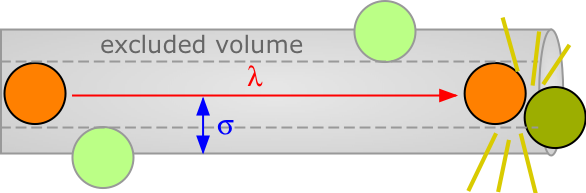
Mean free path diagram showing a molecule’s straight-line flight between collisions and the geometric “collision cross-section” idea. It concretely illustrates the ideal-gas assumption that particles move at constant velocity between brief collision events, with interactions treated as short-lived rather than long-range. Source
This greatly simplifies the microscopic picture of a gas.
If long-range forces were important, particles would begin speeding up or slowing down before contact. Then the model would have to include changes in potential energy as well as kinetic energy. By ignoring those interactions, the ideal gas model treats gas motion as a sequence of free flights interrupted by brief collisions.
This assumption also means particles do not clump together or remain bound to nearby neighbors.
Interpreting the assumptions carefully
Some common misunderstandings are worth avoiding:
Random velocities does not mean identical speeds.
Negligible volume does not mean particles have literally no size.
Elastic collisions does not mean no energy is exchanged between particles; it means the total kinetic energy is conserved in each collision.
Forces only during collisions does not mean collisions are impossible; it means the interaction is brief rather than long-range.
Why these assumptions matter
Together, these assumptions create a simple microscopic picture: tiny particles moving randomly through mostly empty space, bouncing elastically, and otherwise not interacting. This picture is powerful because it links particle motion to the large-scale behavior of gases.
It allows physicists to treat gas behavior without tracking detailed intermolecular forces or the exact shapes of particles. In AP Physics 2, the value of the model is not that it is perfect, but that it captures the main physics when the assumptions are good approximations.
When the model becomes less accurate
The ideal gas model becomes less reliable when its assumptions stop matching reality closely. If particles are packed closely together, their individual sizes are no longer negligible. If particles interact strongly at a distance, the assumption of forces only during collisions fails.
For many real gases, these departures become more important when particles are closer together or more strongly affected by intermolecular attraction. In those cases, the ideal gas model may still provide a rough first description, but it no longer gives a fully accurate microscopic picture.
Practice Questions
State two assumptions of the ideal gas model.
1 mark for each correct assumption, up to 2 marks.
Accept any two of:
particles have random velocities
particle volumes are negligible
collisions are elastic
forces act only during collisions
A scientist studies a gas sample in conditions where the particles are very close together and experience noticeable attractive forces before colliding.
Explain why the ideal gas model may not be appropriate for this sample. In your answer, refer to the assumptions of negligible particle volume, forces only during collisions, and elastic collisions.
1 mark: states that the ideal gas model depends on assumptions that may fail for a real gas
1 mark: explains that when particles are very close together, their volumes are no longer negligible
1 mark: explains that attractive forces acting before contact violate the assumption that forces act only during collisions
1 mark: links these violated assumptions to the gas no longer matching the idealized particle picture
1 mark: correctly notes that even if collisions are still approximately elastic, that alone does not make the gas ideal
FAQ
Noble gases are usually better approximations to an ideal gas because their atoms are monatomic and have relatively weak intermolecular attractions.
Polar gases have uneven charge distribution, so they attract one another more strongly. That makes the assumption of forces only during collisions less accurate.
The model ignores forces during most of a particle’s path through the gas.
During the extremely short collision interval, a strong interaction acts and changes the particles’ motion. So the assumption means “no significant long-range forces between collisions,” not “no force at the instant of impact.”
Dry air is mostly $N_2$ and $O_2$, and under ordinary conditions those molecules are far enough apart that their sizes and attractions usually have only a small effect.
If each component approximately satisfies the ideal-gas assumptions, and the interactions between unlike molecules are also weak, the mixture can still behave very close to ideally.
Perfectly elastic collisions are mainly an idealization. Real collisions can transfer tiny amounts of energy into internal motion or other effects.
However, for many gas particles under ordinary conditions, those losses are small enough that treating collisions as elastic gives an excellent approximation.
Helium atoms are small, nonpolar, and weakly interacting, so the ideal-gas assumptions often work well for them.
Water molecules in steam are polar and can attract one another much more strongly. That makes the assumption of forces only during collisions less accurate, so steam tends to show non-ideal behavior sooner.
