

AP Syllabus focus: 'An ideal gas relates pressure, volume, number of moles or atoms, and temperature using PV = nRT = NkBT.'
The ideal gas law connects the measurable properties of a gas in one compact relationship. For AP Physics 2, it is the main tool for predicting how pressure, volume, temperature, and gas amount change together.
Ideal gas law: A model relationship that connects a gas’s pressure, volume, temperature, and amount of gas.
This single law gives a compact way to describe a gas state and to predict how that state changes when one or more variables are altered.
The ideal gas relationship
An ideal gas is described by four macroscopic quantities: pressure, volume, temperature, and amount of gas. If one of these changes, at least one other quantity must also change unless gas is added or removed.
= pressure, measured in pascals,
= volume, measured in cubic meters,
= amount of gas, measured in moles,
= ideal gas constant,
= number of atoms or molecules
= Boltzmann constant,
= absolute temperature, measured in kelvins,
The two forms express the same physics. Use when the amount of gas is given in moles, and use when the amount is given as a number of particles.
Meaning of the variables
Pressure and volume
Pressure describes how strongly a gas pushes on its container.
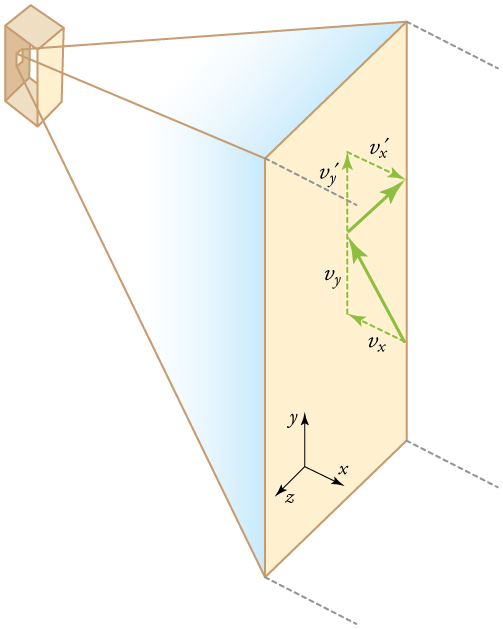
A kinetic-theory diagram showing a molecule colliding elastically with a container wall and reversing its perpendicular momentum component. The image illustrates how many such collisions produce a measurable force per area (pressure), and why higher particle speed (temperature) or more particles increases pressure. Source
Volume is the space available to the gas. For a fixed amount of gas at a fixed temperature, pressure and volume are inversely related.
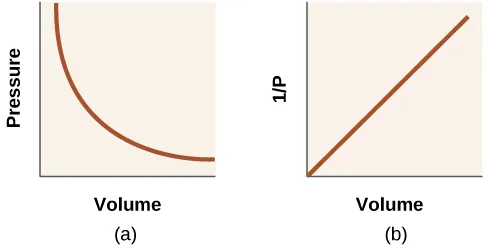
Boyle’s law data shown as (a) a hyperbolic vs. curve and (b) a linear plot using an inverse variable. It reinforces that at constant and , decreasing volume increases pressure so that remains constant for the same gas sample. Source
If the gas is compressed into a smaller volume, its pressure increases. If the volume increases, its pressure decreases. In proportional form, this is when and are constant.
This inverse relationship matters in many AP problems because an expansion or compression changes the gas state even when no gas is added and no gas is removed.
Temperature and amount of gas
In gas-law problems, temperature must be an absolute temperature, so it must be written in kelvins, not degrees Celsius. Ratios such as only make physical sense when temperature is measured from an absolute zero point.
For a fixed amount of gas at constant volume, pressure is directly proportional to temperature: . Heating the gas raises the pressure because the same gas remains in the same space while its temperature increases.
For a fixed amount of gas at constant pressure, volume is directly proportional to temperature: . Heating the gas then causes it to occupy more space.
The amount of gas can be expressed as moles, , or as the number of atoms or molecules, . If temperature and volume stay constant, increasing the amount of gas increases the pressure. If pressure and temperature stay constant, adding more gas requires a larger volume.
Using the two forms of the law
The form is usually most convenient when a problem gives the gas amount in moles. The form is more useful when the problem refers to individual atoms or molecules.
A key idea is that the gas type does not appear directly in the equation. If two different gases are both treated as ideal, the same mathematical relationship applies to both. What matters is the gas state: pressure, volume, temperature, and amount.
Rearranging the ideal gas law
You should be comfortable solving the ideal gas law for any variable. For example, pressure can be written as , volume as , and temperature as . The equation is the same physical law in each case; only the unknown changes.
When the same sample of gas changes from one state to another without any change in gas amount, the law can be compared between two states as . This is useful because the constants cancel, leaving a direct relationship among initial and final conditions.
Proportional reasoning
Many AP questions can be answered without full substitution. If and are constant, doubling doubles . If and are constant, tripling triples . If and are constant, doubling doubles .
This kind of reasoning is especially helpful on conceptual questions. The ideal gas law combines several simpler gas relationships into one statement, so it lets you predict whether a quantity should increase, decrease, or remain unchanged before doing any algebra.
Problem-solving approach
Start by identifying which quantities are known and which one must be found. Then determine whether the gas amount stays constant or changes. After that, decide whether a direct substitution into is best or whether a comparison between two states is simpler.
This prevents common mistakes, such as treating Celsius values as if they were absolute temperatures or assuming that pressure and volume can change independently when the amount of gas and temperature are fixed.
Units and careful setup
Correct units matter. In AP Physics, the safest choice is to use SI units:
pressure in
volume in
temperature in
amount in when using
If a problem gives volume in liters or pressure in kilopascals, convert carefully before substituting unless a consistent constant is provided. The ideal gas law is algebraically simple, so many errors come from units and setup rather than from the physics itself.
Practice Questions
A rigid container of volume holds of an ideal gas at . Calculate the gas pressure. Use .
1 mark for using
1 mark for a correct answer of or equivalent
A sample of ideal gas occupies at a pressure of and a temperature of .
(a) Determine the number of moles of gas in the sample.
(b) The gas is heated to while the pressure remains constant. Determine the new volume.
(c) State whether the number of atoms in the sample changes during this process. Justify your answer.
Use .
(a) 1 mark for using
(a) 1 mark for or equivalent
(b) 1 mark for recognizing that at constant pressure or using
(b) 1 mark for
(c) 1 mark for stating that the number of atoms does not change because the same gas sample is being heated, with no gas added or removed
FAQ
The ideal gas law uses absolute temperature, not a relative scale. Kelvin starts at absolute zero, so a value like $200\ K$ is physically twice $100\ K$ in a way that $200^\circ C$ is not twice $100^\circ C$.
If Celsius were used directly, ratios and proportional relationships would give incorrect results. That is why AP Physics gas-law calculations always require converting to $K$ first.
The variable $n$ counts gas amount in moles, while $N$ counts the actual number of particles. They are related by $N=nN_A$, where $N_A$ is Avogadro’s number.
Because of that, the constants are also related: $R=N_Ak_B$. So $PV=nRT$ and $PV=Nk_BT$ are not different laws; they are two versions of the same relationship.
First convert the mass to moles using the molar mass: $n=m/M$, where $m$ is the sample mass and $M$ is the molar mass.
Once you have $n$, substitute it into $PV=nRT$. This is common when the problem gives a chemical identity, such as helium or oxygen, along with a sample mass.
Yes. If two gases have the same $P$, $V$, and $T$, then they have the same number of moles according to the ideal gas law.
However, equal moles do not always mean equal mass. A mole of a heavier gas has more mass than a mole of a lighter gas, so the samples can match in gas-law variables while still having different masses.
The ideal gas law requires absolute pressure, because zero pressure in the equation means no pressure at all, not just no pressure above atmospheric pressure.
If a gauge pressure is given, add atmospheric pressure first: $P_{absolute}=P_{gauge}+P_{atmospheric}$. Then use that absolute pressure in $PV=nRT$.
