

AP Syllabus focus: 'The net charge or charge distribution of a system can change in response to the presence of, or changes in, the charge distribution of other systems.'
This subtopic focuses on a central electrostatic idea: charged systems do not behave independently. Nearby objects can alter how charge is arranged, and under some conditions can alter the total charge assigned to a system.
Interacting systems
In electrostatics, a system is the object or collection of objects chosen for analysis. The syllabus statement emphasizes that a system’s electrical state depends on other systems around it. If another object has charge, or if its charge distribution changes because it moves or is rearranged, then the electric forces acting on the chosen system also change. That response can appear as a different net charge, a different charge distribution, or both.
A useful starting point is to separate the idea of total charge from the idea of where that charge is located.
Net charge: The algebraic sum of all positive and negative charge in a system.
The phrase “algebraic sum” matters because positive and negative charges are added with signs. A system can contain many charges and still have zero net charge if the positive and negative amounts balance.
Charge distribution: The way electric charge is arranged in space within or on a system.
Charge distribution describes location, not just amount. Two systems can have the same net charge but different charge distributions, and therefore behave differently in an electric interaction. This is why electrostatics is not only about how much charge exists, but also about where that charge is concentrated.
Net charge versus charge distribution
A system can respond to other systems in more than one way. These possibilities should be kept distinct in AP Physics 2 Algebra.
Only the charge distribution changes: the total charge stays the same, but the charge becomes arranged differently.
Only the net charge changes: the total amount of charge in the chosen system changes.
Both change: the total charge changes and the remaining charge is arranged differently than before.
A very important idea is that a system can remain electrically neutral and still experience a significant change in charge distribution.
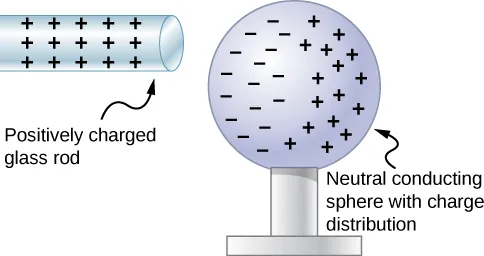
A positively charged rod brought near a neutral conducting sphere causes mobile electrons in the sphere to shift toward the rod, leaving the far side relatively positive. The sphere’s net charge is still zero, but its charge distribution becomes polarized, producing an induced dipole and changing the forces in the interaction. Source
Neutral does not mean “unchanged,” and it does not mean the charge must stay spread out uniformly. It only means the total positive and negative charge still adds to zero.
Why other systems matter
Charges exert electric forces on other charges. Because of that, the presence of a nearby charged system can alter the forces felt at different locations inside the chosen system. If the external system changes position or its own charge distribution changes, then the pattern of electric forces changes as well. The chosen system may then readjust until a new arrangement is reached.
This means electrostatic situations are often interactive.
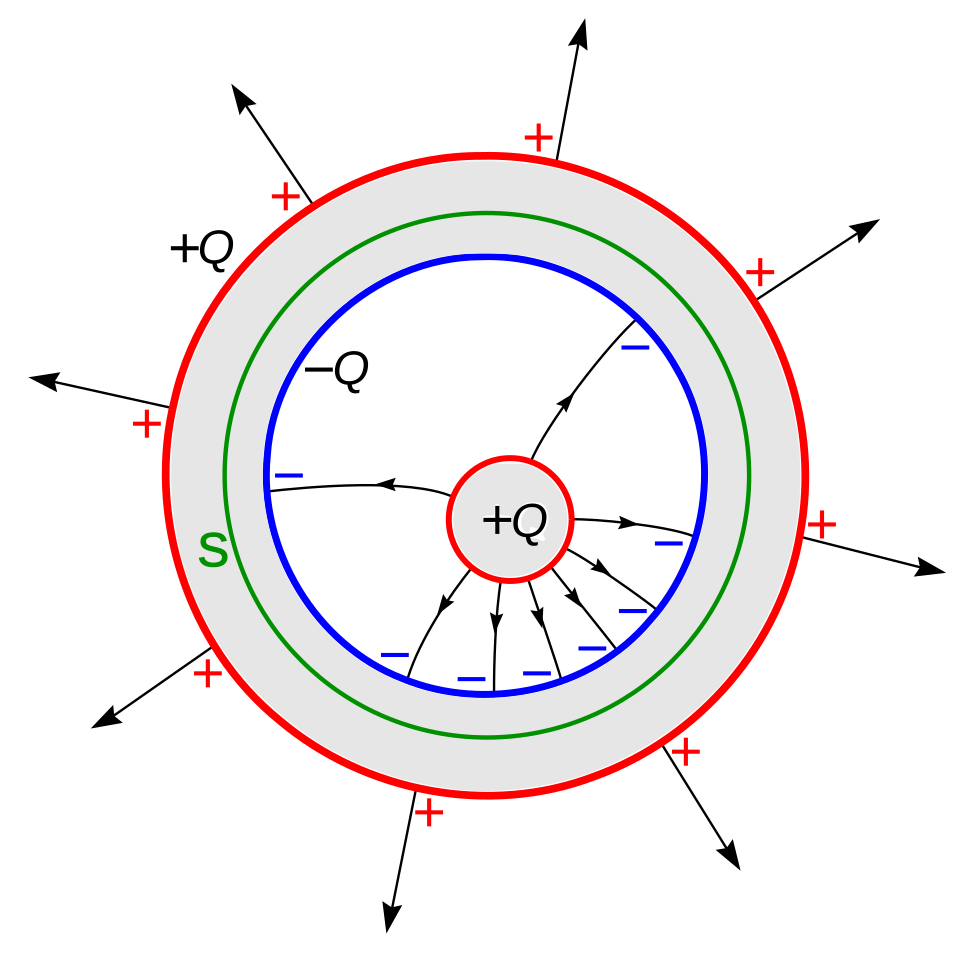
A charged object placed inside a conducting shell causes charges in the conductor to rearrange so that induced charge appears on the inner surface and an equal-magnitude induced charge appears on the outer surface. The diagram highlights how the presence of another system reshapes the conductor’s surface charge distribution and the surrounding electric field pattern. Source
One system does not simply “have charge” by itself in a vacuum of ideas; its observed charge arrangement may depend on what is nearby. When the surroundings change, the chosen system may also change.
The response does not have to involve a change in total charge. Sometimes the same total amount of charge is merely shifted to different regions of the system. In other cases, the chosen system may end up with a different net charge. For AP purposes, the key skill is recognizing which quantity changed and being able to state that clearly.
The importance of the chosen system
Many mistakes come from not identifying the system boundary. In physics, whether a system’s net charge changes depends on what is included inside that boundary.
If the chosen system is a single object, then its net charge changes only if charge enters or leaves that object.
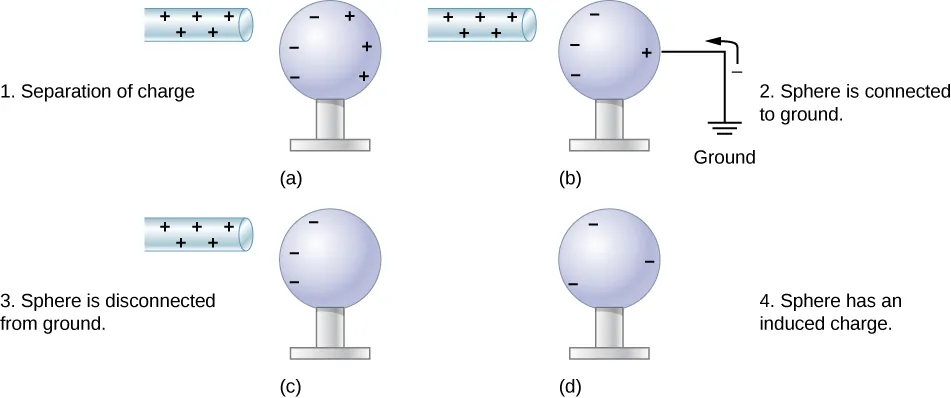
This sequence shows charging by induction with grounding: the sphere first polarizes (distribution changes with no net charge change), then gains electrons through the ground connection (net charge changes), and finally ends with a uniform excess negative charge after the rod is removed. It’s a concrete example of how the system boundary and charge transfer determine whether net charge, charge distribution, or both change. Source
If the chosen system is larger and includes multiple interacting objects, then internal rearrangements between the parts may change the charge of each object while not changing the overall charge of the larger system.
This is why the words in the prompt matter. A question may ask about:
one object,
a pair of objects,
or the entire interacting setup.
A correct response must match that choice. For example, if another charged system is brought nearby, the selected object may show a new charge distribution even if its own net charge stays the same. If the system boundary is changed, the description of what changed may also change.
Describing charge changes precisely
Strong AP responses use precise language. Rather than saying “the object changes charge” in a vague way, state exactly what changed.
Useful habits include:
naming the system before describing what happens,
stating whether the change is in net charge, charge distribution, or both,
connecting the change to the presence of another system or to a change in that system’s charge distribution,
avoiding the assumption that a neutral object must have a uniform distribution of charge,
explaining whether the response is due to charge being rearranged within the system or due to charge crossing the system boundary.
Another important point is that the response may continue as the external situation changes. If a nearby system is moved, rotated, or otherwise altered, the chosen system may adjust again. So charge distribution is often best thought of as something determined by the full electrostatic environment, not by the object alone.
When reading or writing about electrostatics, always ask:
What system is being discussed?
What other charged systems are nearby?
Did the total charge of the chosen system change?
Did only the arrangement of that charge change?
What changed in the surroundings that caused the response?
Practice Questions
A neutral conducting sphere is brought near a positively charged object, but the two do not touch.
State what happens to the sphere’s charge distribution and state whether the sphere’s net charge changes.
1 mark: States that the charge distribution becomes nonuniform, with negative charge shifted closer to the positive object and positive charge shifted farther away.
1 mark: States that the sphere’s net charge does not change and remains zero.
Object A is initially neutral. A charged object B is brought near A, held in place, and then moved farther away. No charge crosses the boundary of object A at any time.
Explain how the presence and motion of B can change A. In your answer, distinguish clearly between net charge and charge distribution, and comment on why the choice of system matters.
1 mark: States that the presence of B changes the electric forces acting on charges in A.
1 mark: States that A’s charge distribution changes while B is nearby.
1 mark: States that A’s net charge does not change because no charge enters or leaves A.
1 mark: States that when B is moved away, A’s charge distribution changes again or returns toward a more even arrangement.
1 mark: Explains that the description depends on the chosen system, since analyzing A alone is different from analyzing a larger system containing both A and B.
FAQ
Force depends on how charge is arranged in space, not only on the total amount.
If charge shifts so that more of it is concentrated on one side of an object, the electric effect near that side can change noticeably. A nearby object may then feel a stronger force, a weaker force, or even a force in a different direction, despite no change in net charge.
No. Symmetry of shape does not guarantee symmetry of charge arrangement.
A symmetric object can develop an asymmetric charge distribution if the surrounding charge distribution is asymmetric. The external environment matters. A shape may be perfectly balanced, but a nearby charged system can still make one region of the object respond differently from another.
Yes. Even a tiny displacement of charge can change the electric conditions around an object.
This is especially important when discussing nearby interactions. A small internal rearrangement may produce a measurable effect on force, field, or potential in the space around the system, even though the object’s total charge remains unchanged.
It emphasizes causation. The change in one system is linked to the presence or altered charge distribution of another system.
This wording helps students avoid treating charge patterns as fixed properties. In many electrostatic situations, the observed arrangement of charge is a response to the surrounding electrical environment.
One clue is that the object interacts differently with nearby charges after another system is brought close, even though no charge was added or removed.
Another clue is that the effect disappears or changes when the nearby system is moved. That kind of reversible behavior often indicates a redistribution of existing charge rather than a permanent change in net charge.
