

AP Syllabus focus: 'Electric permittivity measures how a material polarizes in an electric field. It depends on how easily electrons rearrange; charge carriers move easily in conductors but not in insulators.'
Materials do not all respond to electric fields in the same way. Their microscopic charge motion determines whether they polarize slightly, redistribute charge rapidly, or resist charge motion almost entirely.
Material Response to Electric Fields
Electric permittivity is the material property that describes how strongly a substance responds to an electric field by rearranging charge.
Electric permittivity: A property of a material that indicates how readily the material polarizes when an electric field is present.
When an electric field is applied, positive and negative charges feel forces in opposite directions. The resulting rearrangement may be very small or very large, depending on the material. A material whose charges can shift more easily shows a stronger response to the same external field.
In AP Physics 2 Algebra, permittivity is mainly a qualitative idea. It connects the microscopic behavior of electrons inside matter to the macroscopic electrical behavior of the whole object. The key question is simple: how easily can charge within the material be rearranged?
Not every charge in a substance moves in the same way. In some materials, electrons are tightly bound to atoms or molecules. In other materials, some charge carriers can move through the material much more freely. This microscopic difference explains why conductors and insulators behave so differently.
Polarization of Neutral Matter
Polarization is the internal separation or shifting of positive and negative charge within a material caused by an external electric field.
Polarization: A change in charge distribution within a material in which positive and negative charge shift relative to each other without necessarily changing the object's net charge.
A polarized object can still be neutral overall. One region becomes slightly more negative and another becomes slightly more positive, but the total positive and negative charge in the object is unchanged. Because of this, polarization should not be confused with charging.
Microscopic Picture
Inside atoms, positive charge is concentrated in the nucleus and negative charge belongs to electrons. An external electric field tends to pull these opposite charges in opposite directions.
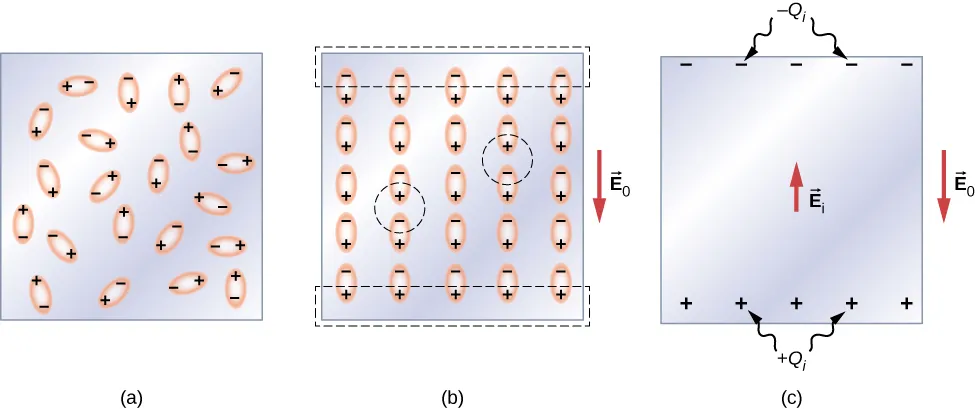
A molecular model of dielectric polarization: without an external field, dipoles are randomly oriented, but an applied field aligns them, producing bound surface charge at the material’s faces. The diagram also shows the induced field inside the dielectric opposing the applied field, capturing how polarization reduces the net internal field. This is the microscopic picture behind why higher-permittivity insulators polarize more strongly for the same applied field. Source
If electrons shift only a small amount relative to the nuclei, the polarization is weak.
If electrons are easier to displace, the polarization is stronger.
Among insulating materials, stronger polarization corresponds to greater permittivity.
Polarization often involves only tiny displacements within atoms or molecules. Electrons do not need to leave the object. This is why even a neutral object can respond to a nearby charged object.
Materials with Mobile Charge Carriers
A conductor is a material in which charge carriers can move easily through the substance.
Conductor: A material that contains charge carriers able to move relatively freely in response to an electric field.
In a conductor, an applied electric field can drive mobile charge carriers across noticeable distances inside the material. Metals are common examples because some electrons are not tightly attached to individual atoms. Those electrons can shift through the solid much more easily than electrons in most insulating materials.
Because charge carriers move easily, a conductor can redistribute charge quickly when exposed to an electric field.
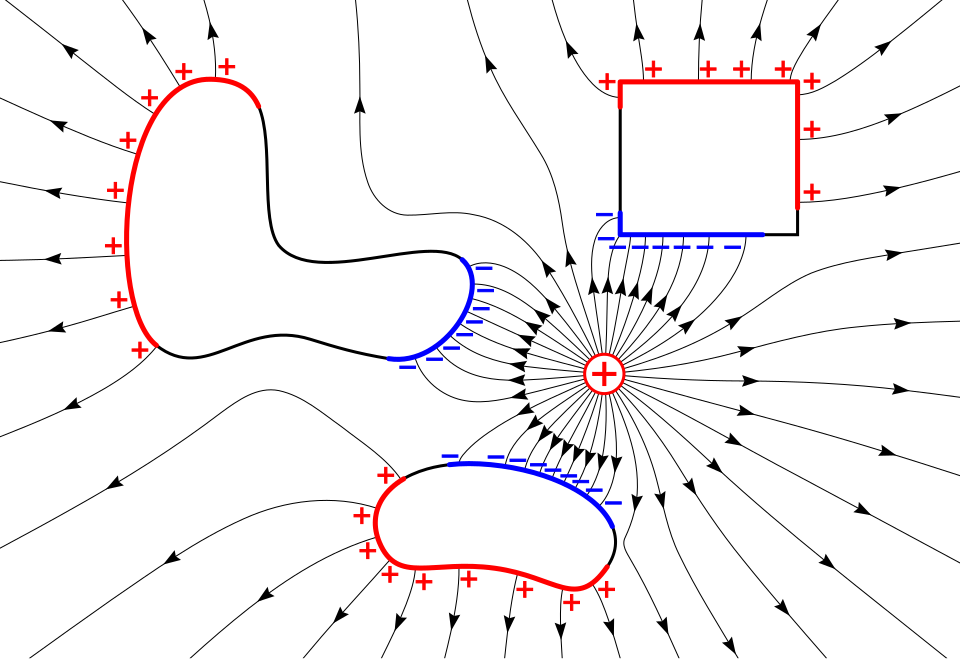
Electrostatic induction in a conductor: a nearby external charge drives mobile charges to redistribute onto the conductor’s surface, creating induced negative and positive regions. The labeled field lines illustrate how the induced surface charges reshape the net electric field and prevent electric field penetration into the conductor’s interior at equilibrium. This directly supports the idea that conductors respond via large-scale charge motion rather than tiny bound-charge shifts. Source
The material's response is therefore not limited to tiny local distortions within atoms. Instead, charge can shift across larger regions of the object. This makes conductors especially responsive to nearby charged objects and especially effective at transferring charge from place to place.
The important AP idea is that easy charge motion leads to strong redistribution. In a conductor, the presence of mobile charge carriers dominates the electrical behavior.
Materials with Bound Charge Carriers
An insulator is a material in which charge carriers are not free to move easily through the substance.
Insulator: A material in which charges are generally bound to atoms or molecules and cannot move freely through the material.
In an insulator, electrons usually remain associated with particular atoms or molecules. A field can still distort their positions slightly, so the material can polarize, but the charges do not flow freely through the entire substance. Rubber, glass, and plastic are familiar examples.
Because charge carriers are not mobile on a large scale, charge placed on an insulator tends to remain localized. However, an insulator still responds electrically by developing small internal shifts of charge. This means an insulator is not electrically inactive; it simply responds differently from a conductor.
Comparing Material Behavior
Both conductors and insulators can respond to an electric field, but the mechanism is different.
Conductors: respond mainly through the motion of mobile charge carriers.
Insulators: respond mainly through small shifts of bound charges within atoms or molecules.
Neutral objects of either type: can show charge separation when an external electric field is present.
Permittivity helps describe how strongly a material polarizes. For insulators, it is especially useful for comparing the degree of polarization produced by the same electric field. For conductors, the ease of charge motion is the dominant feature to remember.
Common Mistakes to Avoid
Students often confuse several related ideas.
Polarization is not the same as gaining net charge. A polarized object can still have zero net charge.
Insulator does not mean charges never move at all. Small internal shifts are still possible.
Conductor does not mean every charge is free. It means enough charge carriers are mobile to allow substantial redistribution.
Permittivity describes response to an electric field. It is a material property, not just a vocabulary term.
Why These Ideas Matter
These ideas explain why materials do not all behave the same way near charged objects. They help account for why metals redistribute charge quickly, why plastics can hold localized charge, and why neutral matter can still be affected through polarization.
Practice Questions
A neutral glass rod is brought near a negatively charged balloon. Describe what happens to the charges inside the glass rod, and state whether the rod gains a net charge.
1 mark: States that the charges in the rod shift slightly, or that the rod becomes polarized.
1 mark: States that the rod does not gain a net charge and remains overall neutral.
A student brings the same positively charged object near two neutral spheres. Sphere M is metal and sphere R is rubber.
(a) Explain how the charge carriers respond in sphere M. (2 marks)
(b) Explain how the charge carriers respond in sphere R. (2 marks)
(c) Identify which sphere would allow charge to move more easily if touched by a charged rod, and justify your answer. (1 mark)
(a) 1 mark: States that sphere M has mobile charge carriers.
(a) 1 mark: States that charge redistributes across the metal sphere in response to the external electric field.
(b) 1 mark: States that in rubber the charges are not free to move through the material.
(b) 1 mark: States that rubber can still polarize through small internal shifts of charge.
(c) 1 mark: Identifies sphere M and justifies that metals are conductors, so charge carriers move more easily.
FAQ
Plastic is an insulator, so excess charge does not move easily through it. That makes it harder for the charge to spread out and leak away quickly.
A metal comb has mobile charge carriers. If it is connected to your hand or surroundings, charge can move off the comb much more easily.
Yes. Under ordinary conditions, air is usually a good insulator because it has very few free charge carriers.
If the electric field becomes strong enough, air molecules can ionize. Once that happens, air no longer acts like a good insulator, and a spark or lightning discharge can occur.
In nonpolar molecules, the electric field mainly distorts the electron distribution. The centers of positive and negative charge shift slightly apart.
In polar molecules, there is already an uneven charge distribution. An external field can both distort the molecule and rotate it so its existing dipole lines up more with the field.
Yes. Electrical behavior can change with temperature, moisture, or impurities.
For example:
Wet materials often conduct better than dry ones.
Heating can increase conductivity in some materials.
Added impurities can create more charge carriers.
So “conductor” and “insulator” describe behavior, but that behavior can depend on conditions.
A dielectric is an insulating material considered specifically for how it polarizes in an electric field.
The word emphasizes the material’s response, not just its poor conductivity. A dielectric can still be very important electrically because its polarization affects how strongly the material responds to the field.
