

AP Syllabus focus: 'Newton's second law states that the acceleration of a system's center of mass is proportional to the net force and points in the same direction.'
Newton’s second law for systems connects forces to the motion of the center of mass, giving a powerful way to predict how complex objects or collections of objects accelerate.
Core idea
System-level motion
When Newton’s second law is applied to a system, the most important quantity is the motion of the center of mass rather than the motion of every particle inside the system.
Center of mass: The point whose motion represents the overall translational motion of a system, as if the system’s mass were concentrated there.
For translational motion, a complicated system can often be treated as though it were a single object located at its center of mass.
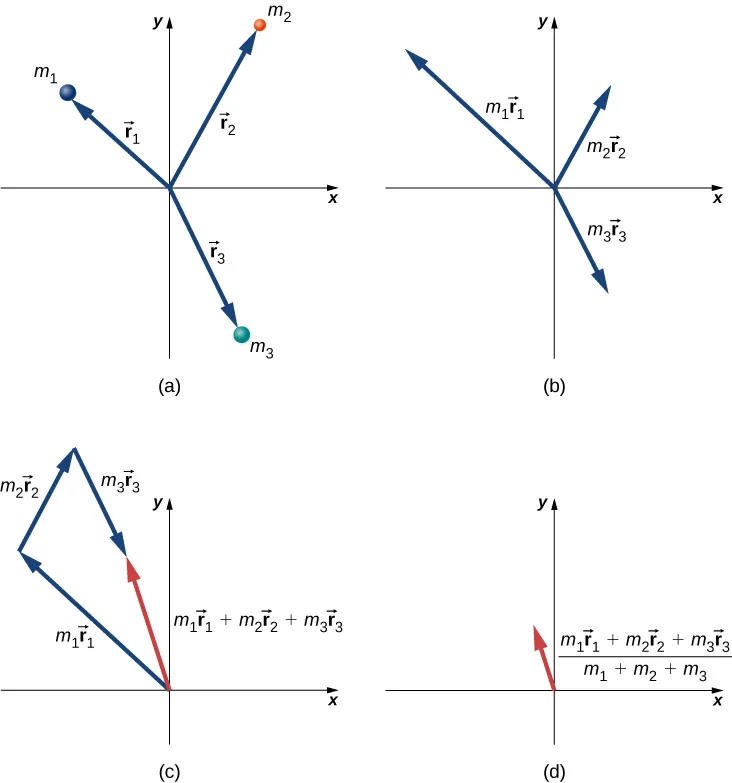
A vector-construction diagram for the center of mass of three particles: the position vectors are scaled by mass, added, and then divided by the total mass to locate the center of mass. It visually encodes the idea that the system’s translational motion can be represented by a single point even when the masses are distributed in space. Source
This does not mean every part of the system has the same acceleration. It means there is one acceleration, called , that describes how the system as a whole responds to external influences.
The force that matters is the net external force, meaning the vector sum of all forces exerted on the system by objects outside the system.
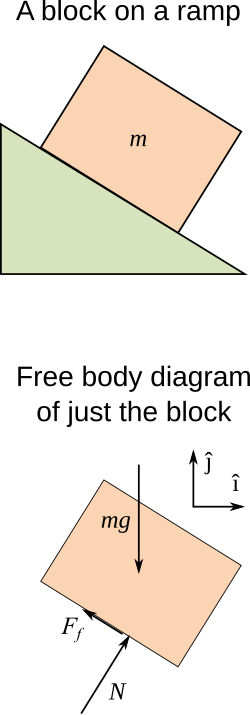
A block-on-incline free-body diagram showing the external forces (weight, normal force, and friction) isolated on the object. This visual makes the “vector sum of external forces” idea concrete: the net external force from these vectors determines the translational acceleration (and, for a system, the center-of-mass acceleration). Source
Newton’s second law links that net force to the acceleration of the center of mass.
= Net external force on the system, newtons
= Total mass of the system, kilograms
= Acceleration of the center of mass, meters per second squared
This is a vector relationship. It tells you both how large the acceleration is and which way it points.
Interpreting the law
The equation does not say that every force on every part of the system independently produces . Several external forces may act at once, and some can oppose others. What matters is their vector sum. A large force can be partly or fully offset by another force, producing a smaller acceleration than either force alone would suggest.
For a single particle, the center-of-mass acceleration is just the particle’s acceleration. For a collection of objects, represents the translational motion of the entire system. The law still applies even if different parts of the system have different instantaneous motions. In that sense, Newton’s second law filters out internal complexity and isolates the part of motion controlled by the environment.
Proportionality
Saying that is proportional to the net force means the acceleration changes in direct response to changes in the force, as long as the system mass stays constant.
If the magnitude of the net external force doubles, the magnitude of doubles.
If the net external force is cut in half, the magnitude of is also cut in half.
If the same force acts on a system with a larger total mass, the acceleration of the center of mass is smaller.
This proportionality is one of the most important ideas in mechanics. It explains why a light system is easier to accelerate than a heavy one, and why increasing the unbalanced external force produces a larger change in motion.
For AP Physics C Mechanics, this statement is typically used for systems whose total mass remains constant during the motion being analyzed.
Direction
Because both force and acceleration are vectors, the center-of-mass acceleration points in the same direction as the net external force. If the net force points to the right, points to the right. If the net force points downward, points downward. If the net force points at an angle, the acceleration points along that same angle.
This does not mean the system’s velocity must point in the same direction as the force. A system can be moving upward while the net force, and therefore the acceleration, points downward. Newton’s second law describes how the motion changes, not just the direction of motion at an instant.
In two-dimensional problems, it is often useful to interpret the law component by component. The x-component of the net external force determines , and the y-component determines . The full acceleration of the center of mass is built from those components.
Why the center of mass is so useful
A real system may have many parts, and those parts do not always behave identically. One part may speed up while another slows down. Some parts may even move in opposite directions relative to one another. Even in that situation, the overall translational motion of the entire system is still described by the motion of the center of mass.
That makes Newton’s second law far more powerful than it first appears. Instead of tracking every microscopic detail, you can often ask one central question: what is the net external force on the whole system? Once that is known, the acceleration of the center of mass follows directly. This viewpoint is often the fastest route to the correct physical interpretation.
This is especially important in AP problems involving multiple connected objects, extended bodies, or systems whose internal parts interact strongly. The internal complexity may be large, but the center-of-mass response to the environment can still be simple.
Using the law correctly
Choosing and reading the system
To use Newton’s second law for the center of mass effectively:
Choose the system carefully.
Identify only forces exerted by the surroundings on that system.
Add those forces as vectors to find the net external force.
Use the total mass of the chosen system.
Interpret the result as the acceleration of the center of mass, not automatically the acceleration of each separate part.
The choice of system matters. A force that is external for one system may not be external for a larger system. After the system boundary is chosen, only forces from outside that boundary belong in .
A common mistake is to confuse the acceleration of one object in the system with the acceleration of the entire system’s center of mass. Another common mistake is to focus on one large force and ignore smaller forces that change the net result. In AP Physics C, the law is most valuable when you keep the distinction clear between individual motion and center-of-mass motion.
FAQ
Yes. For some shapes, such as a ring or hollow sphere, the centre of mass is located in empty space rather than in the material itself.
That does not cause any problem. The centre of mass is a geometrical point that represents translational motion, so $ \sum F_{ext}=Ma_{cm} $ still applies to its motion exactly as usual.
No. Rotation adds extra physics, but it does not replace the centre-of-mass form of Newton’s second law.
The net external force determines the translational acceleration of the centre of mass.
The net external torque determines how the system rotates.
An object can translate, rotate, or do both at once, but the centre-of-mass motion still follows $ \sum F_{ext}=Ma_{cm} $.
Then the centre-of-mass acceleration also changes with time. At each instant, the acceleration is set by the instantaneous value of the net external force divided by the total mass.
In that case, $a_{cm}$ is not constant, so the velocity and position of the centre of mass must usually be found by calculus rather than constant-acceleration formulas.
The translational motion of the object depends on the resultant external force, not on whether that force is spread out or applied locally.
A force applied at one point may also create rotation, depending on the line of action, but the centre-of-mass acceleration is still determined only by the net external force and the total mass. Point of application matters for torque; it does not change the basic centre-of-mass law.
For a system, the deeper statement is that the net external force equals the rate of change of total momentum:
$ \sum F_{ext}=\dfrac{dp_{tot}}{dt} $
If the total mass is constant, then $p_{tot}=Mv_{cm}$. Differentiating gives $ \sum F_{ext}=Ma_{cm} $.
So the centre-of-mass form of Newton’s second law is closely tied to the momentum description of motion.
Practice Questions
A system of total mass experiences a net external force of to the left. What is the acceleration of the system’s center of mass?
1 mark for using
1 mark for calculating
1 mark for giving the correct direction: left
A cart of mass carries a block of mass . A horizontal pull of acts on the cart to the right. Friction from the ground on the cart is to the left. Treat the cart and block together as one system.
(a) Determine the net external force on the system.
(b) Determine the acceleration of the system’s center of mass.
(c) State the direction of the center-of-mass acceleration.
(d) Explain why the contact force between the cart and block does not change your answer.
1 mark for identifying the net external force as to the right
1 mark for using the total system mass of
1 mark for calculating
1 mark for stating the direction is to the right
1 mark for explaining that only external forces act in for the chosen system, while the cart-block contact force is internal to that system
