

AP Syllabus focus: 'For a system, the net external force equals the system mass times the acceleration of its center of mass.'
Newton’s second law becomes more powerful when several interacting objects are treated as one system. This approach reduces unnecessary detail and focuses attention on the external forces that control the motion of the whole system.
Applying Newton’s Second Law to Systems
In many mechanics problems, the best strategy is not to analyze each object separately at first. Instead, you choose a physical system containing all relevant objects and apply Newton’s second law to that entire system. This is especially useful when the objects interact strongly with one another, because those interaction forces often do not need to appear in the final equation.
Physical system: A chosen collection of one or more objects treated as a single unit for analysis.
When a system is used, the key question is not “What forces act between the parts?” but rather “What forces act on the system from outside?” That shift in viewpoint is the central idea of this subtopic.
= net external force on the system, in newtons
= total mass of the system, in kilograms
= acceleration of the system’s center of mass, in meters per second squared
This equation is the system form of Newton’s second law. It says that the translational motion of the system depends only on the net external force and the total mass of the system.
What the equation means
The mass is the sum of the masses of all objects inside the system. The acceleration is not automatically the acceleration of every individual part. It is the acceleration of the system’s center of mass, which describes how the system as a whole translates.
That distinction matters. The individual objects in a system may move differently from one another, but the entire system still obeys one translational equation. If all parts move together without changing their relative positions, then the acceleration of each part matches the center-of-mass acceleration. If the parts move relative to one another, the system equation still applies to the overall translational motion.
External forces control the motion
The left side of the equation includes only external forces. These are forces exerted on the system by objects outside the chosen boundary. Forces exerted by one part of the system on another part of the same system are internal and are not included in the net external force.
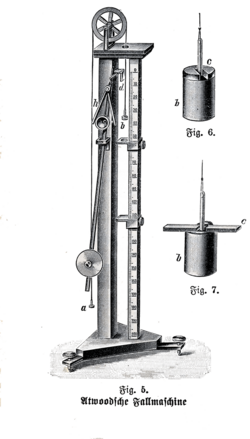
Diagram of an Atwood machine showing two masses connected by a string over a pulley, with acceleration directions and force arrows indicated. This picture helps students identify which forces would be internal (tension between the masses if both are inside the system boundary) versus external (weights due to Earth, and any support force at the pulley). It provides a visual anchor for applying to multi-object systems. Source
This is why the system method can simplify a problem. If a complicated interaction force acts between two objects and both objects are placed inside the same system, that force does not need to appear in the system equation. The motion of the center of mass is determined only by what the surroundings do to the system.
A useful consequence is that you can often ignore many unknown forces by choosing the system wisely. The system boundary decides which forces are external and which are internal.
Choosing a useful system
A good system choice makes the algebra simpler and the physics clearer. In AP Physics C Mechanics, a useful system usually has these features:
It includes the objects that share the motion you want to describe.
It turns complicated interaction forces into internal forces.
It leaves only a small number of important external forces.
It has a clearly defined total mass.
The choice of system is not automatic. A force can be external in one analysis and internal in another, depending on what objects are included. Because of this, the phrase for a system is essential in the syllabus statement. Newton’s second law is always true, but the form of the force equation depends on the chosen boundary.
Applying the law in components
Because force and acceleration are vectors, the system equation is often applied by components.
For example, along chosen axes you may write and .
A clear process is:
Choose the system.
Identify all forces exerted on that system from the outside.
Find the total mass of the system.
Determine the relevant component of the center-of-mass acceleration.
Apply Newton’s second law in each needed direction.
This method is especially efficient when the direction of acceleration is known in advance. Then the force equation can be written directly along that direction.
What this approach does and does not give you
Applying gives information about the translational motion of the whole system. It does not automatically provide every internal detail. For example, it may tell you the acceleration of the system without immediately giving all forces between the parts.
That is not a weakness of the law. It reflects the fact that system analysis is designed to capture the motion of the whole, not every internal interaction. In many problems, the system equation is the fastest path to the acceleration, and then separate object equations are used only if additional internal quantities are needed.
Common mistakes
Several errors appear often:
Including internal forces in .
Using the mass of only one object instead of the total system mass.
Treating as though it must equal the acceleration of every part.
Forgetting that the system boundary determines whether a force is external.
Writing a scalar equation without resolving vector directions carefully.
Correct application of to physical systems depends on a disciplined system choice, a correct list of external forces, and a clear understanding that the equation describes the acceleration of the center of mass.
FAQ
Yes. The system may stretch, compress, or deform internally, yet the translational equation still applies to the centre of mass.
What matters is that you are tracking the motion of the whole system, not requiring every point in it to move the same way.
The internal rearrangement can be complicated, but the centre of mass still responds to the net external force according to $ \sum \vec F_{ext}=M\vec a_{cm} $.
It is not enough when the question asks for an internal force or for the motion of one part relative to another.
In that case, the system equation may give the overall acceleration first, but you then need an additional equation for an individual object or subsystem.
So the method is powerful, but it does not replace all other free-body analyses.
A good test is to ask whether including that object removes an awkward unknown force.
Useful reasons to include an object:
it shares the main motion you care about
it exerts a force you would rather treat as internal
it makes the net external force easier to identify
Less useful reasons:
it introduces extra external forces without simplifying anything
it makes the total mass harder to track than necessary
Yes. Newton’s second law applies instant by instant.
If the external force changes with time, then the centre-of-mass acceleration also changes with time. The equation is still valid at each moment: $ \sum \vec F_{ext}(t)=M\vec a_{cm}(t) $
This is why the same principle works for both constant-force and variable-force motion.
For translational motion, add them as vectors to find the net external force.
Their points of application may matter for rotation, but the centre-of-mass equation for translation depends only on the vector sum of the external forces.
So if you are asked only about the system’s translational acceleration, the first priority is the resultant external force, not where each force is applied.
Practice Questions
A system consists of two blocks of masses and on a frictionless horizontal surface. A single external horizontal force acts on the system. Write an expression for the acceleration of the system.
1 mark for identifying total mass as
1 mark for writing
Two blocks of masses and are connected by a light string and pulled to the right on a frictionless horizontal surface by an external force of applied to one block.
(a) Treat the two blocks as one system and calculate the acceleration.
(b) Explain why the tension in the string does not appear in the system equation.
(c) If the pulling force remains but a third block of mass is added to the same system, determine the new acceleration.
1 mark for identifying the system mass in part (a) as
1 mark for using
1 mark for calculating
1 mark for stating in part (b) that tension is internal to the chosen system
1 mark for explaining that only external forces appear in
1 mark for identifying the new total mass in part (c) as and calculating
