

AP Syllabus focus: 'Unbalanced forces mean the net force on a system is not zero. A system's velocity changes only when a nonzero net external force acts on it.'
This topic explains when motion actually changes: not because forces simply exist, but because the external forces on a system fail to cancel.
Net force and unbalanced forces
Vector sum, not individual forces
A system may have one force acting on it or many. What matters for motion is the combined effect of all the external forces, not any single force considered alone.
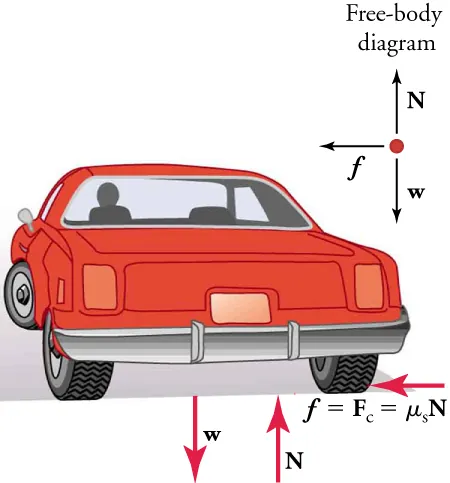
Free-body diagram for a car turning on level ground: weight and normal force balance vertically, while static friction provides the horizontal net force. The unbalanced horizontal component is what produces the inward acceleration (the change in direction of the velocity). Source
If the forces cancel exactly, there is no change in velocity. If they do not cancel, the system has an unbalanced force acting on it.
Unbalanced forces: Forces acting on a system whose vector sum is not zero.
Because force is a vector, direction is just as important as magnitude. Two large forces can still produce no change in motion if they are equal in magnitude and opposite in direction. A smaller set of forces can change motion if their vector sum is nonzero. This is why physicists focus on the net external force.
= Net external force on the system, in newtons.
= Vector sum of all external forces acting on the system, in newtons.
It gives the key first step: decide whether the system’s velocity must stay the same or begin to change.
Zero net force does not mean zero forces. Several forces may act and still cancel. In that case the motion does not change. Any unmatched force or uncanceled force component makes the force unbalanced and changes the system’s velocity.
What it means for velocity to change
Change can mean speed, direction, or both
A system’s velocity changes only when a nonzero net external force acts. Several forces may act at once and still leave the same velocity if they balance.
Velocity: A vector quantity that describes how fast an object moves and the direction in which it moves.
Because velocity includes direction, a change in velocity can happen in more than one way:
the system speeds up
the system slows down
the system changes direction
both speed and direction change at the same time
So, “changing motion” does not mean only “going faster.” A system moving at constant speed can still have changing velocity if its direction changes.
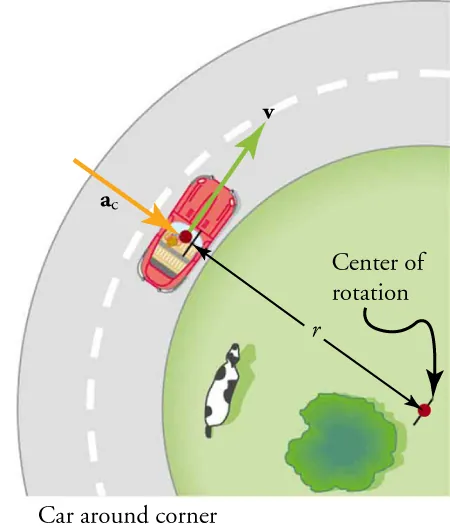
Uniform circular motion: the instantaneous velocity vector is tangent to the path, while the centripetal acceleration vector points toward the center of curvature. Because is nonzero, the net external force must also be nonzero and directed inward at that instant. Source
For this subsubtopic, the central idea is that any such change requires a nonzero net external force.
If the net external force is zero, the velocity does not change. The system may remain at rest, or it may continue moving in a straight line with the same speed. If the net external force is nonzero, the system cannot keep the same velocity.
Why the word external matters
Only external forces on the chosen system can change that system’s overall motion. When deciding whether motion changes, ask what forces are exerted on the system by its surroundings. Those are the forces that contribute to the net external force.
Students sometimes list every force they can imagine without first identifying the system. A force must act on the system, from something outside it, to count toward the net external force. If you choose a different system, the relevant external forces can change.
This is why force analysis starts with a clear system choice and then asks whether the external forces balance or not.
Reading motion from force information
When you are given force information, use the following reasoning pattern:
identify the system
list all external forces acting on it
combine those forces as vectors
decide whether the net external force is zero or nonzero
infer whether the velocity stays the same or changes
The net external force tells you about the change in velocity at that instant, not about the entire past path of the system.
The reverse reasoning is also useful: if velocity is changing, the net external force is nonzero.
Be careful with direction. A moving system can have a net force opposite its motion, which means it slows down. A moving system can also have a net force in the same direction as its motion, which means it speeds up. The presence of motion alone does not prove that a force is currently acting in the direction of motion.
Common mistakes to avoid
A frequent mistake is to say that an object moving in some direction must have a force in that same direction. Motion and force are not the same idea. Velocity describes how the system is moving now; net external force determines whether that velocity will change.
Another common mistake is to count forces without using vector addition. Forces do not combine by simple arithmetic unless they lie along the same line and a sign convention has been chosen.
Students also sometimes confuse nonzero force with nonzero net force. One force may exist, but the total of all external forces may still be zero. Motion changes only because of the net external force.
Finally, do not use a snapshot of position or speed alone to decide whether forces are balanced. The key question is whether the velocity is changing. Unbalanced forces are identified by change in velocity, and change in velocity requires a nonzero net external force.
FAQ
Feeling a force does not guarantee a nonzero net force. Several forces can act on the same person at once.
If those forces balance, the net external force is zero.
A person standing still can have gravity pulling downward and a support force pushing upward with equal magnitude.
In that case, the person feels forces, but their velocity does not change.
Before the seat belt and seat exert enough force, the passenger’s body tends to keep its previous velocity.
The car’s velocity changes quickly because the brakes create an external force on the car.
The passenger keeps moving forwards relative to the car until the seat belt or dashboard exerts an external force on the passenger.
That force then changes the passenger’s velocity.
In deep space, external forces may be extremely small for long periods.
If the net external force is close to zero, the spacecraft’s velocity changes very little. That means it can continue moving with nearly constant velocity even though no engine is pushing it.
Small gravitational pulls or tiny gas leaks can still matter, but the change may be gradual rather than obvious.
Air resistance is an external force, so leaving it out can change the net force in your model.
If you ignore it, you may predict that the velocity stays the same or changes in the wrong way.
In reality, drag often opposes the motion and reduces the net force in the forward direction.
This matters especially for fast-moving or low-mass objects.
Forces only cancel in a net-force calculation if they act on the same system.
If one force acts on object A and the opposite force acts on object B, they do not cancel when you analyse just one object. The choice of system is therefore essential when deciding whether the net external force is zero or nonzero.
Practice Questions
A cart moves to the right on a straight track. The horizontal forces on it are to the right and to the left. State whether the forces are balanced or unbalanced, and describe how the cart’s velocity changes at that instant. [2 marks]
1 mark: Identifies the forces as unbalanced, or gives net force as to the left.
1 mark: States that the velocity changes; since the cart is moving right while the net force is left, it slows down.
A block on a horizontal surface is pulled to the right by a rope. During interval I, the pull is to the right and friction is to the left. During interval II, the pull drops to to the right while friction remains to the left. The block is moving to the right at the start of interval I.
(a) Determine the net horizontal force during interval I. [1 mark]
(b) State whether the block’s velocity changes during interval I, and describe that change. [2 marks]
(c) Determine the net horizontal force during interval II. [1 mark]
(d) State whether the block’s velocity changes during interval II, and describe the motion. [1 mark]
(a) 1 mark: Net force is to the right.
(b) 1 mark: States that the velocity changes because the net external force is nonzero.
(b) 1 mark: States that the block speeds up to the right.
(c) 1 mark: Net force is .
(d) 1 mark: States that the velocity does not change in interval II, so the block continues moving to the right with constant velocity.
