AP Syllabus focus: 'A categorical variable takes values that are category names or group labels, such as dominant hand or highest degree earned.'
Categorical variables let statisticians sort individuals into meaningful groups, making it possible to describe patterns, compare populations, and ask questions using labels instead of measured amounts.
What a categorical variable records
A categorical variable records the group, type, or label attached to an individual rather than a measured quantity.
Categorical variable: A variable whose values are category names or group labels used to classify individuals.
The possible values of a categorical variable are called categories or levels. These values tell you which kind of individual you have, not how much of something is present. Examples include dominant hand, blood type, favorite music genre, and highest degree earned.
A categorical variable may use words, abbreviations, or even numbers as labels. What matters is the role of the value. If the value is being used to name a group, then the variable is categorical.
Labels, not amounts
With categorical data, arithmetic usually does not make sense. You would not average categories such as left-handed and right-handed, or add together categories such as bachelor's degree and master's degree. The values are labels for classification, not measurements on a numerical scale.
This idea is the key test for identification: if the values describe membership in a group, the variable is categorical.
How to recognize a categorical variable
When you are deciding whether a variable is categorical, focus on the question the variable answers.
Does the variable answer which group or what type?
Are the values names of groups rather than counts or measurements?
Would adding, subtracting, or averaging the values be meaningless?
If numbers are used, are they only acting as codes or labels?
If the answer to these questions points to classification, the variable is categorical.
Context matters. A variable can look numerical but still be categorical if the numbers only label groups. For instance, a school might code lunch choices as 1, 2, 3, and 4. Those numbers do not represent quantity; they stand for categories. In contrast, if the numbers represent an actual count or amount, the variable is not categorical.
Common examples
Common categorical variables in AP Statistics settings include:
Dominant hand
Highest degree earned
State of residence
Political party identification
Type of pet owned
Phone operating system
Class standing when values are first-year, sophomore, junior, and senior
Some categorical variables have only two possible categories, such as yes or no, pass or fail, or owns a car and does not own a car. These are still categorical because each value is a label.
Important features of good categories
For a categorical variable to be useful, its categories should be clearly defined. Poorly chosen categories can make data confusing or misleading before any analysis even begins.
Categories should be distinct
Each individual should fit into a category in a clear way. If categories overlap, the same observation may seem to belong in more than one place. For example, categories such as "under 20," "20 to 30," and "30 or older" are unclear because the value 30 appears in two places.
Distinct categories help make classification consistent across all observations.
Categories should match the question
The categories should reflect the actual purpose of the study. If a researcher wants to understand education level, categories such as high school diploma, associate degree, bachelor's degree, and graduate degree are meaningful. If the categories are too vague, the variable may fail to capture useful information.
Sometimes a study needs an other or none of the above category so that all possible responses have a reasonable place. Without this, some individuals may be hard to classify.
Ordered and unordered categories
Not all categorical variables behave in exactly the same way.
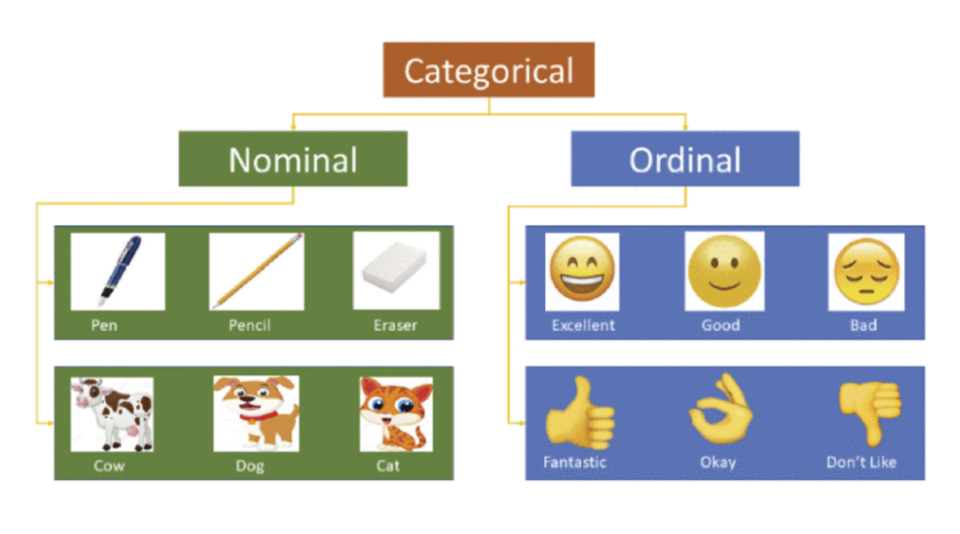
This diagram contrasts nominal (unordered) categories with ordinal (ordered) categories. It emphasizes that ordinal categories have a meaningful order, even though the “distance” between levels is not measured on a numerical scale. Use it to visually anchor the idea that both types are still categorical because their values function as labels. Source
Some categories have no natural order, while others do.
Unordered categories
Variables such as eye color, blood type, and country of birth have categories that are simply different from one another. One category is not greater or less than another.
Ordered categories
Some categorical variables have categories that follow a logical order, such as class standing or satisfaction level. Even then, the variable remains categorical because the values still represent group labels. The order may be meaningful, but the gaps between categories are not measured on a true numerical scale.
This distinction matters because students sometimes mistake ordered labels for numerical data. An order alone does not make a variable quantitative.
Why categorical variables matter in statistics
Categorical variables are essential because they allow statisticians to study how individuals are distributed across groups. They are often used to describe the composition of a sample or population, such as the proportion of students in different grade levels or the share of voters identifying with different parties.
Categorical variables also support comparison.
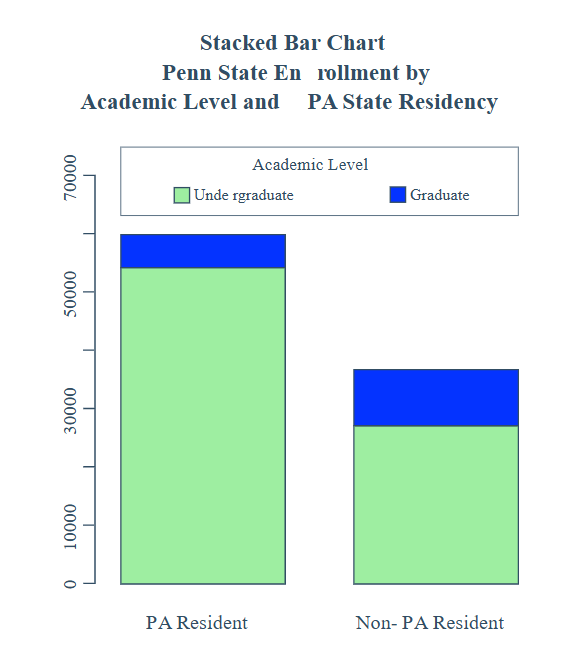
This stacked (segmented) bar chart displays counts for two categorical variables at once, with one variable defining the bars and the other shown as colored segments within each bar. Reading the segment sizes and totals illustrates how statisticians compare category frequencies across groups. It also motivates why clear category labels and legends matter for interpretation. Source
If two groups are measured using the same categorical variable, statisticians can compare how common each category is in each group. The usefulness of those comparisons depends on clear, consistent category labels.
Because categories depend on context, the same wording may not mean the same thing in every study. A strong statistical description always connects the variable back to the real-world setting.
Common mistakes to avoid
Students often misidentify variables because they focus only on appearance instead of meaning. Watch for these common mistakes:
Treating a coded category as if it were a measured number
Assuming that a variable is quantitative just because digits are used
Using category labels that overlap or are poorly defined
Ignoring the context that explains what the labels mean
Thinking that an ordered set of labels must be quantitative
A careful reader asks what the values actually represent. If they identify categories, groups, or labels, then the variable is categorical.
Practice Questions
A survey asks each student to report their preferred mode of transportation to school: bus, car, bike, or walk.
Identify the variable and explain why it is categorical.
1 mark for identifying the variable as preferred mode of transportation to school.
1 mark for explaining that the values are group labels or categories, not numerical measurements.
A college records the following variables for each student:
number of siblings
intended major
residence hall code: 101, 102, 103, 104
class standing: first-year, sophomore, junior, senior
height in inches
(a) Identify all categorical variables.
(b) Explain why residence hall code is categorical even though numbers are used.
(c) Explain why class standing is categorical even though the categories have a natural order.
(d) State one mistake a student might make when classifying these variables and correct it.
2 marks for identifying intended major, residence hall code, and class standing as categorical variables.
1 mark for explaining that residence hall code uses numbers only as labels for groups, not as measurements.
1 mark for explaining that class standing gives group labels in order, but the labels are still categories rather than numerical amounts.
1 mark for a valid mistake and correction, such as saying residence hall code should not be treated as quantitative just because it uses numbers.
FAQ
Yes. A variable is categorical if the numbers act only as labels for groups.
Examples include:
locker number
team number
residence hall code
A good test is to ask whether arithmetic with the values would have meaning. If averaging or subtracting the values makes no sense, the variable is probably categorical.
A nominal variable has categories with no natural order, such as blood type or favorite sport.
An ordinal variable has categories with a meaningful order, such as low, medium, high or strongly disagree to strongly agree.
Even for ordinal variables, the categories are still labels. The order matters, but the distance between categories is not measured in equal units.
Usually, they should be handled carefully rather than automatically treated as ordinary categories.
If the goal is to study response patterns, “missing,” “refused,” or “unknown” may be kept as separate response statuses.
If the goal is to study the actual categories of the variable, those responses are often treated as missing data instead.
The key is to decide this rule before analysis and report it clearly.
That usually means the variable was not defined well enough for a single-category response.
Possible fixes include:
allowing multiple responses
creating separate yes/no variables
redesigning the categories so they do not overlap
Forcing each person into exactly one category can lose information if the real situation allows more than one valid label.
Combining categories can be useful when some groups are very small or when several categories represent nearly the same idea.
This should be done only when:
the combined categories still make sense in context
important differences are not being hidden
the rule for combining is explained clearly
Poorly chosen combinations can make a categorical variable less informative, even if the data become simpler to read.