

AP Syllabus focus: 'A variable is a characteristic that changes from one individual to another. Students identify variables in a set of data.'
When statisticians look at a data set, one of the first tasks is to determine exactly what characteristics have been recorded. Clear identification of variables makes later analysis accurate and meaningful.
What a variable is
A variable is the basic feature recorded in a data set.
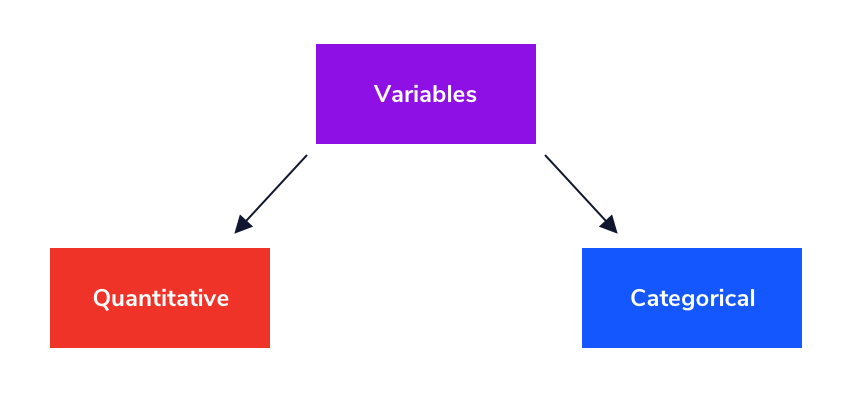
This diagram summarizes a fundamental classification used throughout introductory statistics: variables are either quantitative (numerical measurements) or categorical (group labels). Seeing this split helps you write variable names that match what was actually recorded, rather than describing the topic in vague terms. Source
Variable: A characteristic that changes from one individual to another.
A data set usually records several variables at the same time. Each variable corresponds to a question or measurement applied to every individual in the data. The answers to that question are the values of the variable.
This distinction matters. A variable is the characteristic itself, while a value is one specific recorded result. For instance, age is a variable, but 17 is a value of that variable. On AP Statistics questions, you are usually asked to identify the variable, not merely to list one observed value.
A characteristic must be capable of varying from one individual to another in order to be considered a variable. If the recorded information describes the same feature for each case, then that feature is a variable even if some individuals happen to share the same value.
Individuals and data sets
To identify variables correctly, you must first know who or what the data describe. These are called individuals.
Individual: A person, object, or other entity described by the data.
In many data sets, each row represents one individual and each column represents one variable.
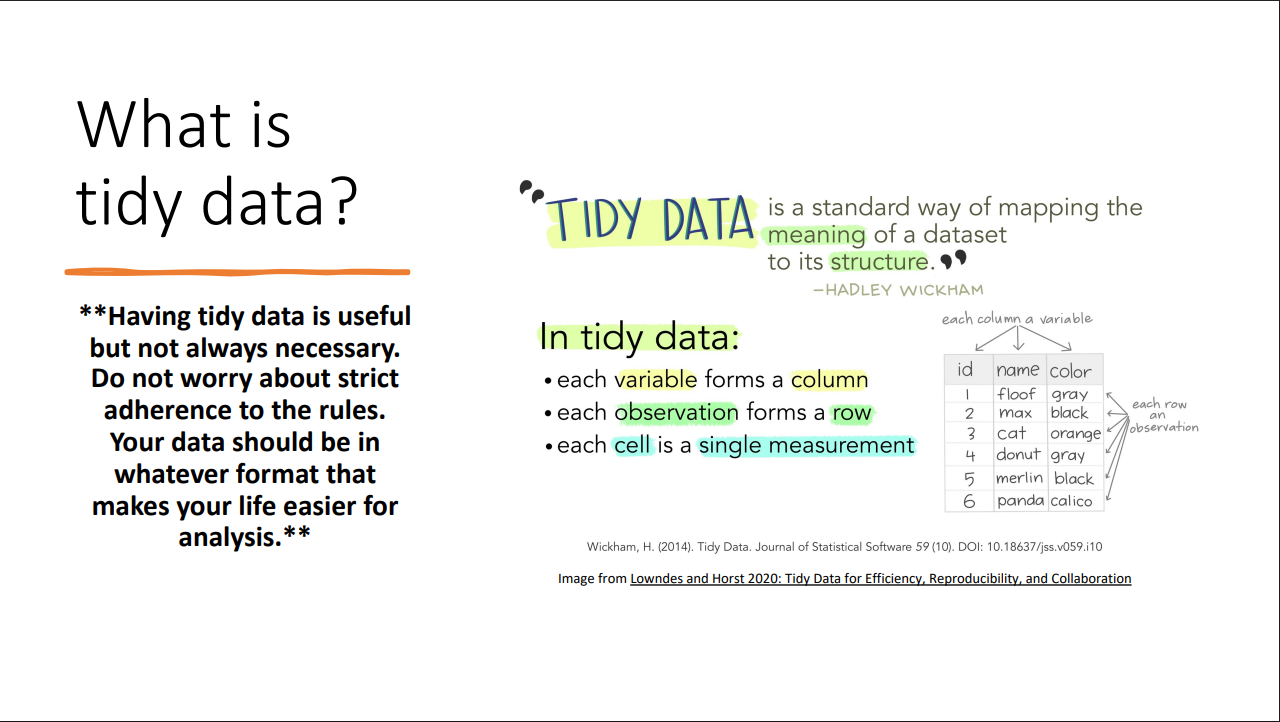
This “tidy data” diagram shows the common table layout used in statistics: each column represents a variable and each row represents an individual (observation). It helps you connect the vocabulary (individual, variable, value) to what you actually see in a spreadsheet-style data set. Source
However, the same idea applies even when data are described in sentences instead of a spreadsheet. The individual could be a student, household, car, state, game, day, or any other unit being observed.
A variable only makes sense in relation to the individuals. If the individuals are students, a variable might be class year or test score. If the individuals are cities, a variable might be population. The variable tells you what characteristic was recorded for each individual.
How to identify variables in a data set
When you are given a data set or a written description, use a simple process:
First, determine the individuals.
Next, ask what information was recorded for each individual.
State each variable as a characteristic, not as a value.
Include enough context so the variable is clearly identified.
A strong variable name is precise. It should tell the reader exactly what was measured or recorded. Words such as score, level, or amount may be too vague unless the context explains what they refer to.
Variables may appear in many forms.
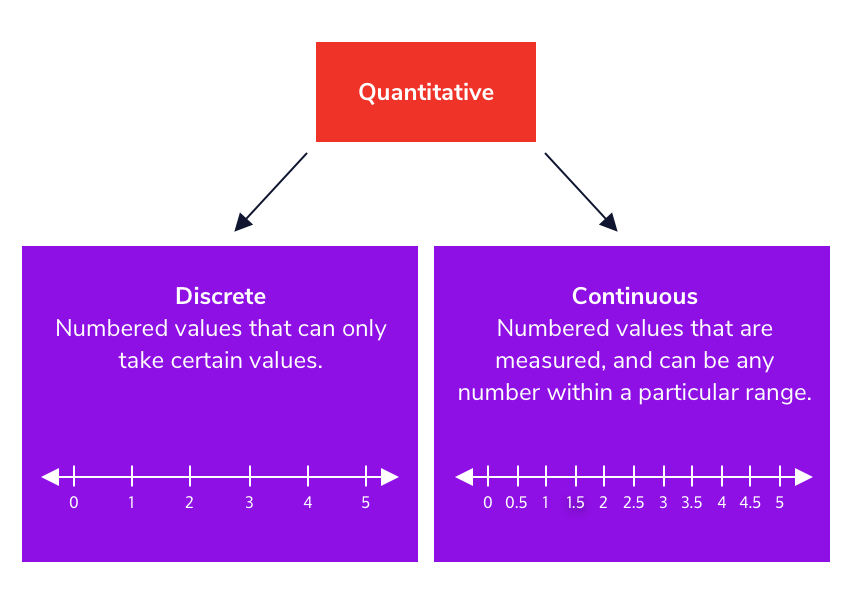
This figure distinguishes discrete quantitative variables (counts) from continuous quantitative variables (measurements on a continuum). The number-line visuals emphasize that “what form it takes” (e.g., integers vs decimals) can reflect the underlying measurement process, even though many formats can still represent variables. Source
They can be written as words, numbers, dates, or codes. The format does not determine whether something is a variable. What matters is whether it describes a characteristic that can differ across individuals.
Clues that help you spot variables
Column headings
In a spreadsheet or chart, column headings often name the variables. Still, you should read them carefully. A short heading may need the surrounding context to make its meaning clear. A heading such as time is incomplete unless you know time for what activity and in what units.
Survey or measurement prompts
In a written description, a variable may be hidden inside a repeated question or instruction. If every participant was asked the same question, the characteristic addressed by that question is a variable.
Units and conditions
Units often help identify the variable correctly. A response measured in hours is different from one measured in miles, even if both are described loosely as an amount. Conditions matter too. A measurement taken before an activity may represent a different variable from the same measurement taken afterward.
Context words
Words naming place, group, or timing often belong in the variable description. Leaving them out can make the variable too broad. A good AP response identifies the variable in context, not as an isolated label.
Common mistakes
Students often make predictable errors when identifying variables:
Confusing individuals with variables: the people or objects in the data are not the variables.
Giving a value instead of a variable: a single response is not the characteristic being studied.
Using a topic instead of a recorded characteristic: broad ideas are not specific enough unless they match what was actually recorded.
Ignoring context: a label may sound correct but still be incomplete without units, setting, or timing.
These mistakes usually happen when the reader moves too quickly. Slowing down and asking, “What was recorded for each individual?” helps prevent them.
Writing variable names clearly
On AP Statistics tasks, clear wording matters. A variable should be named so that another reader could identify the exact recorded characteristic without guessing.
Good practice includes:
naming the characteristic directly
keeping the description tied to the individuals
including units when they matter
including time or setting when needed for clarity
avoiding shorthand that loses meaning
Precise identification is important because every later statistical step depends on knowing exactly what each variable represents.
Quick self-check for identifying variables
Before finalizing your answer, ask yourself:
Who or what are the individuals?
What characteristic was recorded for each one?
Am I naming the characteristic rather than one value?
Does my wording include enough context to be clear?
Would another student recognize the same variable from my description?
Practice Questions
A school counselor records the following information for each senior: GPA, number of college applications submitted, and intended major.
Identify the variables in this data set. [3 marks]
1 mark for identifying GPA as a variable
1 mark for identifying number of college applications submitted as a variable
1 mark for identifying intended major as a variable
A researcher studies 50 apartments in a city. For each apartment, the data set includes monthly rent, number of bedrooms, neighborhood, and whether parking is available.
(a) Identify the individuals in this data set. [1 mark]
(b) Identify the variables in this data set. [4 marks]
(c) Explain the difference between a variable and a value using one of the variables from this data set. [1 mark]
Total: 6 marks
(a) 1 mark for stating that the individuals are the 50 apartments
(b) 1 mark each for identifying monthly rent, number of bedrooms, neighborhood, and whether parking is available as variables
(c) 1 mark for explaining that a variable is the characteristic recorded for each apartment, while a value is one specific entry, such as a particular monthly rent or a particular neighborhood
FAQ
Not always in the most meaningful statistical sense.
An ID number may appear in a data set, but it often serves only as a label to distinguish individuals. If it does not measure or describe a changing characteristic of interest, many statisticians would not treat it as an analytic variable.
However, it is still a recorded field in the data set, so teachers may expect you to recognize that it is present while also understanding that it is mainly an identifier.
Yes. A single broad idea can be split into several distinct variables if it is recorded in different ways.
For example:
measurement at different times
measurement in different units
measurement under different conditions
These should be treated as different variables because each one represents a different recorded characteristic, even if they are closely related.
It can still be a variable if the characteristic was recorded for every individual.
The key idea is that the characteristic is capable of varying from one individual to another. In one particular sample, it may happen that all observed values are the same.
That does not change what the variable is, although it may make the variable less useful for analysis in that specific data set.
A missing entry does not remove the variable.
If the data set was intended to record the same characteristic for each individual, then that characteristic is still a variable even when some values are blank, unavailable, or unrecorded.
You should identify the variable based on what the data set is designed to measure, not on whether every single value is present.
Yes. This is often called a derived variable.
A researcher might combine existing fields to create a new characteristic, such as:
total study time per week
change from before to after
difference between two recorded amounts
Once created, that new characteristic can be treated as its own variable, provided it is defined clearly for every individual.
