

AP Syllabus focus: 'A quantitative variable takes numerical values for a measured or counted quantity, such as height, age, or concentration.'
Quantitative variables are central in statistics because they record how much, how many, or how old. Recognizing them correctly is the first step toward choosing sensible displays, summaries, and statistical methods.
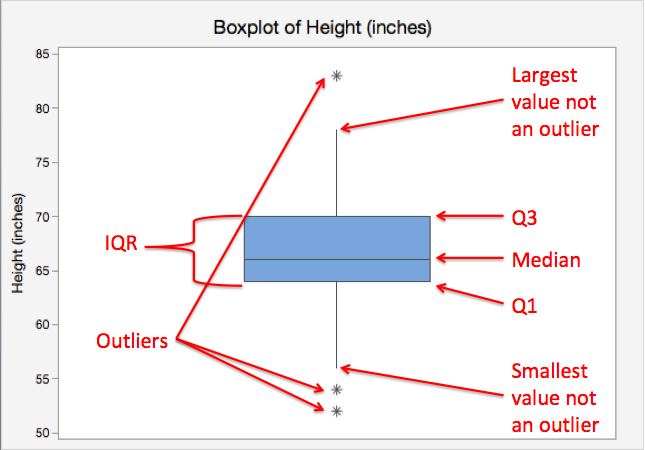
A labeled boxplot for a quantitative variable (height in inches), showing the median, quartiles ( and ), the interquartile range (IQR), whiskers, and outliers. Because these features are defined using numerical order and distances, this display only makes sense when the variable truly measures an amount. Source
What Makes a Variable Quantitative?
A quantitative variable records a numerical amount for each individual in a data set. The number must represent a real quantity that can be measured or counted in context.
Quantitative variable: A variable that takes numerical values for a measured or counted quantity.
A variable is quantitative because of what its values mean, not because the values look mathematical. If the recorded numbers tell how much, how many, how far, how long, or how old, the variable is quantitative. Typical examples include height, age, income, reaction time, and number of books read.
The AP Statistics specification emphasizes two sources of quantitative values:
Measured quantities, such as height, mass, temperature, or concentration
Counted quantities, such as number of goals, absences, or defective items
Both kinds produce numbers, but the important idea is the same: each value represents an amount.
Recognizing Quantitative Variables in Context
To decide whether a variable is quantitative, focus on the question the variable answers. A useful test is to ask, “What does this number tell me about the individual?”
Ask What the Number Means
A variable is usually quantitative if the value answers one of these kinds of questions:
How much? Examples: mass, rainfall, dosage
How many? Examples: number of pets, wins, or text messages
How long or how far? Examples: travel time, distance, lifespan
How old or how fast? Examples: age, speed, heart rate
If the number is only naming a group, location, or person, then it is not acting as a quantitative variable, even if digits are used.
Units and Measurement Matter
Quantitative variables often have units, such as centimeters, dollars, years, or milligrams per liter. Units explain what the quantity measures and make the data interpretable. Without context and units, a number like 12 is incomplete because it could mean 12 years, 12 inches, or 12 customers.
Some quantitative variables are recorded as whole numbers because they count objects or events. Others can take decimal values because they come from measurement. In real data, measured values may also be rounded, but they still represent numerical amounts.
A quantitative variable does not need to look the same in every setting. For example, age might be recorded in years for one study and in months for another. It is still quantitative because it measures a quantity.
Quantitative Does Not Just Mean “Written as a Number”
One of the most common mistakes in introductory statistics is assuming that any variable written with digits must be quantitative. That is not true.
Codes and Identifiers
Numbers used as labels are not quantitative. Examples include student ID numbers, jersey numbers, ZIP codes, room numbers, and telephone numbers. These values identify or classify, but they do not measure or count an amount.
Arithmetic on these labels has no useful meaning. Averaging phone numbers or subtracting jersey numbers does not describe anything statistical about quantity.
Ordered Labels Can Still Fail to Be Quantitative
Sometimes categories are represented by numbers, such as a rating scale from 1 to 5 or performance levels coded as 1, 2, 3, and 4. These values may show order, but they do not automatically represent equal numerical differences.
For AP Statistics, the key question remains the same: Do the values measure or count a quantity? If yes, the variable is quantitative. If the numbers only label categories, even ordered categories, then the variable is not quantitative.
This distinction matters because later statistical methods depend on whether the values truly represent amounts.
Describing Quantitative Variables Precisely
State the Variable in Context
When identifying a quantitative variable, name both the quantity and the individuals being measured. “Age of each customer in years” is more precise than simply “age.” Good statistical writing connects the variable to the real-world setting.
A clear description should make clear:
who or what is being observed
what quantity is recorded
how the value is expressed, including units when relevant
This precision is important because the same general word can mean different things in different studies. A “score” might mean points on a test, runs in a game, or concentration on a laboratory scale.
Common Pitfalls
Students often make avoidable errors when identifying quantitative variables:
Confusing a number label with a measured or counted amount
Ignoring units when the units help define the variable
Treating a code or ranking as automatically quantitative
Naming the variable too vaguely to tell what the number represents
Careful identification of quantitative variables supports every later step in statistics, because the variable type determines which summaries and interpretations will make sense.
Practice Questions
A survey of college applicants records the following for each student: age, intended major, number of colleges applied to, and application ID number.
Identify the quantitative variables.
1 mark for age
1 mark for number of colleges applied to
No mark for intended major or application ID number
A wildlife researcher records the following for each bird captured: species, wingspan in centimeters, band number, number of ticks found, and habitat quality rating coded as 1 = poor, 2 = fair, 3 = good, 4 = excellent.
(a) Identify the quantitative variables.
(b) For each of the other variables, explain why it is not quantitative.
(c) Explain why both quantitative variables qualify even though one is usually measured and the other is counted.
1 mark for identifying wingspan as quantitative
1 mark for identifying number of ticks as quantitative
1 mark for explaining species is not quantitative because it is a category label
1 mark for explaining band number and habitat quality rating are not quantitative because they are codes or ordered labels, not measured or counted amounts
1 mark for explaining that wingspan is measured and number of ticks is counted, so both are quantitative
FAQ
Yes. If exact ages are replaced by groups such as 0–9, 10–19, and 20–29, the new variable is no longer quantitative.
The original variable, age, is quantitative. The grouped version is a set of categories created from that quantity.
Yes, if each percentage represents a numerical amount for an individual or unit.
For example, percent of homework completed, percent body fat, or percent of defective items in a batch can all be quantitative because each value measures a proportion.
Yes. Quantitative variables can include negative numbers or zero when the context allows it.
Examples include temperature in Celsius, net gain or loss, elevation relative to sea level, and change in blood pressure. The key issue is still whether the value represents an amount.
It depends on what the numbers mean. A single rating scale often behaves more like ordered categories than a true measured quantity.
If the numbers are just labels for response levels, treat them cautiously. If the values come from a defined measurement process with meaningful numerical spacing, they may be more appropriate as quantitative.
Usually yes. Changing inches to centimeters, dollars to euros, or seconds to minutes still leaves the variable quantitative.
Even a derived value, such as a logarithm of concentration, remains quantitative because it is still a numerical measure of an underlying amount. The main requirement is to state clearly what the transformed values mean.
