

AP Syllabus focus:
‘VAR-4.D.2: Explore the multiplication rule, which articulates that the probability of both events A and B occurring is the product of the probability of event A occurring and the probability of event B occurring given A has occurred, denoted as P(A and B) = P(A) × P(B.’
The multiplication rule for independent events helps quantify how likely two events are to occur together, emphasizing how independence shapes probability relationships in random processes.
Understanding the Multiplication Rule
The multiplication rule for independent events is a foundational tool used to determine the likelihood that two events occur simultaneously. When events are independent, the occurrence of one event does not influence or alter the likelihood of the other. This rule provides a direct way to evaluate combined outcomes in random processes and supports the broader framework of probability reasoning required in AP Statistics.
Introducing Independent Events in Context
Two events are considered independent when knowledge of one event’s outcome does not change the probability of the other event occurring. This notion of independence is essential because the multiplication rule relies on the assumption that the two probabilities remain unaffected by each other.
Independent Events: Two events are independent if the occurrence of one does not affect the probability of the other occurring.
Understanding this relationship ensures that the multiplication rule is used appropriately and only when the independence condition is satisfied. When events are not independent, a different approach to probability is required, involving conditional probability rather than direct multiplication.
The Multiplication Rule Explained
The multiplication rule describes how to calculate the probability that both event A and event B occur together, also referred to as their joint probability. The rule states that the chance of both events happening equals the probability of the first event multiplied by the conditional probability of the second event occurring after the first.
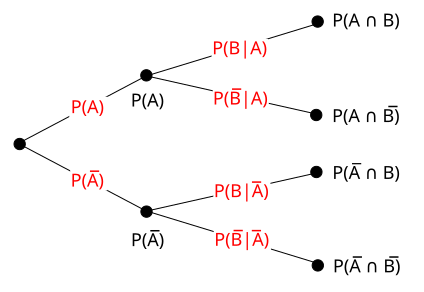
Probability tree diagram for two events A and B. Each branch is labeled with either a marginal probability such as P(A) or a conditional probability such as P(B|A), and each endpoint shows the corresponding joint probability (for example, P(A ∩ B)). The additional branches involving complements Ā and B̄ extend beyond the AP focus but help illustrate how the multiplication rule applies to all possible joint outcomes. Source.
EQUATION
= Probability that both events occur
= Probability that event A occurs
= Probability that event B occurs given that A has occurred
When events are independent, the conditional probability of B given A simplifies because knowing A has occurred provides no new information about B. This simplification leads to a special form of the multiplication rule used specifically for independent events.
A brief reminder that independence must be established before applying this simplified form helps ensure accuracy in probability evaluation and prevents misapplication of the rule where conditional dependence exists.
The Special Case for Independent Events
For independent events, the multiplication rule becomes much simpler. Because the probability of event B is not influenced by event A, the conditional probability equals . This allows the formula to reduce to a direct product of the two individual probabilities, reflecting the complete lack of influence between the events.
EQUATION
= Probability that event A occurs
= Probability that event B occurs
This formulation is central to AP Statistics because it provides a mathematically sound and efficient method for determining the likelihood of combined independent outcomes. It preserves the structural characteristics of independence and ensures that probability calculations reflect the nature of the random process being studied.
A clear recognition of when to use this form of the multiplication rule strengthens a student’s ability to analyze probability scenarios effectively, particularly in situations involving repeated or unrelated random events.
Applying the Multiplication Rule Conceptually
While AP Statistics does not require examples within this section, understanding how and when the multiplication rule applies conceptually is crucial for problem-solving across the course. The rule is often used in the context of repeated independent trials, simultaneous random events, or any situation where two outcomes must occur together without influencing one another.
Key Points for Identifying Independence
Students should focus on recognizing independence through contextual reasoning and information provided in probability settings. The following considerations help determine whether the multiplication rule for independent events is appropriate:
Check whether the problem states or implies independence. Independence is often explicitly given or can be inferred from the situation.
Confirm that one event does not alter the likelihood of the other. This requires interpreting descriptions of random processes carefully.
Distinguish independence from mutually exclusive events. Mutually exclusive events cannot occur together, whereas independent events can occur together without influencing each other.
Evaluate whether repeated trials share identical conditions. Consistent probabilities across trials indicate independence in many scenarios.
Importance in Statistical Reasoning
Understanding the multiplication rule for independent events supports deeper engagement with probability models and strengthens the ability to construct and interpret complex probability statements. This rule also serves as a precursor to more advanced topics, such as probability distributions, expected values, and applications of randomness in statistical inference.
By mastering the multiplication rule, students gain a reliable tool for quantifying joint likelihoods in independent settings and for supporting conclusions drawn from structured probability reasoning.
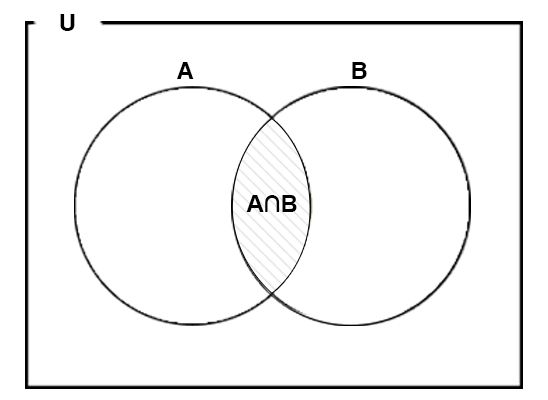
Venn diagram illustrating the intersection of events A and B within a universal set U. The shaded region represents A ∩ B, the outcomes belonging to both events simultaneously. The inclusion of explicit set labels goes slightly beyond the immediate syllabus requirement but remains entirely consistent with AP Statistics notation. Source.
FAQ
Independence can sometimes be inferred from context. If the description suggests the events occur in unrelated settings or involve separate systems, independence may be reasonable.
You can also check whether the probability of one event changes when additional information is provided. If knowing one outcome does not alter the probability of the other, the events are independent.
In some situations, data may show that the probability of B given A is roughly the same as the overall probability of B, supporting independence.
The multiplication rule relies on the assumption that the second event’s likelihood remains the same regardless of whether the first event occurs.
If the events influence each other, multiplying their individual probabilities gives an incorrect joint probability.
In dependent scenarios, probabilities must be adjusted using conditional information rather than simple multiplication.
Yes, it extends to any number of independent events.
For three events A, B, and C, independence means all events do not affect one another. In that case, the probability that all three occur is:
• P(A and B and C) = P(A) × P(B) × P(C)
This extension is often used when events represent repeated independent trials within the same random process.
Students often assume events are independent simply because they seem unrelated, even when the context suggests a relationship.
Another misconception is confusing independence with mutually exclusive events. Mutually exclusive events cannot occur together, but independent events can.
Some also mistakenly believe that a pattern in outcomes implies dependence, when patterns may occur by chance alone.
Randomness refers to the unpredictability of individual outcomes, while independence refers to the relationship (or lack of one) between two events.
A process can be random but still involve dependent events if one outcome affects future probabilities.
Independence specifically focuses on whether one event alters the likelihood of another, not whether the outcomes themselves appear random.
Practice Questions
Question 1 (1–3 marks)
A fitness centre records that the probability a randomly selected member attends a yoga class on a given day is 0.35. The probability that a member also uses the weights area on the same day is 0.5. The two activities are independent.
(a) Find the probability that a randomly selected member both attends a yoga class and uses the weights area on the same day.
Question 1 (1–3 marks)
(a)
• 1 mark for stating or using the multiplication rule for independent events: P(A and B) = P(A) × P(B).
• 1 mark for correct substitution: 0.35 × 0.5.
• 1 mark for the correct final answer: 0.175.
Total: 3 marks
Question 2 (4–6 marks)
A school tracks two independent events among pupils:
• Event A: completing homework on time
• Event B: participating in an after-school club
The probability a pupil completes their homework on time is 0.72, and the probability a pupil participates in an after-school club is 0.4.
(a) Explain why the multiplication rule applies in this situation.
(b) Calculate the probability that a pupil both completes homework on time and participates in an after-school club.
(c) Comment on what this probability means in the context of the school.
Question 2 (4–6 marks)
(a) Up to 2 marks
• 1 mark for stating that the events are independent, meaning one event does not affect the probability of the other.
• 1 mark for linking independence to the validity of applying the multiplication rule.
(b) Up to 2 marks
• 1 mark for using the rule P(A and B) = P(A) × P(B).
• 1 mark for correct calculation: 0.72 × 0.4 = 0.288.
(c) Up to 2 marks
• 1 mark for interpreting the numerical result as the proportion or likelihood of pupils who do both activities.
• 1 mark for explaining this in context, such as noting that about 28.8% of pupils complete homework on time and participate in a club.
Total: 6 marks
