AP Syllabus focus:
‘For normal population distributions: The sampling distribution of x-bar is normally distributed. For non-normal population distributions: The sampling distribution of x-bar approaches normal distribution with sufficient sample size (n ≥ 30), according to the Central Limit Theorem. This principle allows for normal approximation for the distribution of sample means under broad conditions.’
Understanding when the sampling distribution of the sample mean becomes approximately normal is essential for making valid probability statements about sample means in practical statistical investigations.
Normality Criteria for Sampling Distributions
The sampling distribution of the sample mean, often written as x-bar, plays a key role in inference. This subsubtopic focuses on how the shape of the population distribution and the size of the sample determine whether the sampling distribution of x-bar can be treated as approximately normal. These criteria allow students to apply normal probability methods appropriately in real data contexts.
Normal Population Distributions
When the underlying population is itself normally distributed, the sampling distribution of the sample mean is also normal for any sample size.
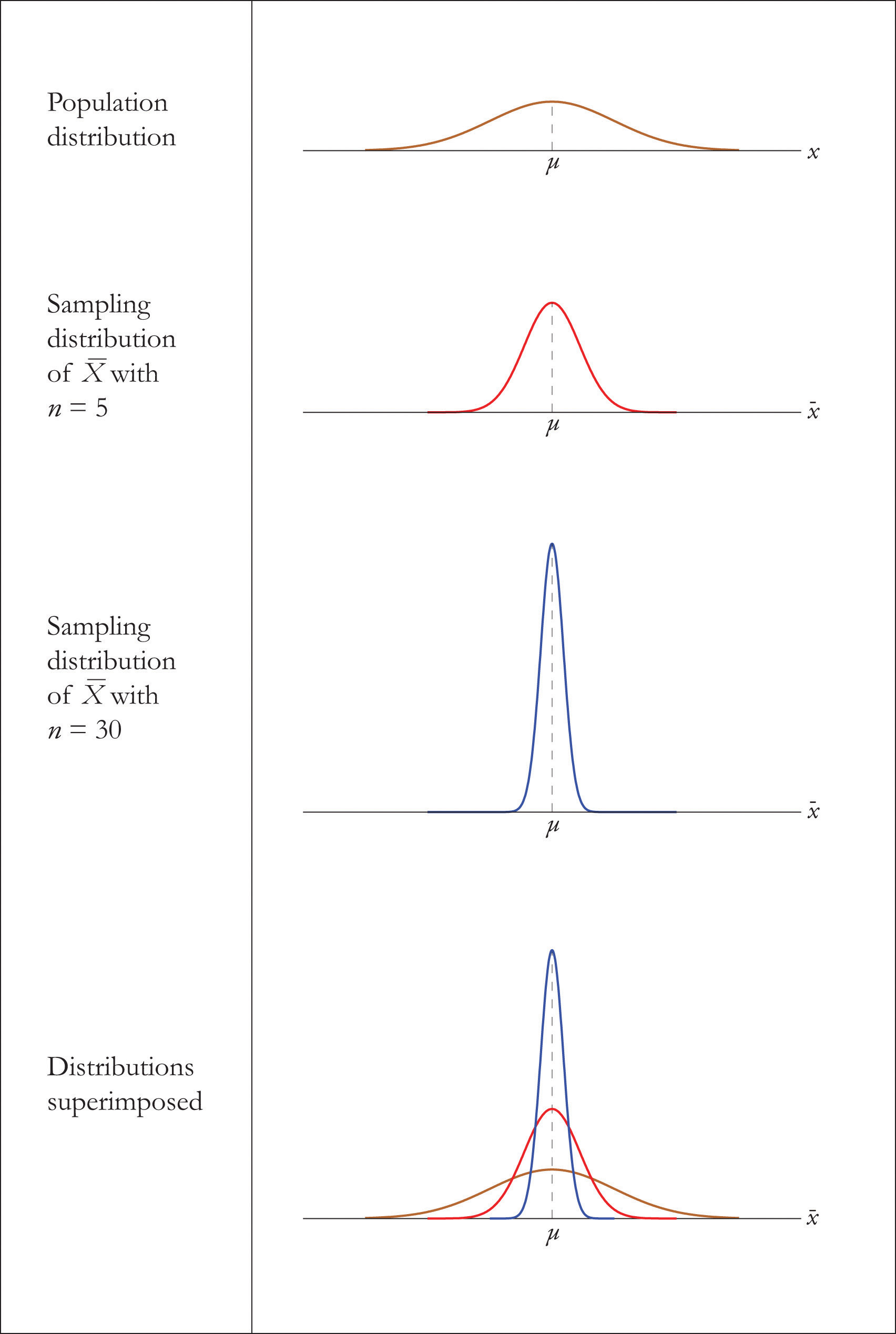
The figure illustrates how sampling distributions of the sample mean maintain a normal shape when drawn from a normal population and become narrower as sample size grows. Source.
This result holds whether the sample is small or large because the sample mean of values drawn from a normal population inherits normality from that population.
Normal Distribution: A continuous, symmetric, bell-shaped distribution defined by its mean and standard deviation.
This property ensures that normal probability techniques can always be used for sample means when the population distribution is known to be normal. Students should recognize that this scenario provides the strongest guarantee of normality in sampling distributions.
Non-Normal Population Distributions
Many real-world populations are not well modeled by a normal distribution. They may be skewed, uniform, bimodal, or heavy-tailed. In such cases, the sampling distribution of the sample mean does not begin as normal for small sample sizes. Instead, its behavior depends on the Central Limit Theorem (CLT).
Central Limit Theorem (CLT): A statistical principle stating that the sampling distribution of the sample mean becomes approximately normal as sample size increases, regardless of the shape of the population distribution, provided certain conditions are met.
The CLT provides the foundation for using normal approximations even when the population distribution deviates substantially from normality.
Sample Size Requirements
For non-normal population distributions, the normal approximation improves as the sample size grows.
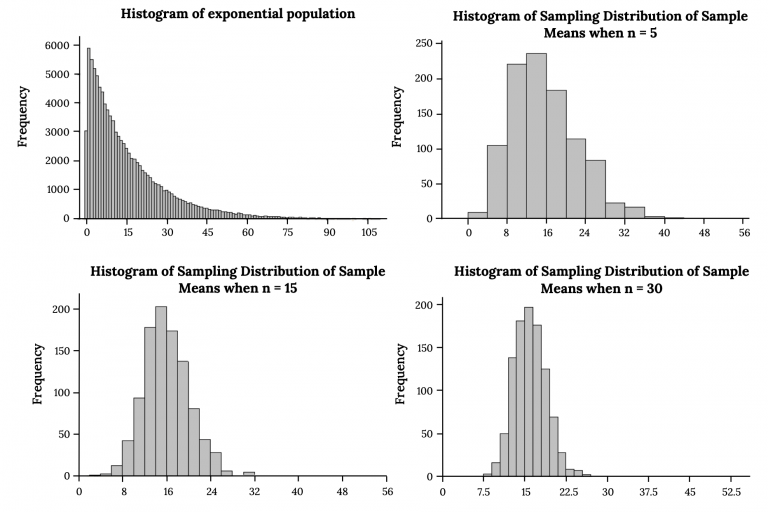
The figure demonstrates how sampling distributions of the mean become increasingly symmetric and approximately normal as sample size grows, even when the population itself is strongly skewed. Source.
The syllabus identifies n ≥ 30 as a commonly accepted threshold for the CLT to produce an approximately normal sampling distribution of x-bar.
Important points about the n ≥ 30 rule:
It is a rule of thumb, not a strict mathematical boundary.
It performs best when the population distribution is not extremely skewed.
Larger samples may be required when the population contains strong skewness or outliers.
Students should learn to connect the shape of the population with the expected behavior of the sampling distribution as sample size changes.
Why the CLT Enables Normal Approximation
The Central Limit Theorem explains that as sample size increases, the influence of individual extreme values weakens. Each sample mean aggregates many observations, causing the distribution of these means to become smoother and more concentrated around the population mean.
This behavior supports the use of normal probability methods in many data analysis contexts, even when the population distribution is unknown or irregular, provided that the sample is sufficiently large.
Standard Deviation of the Sampling Distribution
Although this subsubtopic focuses on conditions for normality, students must remember that the shape of the sampling distribution interacts with its spread. The standard deviation of x-bar, often called the standard error, influences how quickly the distribution becomes tightly clustered around the mean as sample size increases.
EQUATION
= Standard deviation of the sampling distribution of the sample mean
= Population standard deviation
= Sample size
This reduction in spread helps the distribution of sample means stabilize, reinforcing the normal shape predicted by the CLT for sufficiently large n.
A sentence here ensures proper spacing before further structured content.
Applying Normality Criteria in Practice
When determining whether it is appropriate to assume a normal sampling distribution for x-bar, students should consider:
Population Shape
If the population is normal, the sampling distribution is normal for all n.
If the population is non-normal, normality depends on sample size.
Sample Size
Use the normal model when n ≥ 30, unless the population distribution is extremely skewed.
Use caution with small samples from non-normal populations.
Purpose of the Analysis
Probability calculations for x-bar require an approximately normal sampling distribution.
The validity of confidence intervals and hypothesis tests depends on meeting these criteria.
Key Takeaways for AP Students
To effectively apply normal probability techniques:
Recognize when the shape of the population guarantees normality.
Evaluate whether the sample size is sufficiently large for the CLT to apply.
Use the normal distribution confidently when conditions are satisfied.
Understand that these criteria are fundamental for the proper use of inference methods involving sample means.
These criteria form one of the central building blocks for statistical inference, enabling meaningful interpretation of sample means across varied population contexts.
FAQ
Extreme skewness slows the rate at which the sampling distribution of the sample mean becomes approximately normal.
In such cases, a sample size substantially larger than the usual guideline of 30 may be required.
Very long-tailed or heavily skewed populations often require n values of 50, 80, or even 100 before the shape stabilises enough for a reliable normal approximation.
Averaging reduces the influence of individual extreme values.
Each sample mean reflects many observations, smoothing out irregular features of the population.
As samples accumulate, the randomness in individual observations cancels out, causing the distribution of means to become more symmetric and mound-shaped.
Generally yes, but with limitations.
For most practical distributions, larger sample sizes increase normality.
However:
• Severe outliers or heavy tails may require very large n.
• If data are not independent, increasing n will not guarantee normality, as the CLT requires independence.
Variability does not affect whether the sampling distribution becomes normal, but it does affect how quickly it tightens around the mean.
Populations with larger variability produce wider sampling distributions, so even when the shape is roughly normal, the spread may remain large unless the sample size is increased.
When population shape is not provided, statisticians often rely on diagnostic cues from sample data:
• Strong skewness or noticeable outliers suggest a need for larger n.
• Rough symmetry or moderate tails support using n near 30.
Graphical checks such as histograms or boxplots help indicate whether the sample’s structure implies a potentially problematic population shape.
Practice Questions
Question 1 (1–3 marks)
A population of household electricity usage is strongly right-skewed. A researcher takes a random sample of size n = 40 and plans to use the normal distribution to model the sampling distribution of the sample mean.
Explain why using a normal approximation for the sampling distribution of the sample mean is appropriate in this situation.
Question 1 (1–3 marks)
• 1 mark: States that the sample size is sufficiently large.
• 1 mark: Mentions that the Central Limit Theorem applies when n is large, even for skewed populations.
• 1 mark: Clearly explains that therefore the sampling distribution of the sample mean will be approximately normal.
Total: 3 marks.
Question 2 (4–6 marks)
A factory records the daily number of minor machine faults. The distribution of faults per day is highly skewed with occasional extreme values.
A quality-control analyst wishes to estimate the mean number of faults per day.
(a) Explain whether the sampling distribution of the sample mean will be approximately normal for a sample of size n = 12.
(b) The analyst instead uses a sample of size n = 45. State the theorem that justifies the use of a normal model for the sampling distribution of the sample mean in this case, and explain why it applies.
(c) Give one implication of the sampling distribution being approximately normal for later inferential procedures.
Question 2 (4–6 marks)
(a) (0–2 marks)
• 1 mark: States that n = 12 is quite small.
• 1 mark: Explains that for a highly skewed population, a small sample size is unlikely to produce an approximately normal sampling distribution of the mean.
(b) (0–3 marks)
• 1 mark: Correctly names the Central Limit Theorem.
• 1 mark: States that the sample size n = 45 is sufficiently large.
• 1 mark: Explains that with a large sample size, the distribution of the sample mean becomes approximately normal regardless of population shape.
(c) (0–1 mark)
• 1 mark: Gives a correct implication, such as enabling the use of confidence intervals or hypothesis tests based on normality assumptions.
Total: 6 marks.