AP Syllabus focus:
‘For a numerical variable from a population with mean μ and standard deviation σ, when sampling with replacement:
- The sampling distribution of the sample mean (x-bar) will have a mean (μ_x-bar) equal to the population mean (μ).
- The standard deviation of x-bar (σ_x-bar) is σ/sqrt(n), denoting the spread of sampling distribution. Adjustments for sampling without replacement are negligible if the sample is less than 10% of the population.’
This subsubtopic explains how the sampling distribution of the sample mean behaves, emphasizing how its center and spread relate to the population it comes from. Understanding these parameters is essential for interpreting sample data accurately.
Parameters of the Sampling Distribution of the Sample Mean
The concept of a sampling distribution forms the foundation for modern statistical inference. When many samples of the same size are repeatedly drawn from a population, the sample means form their own distribution.
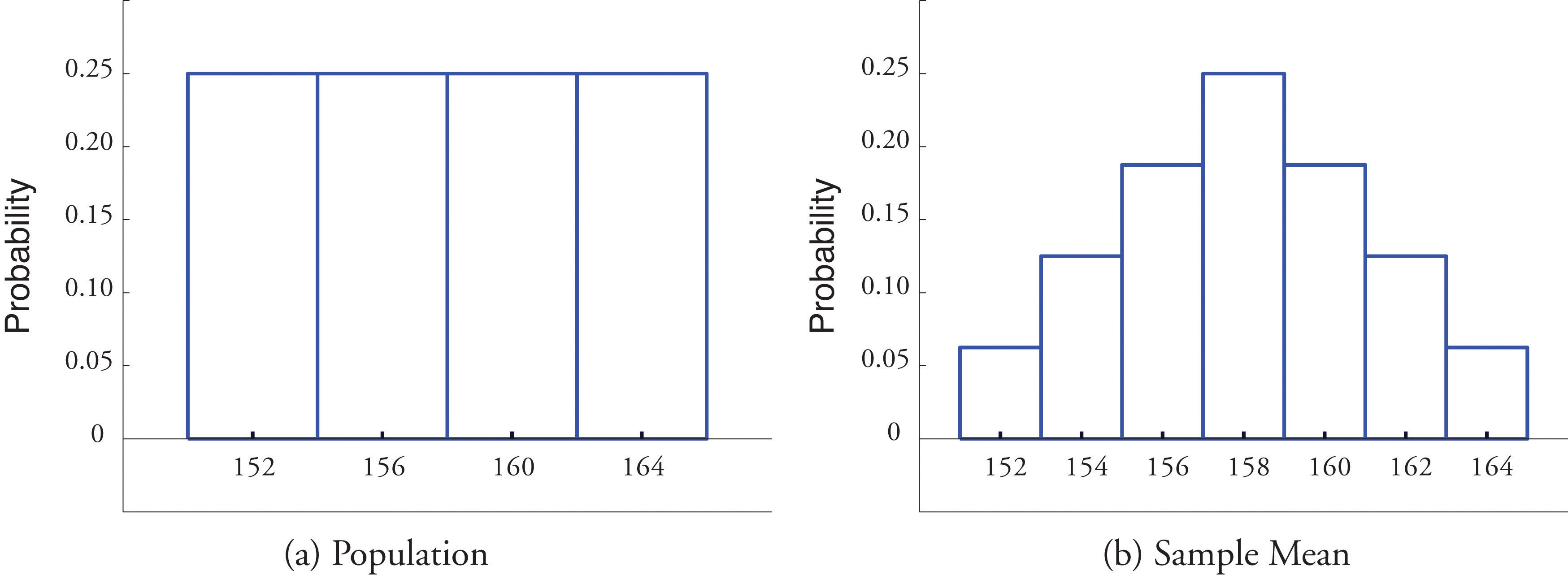
This figure contrasts the distribution of the population with the distribution of the sample mean for repeated samples. The sampling distribution is more concentrated around the center than the population distribution, illustrating that sample means vary less than individual data values. Its emerging bell shape reflects the structure that later connects to the Central Limit Theorem, though that concept extends beyond this subsubtopic. Source.
This distribution is predictable and structured, allowing statisticians to quantify uncertainty, compare samples, and perform formal inference procedures.
Understanding the Mean of the Sampling Distribution
The sampling distribution of the sample mean, often written as x̄, has a special and powerful property: its center is the same as the population’s true mean. This makes the sample mean a particularly useful and trustworthy estimator.
Sampling Distribution of the Sample Mean: The distribution of all possible values of the sample mean computed from repeated samples of the same size drawn from a population.
Because the average of all possible sample means equals the population mean, the sample mean is considered an unbiased estimator. This unbiasedness ensures that with repeated sampling, the estimator does not systematically overestimate or underestimate the true parameter.
EQUATION
= Mean of the sampling distribution of the sample mean
= Population mean
This relationship tells us that, on average, x̄ targets the true population mean, which is essential for reliable inference.
A key implication is that increasing the sample size does not change the center of the sampling distribution. It only affects the spread, which determines how much the sample mean fluctuates between samples.
Understanding the Standard Deviation of the Sampling Distribution
The standard deviation of the sampling distribution, also known as the standard error of the mean, describes the variability of sample means across repeated samples. It quantifies how much the sample mean typically differs from the population mean.
Standard Error of the Mean: The standard deviation of the sampling distribution of the sample mean, measuring the typical deviation of sample means from the population mean.
When sampling with replacement—or when the sample is small relative to the population—the standard error has a consistent mathematical form. This form shows that larger samples reduce the variability of the sample mean, making estimates more precise.
EQUATION
= Standard deviation of the sampling distribution (standard error)
= Population standard deviation
= Sample size
This equation reveals several critical principles:
Larger samples lead to smaller standard errors.
Smaller standard errors mean more consistent sample means.
A population with more variability (larger σ) produces more variable sample means.
The square-root structure reflects diminishing returns: doubling the sample size does not halve the standard error, but reduces it by a factor of .
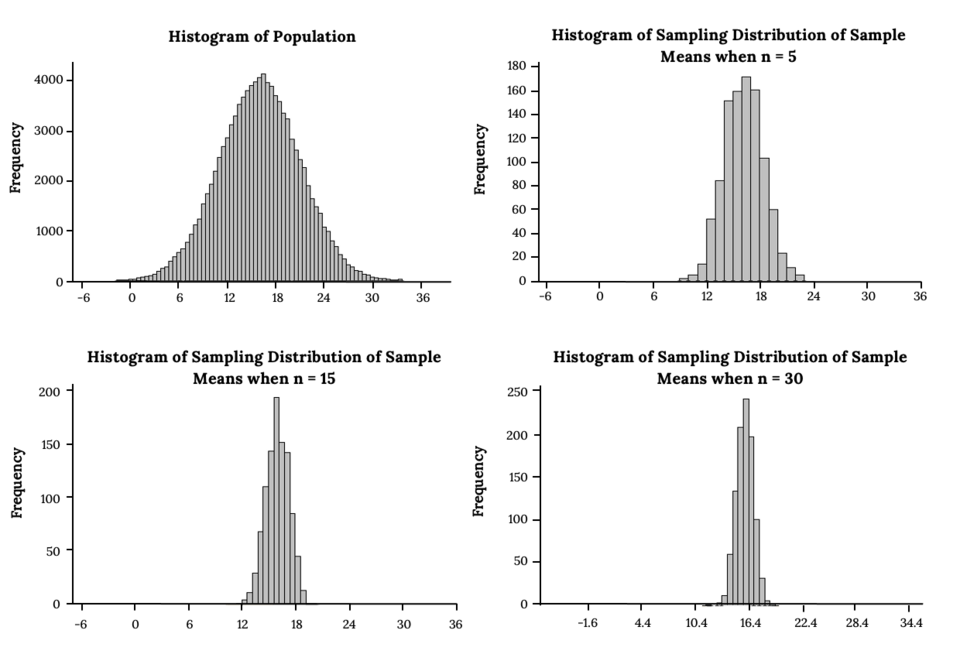
This figure displays a normal population alongside sampling distributions of the sample mean for several sample sizes. As the sample size increases, the sampling distributions become narrower while remaining centered at the same mean, illustrating the decreasing standard error. Its bell-shaped appearance reflects the behavior predicted by the Central Limit Theorem, which extends beyond this subsubtopic but connects naturally to later concepts in the syllabus. Source.
Understanding how the standard error behaves helps students evaluate reliability. When the standard error is small, a single sample mean is likely to be close to the population mean.
The Role of Population Size and Sampling Without Replacement
In many practical settings, sampling occurs without replacement. When a sample makes up more than 10% of the population, this has a noticeable impact on variability because values are not fully independent. However, the specification emphasizes that when:
The sample size is less than 10% of the population,
the difference is negligible, allowing students to use the standard error formula without adjustment. This simplifies computations and aligns with typical AP Statistics practice.
Why These Parameters Matter
Understanding the parameters of the sampling distribution is essential because they:
Support the logic behind statistical inference
Connect the behavior of samples to the characteristics of populations
Provide the foundation for confidence intervals and hypothesis tests
Help students evaluate how reliable a single sample mean is as an estimate
Bullet points can help clarify core ideas students must retain:
The mean of the sampling distribution equals the population mean.
The standard deviation of the sampling distribution shrinks with larger sample sizes.
Sampling with replacement or a sample smaller than 10% of the population ensures the standard error formula is valid.
These parameters describe the predictable behavior of sample means across repeated samples.
The predictable structure of the sampling distribution allows statisticians to reason from samples to populations. Because the mean and standard error are known quantities, they form the mathematical backbone of the inferential procedures that follow in later topics.
FAQ
The distribution of raw data reflects how individual values vary within the population, often showing skewness, clusters, or outliers.
The sampling distribution of the sample mean reflects how the mean of many samples would vary. It is typically smoother, more concentrated around the population mean, and less affected by extreme values.
This occurs because averaging reduces irregularities in the data, making the sampling distribution more stable and predictable.
Averaging cancels out some of the random highs and lows present in individual observations.
Because each sample mean is based on multiple values, the impact of any single unusual observation is diluted.
The larger the sample size, the greater this dilution effect.
This is why the standard error of the mean decreases as sample size increases.
No, the centre and spread of the sampling distribution do not depend on the shape of the population.
Regardless of skewness or irregularities in the population, the sampling distribution still has mean equal to the population mean and standard deviation equal to the population standard deviation divided by the square root of the sample size.
Shape only becomes relevant when considering normality, which is outside the scope of this subsubtopic.
The formulas for the mean and standard deviation of the sampling distribution hold for any sample size because they come directly from probability laws governing expectations and variances.
Even a small sample has its mean centred on the population mean, and its variability follows the same mathematical structure.
Sample size affects only the magnitude of the standard error, not the validity of the formulas.
If the population standard deviation is incorrectly specified, the standard error of the mean will also be inaccurate.
This leads to:
• Underestimation of uncertainty if sigma is too small.
• Overestimation of uncertainty if sigma is too large.
Although the centre of the sampling distribution remains correct, incorrect estimates of sigma affect the precision attached to sample means and weaken the reliability of any inference based on them.
Practice Questions
Question 1 (1–3 marks)
A population has a mean of 50 and a standard deviation of 12. A random sample of size 36 is taken with replacement.
a) State the mean of the sampling distribution of the sample mean.
b) Calculate the standard deviation of the sampling distribution of the sample mean.
c) Explain in context what the standard deviation of the sampling distribution represents.
Question 1
a) 1 mark
• Correctly states that the mean of the sampling distribution is 50.
b) 1 mark
• Correctly calculates the standard deviation as 2 (12 divided by the square root of 36).
c) 1 mark
• States that it represents the typical amount by which sample means vary from the population mean across repeated samples.
(Allow equivalent wording such as “the expected variation of sample means from 50”.)
Total: 3 marks
Question 2 (4–6 marks)
A researcher studies the resting heart rates of adults in a large city. The population has a mean of 72 beats per minute and a standard deviation of 10 beats per minute. The researcher repeatedly takes random samples of size 25 with replacement and records the sample means.
a) Describe the centre and spread of the sampling distribution of the sample mean.
b) Explain why the parameters you give in part (a) are appropriate for describing this sampling distribution.
c) Discuss how the sampling distribution would change if the researcher doubled the sample size to 50.
Question 2
a) 2 marks
• States that the mean of the sampling distribution is 72. (1 mark)
• States that the standard deviation of the sampling distribution is 2 (10 divided by the square root of 25). (1 mark)
b) 2 marks
• Explains that the mean equals the population mean because the sample mean is an unbiased estimator. (1 mark)
• Explains that the standard deviation uses the formula sigma divided by the square root of n because sampling is with replacement (or the population is large), so the usual standard error applies. (1 mark)
c) 2 marks
• States that increasing the sample size would decrease the standard deviation of the sampling distribution. (1 mark)
• Explains that the decrease follows the square root relationship, so doubling n does not halve the spread but reduces it by a factor of the square root of 2. (1 mark)
Total: 6 marks