AP Syllabus focus:
‘If both populations are normally distributed, the sampling distribution of the difference in sample means (x-bar1 - x-bar2) is also normally distributed.
- If the populations are not normally distributed but both sample sizes are ≥ 30, the sampling distribution of (x-bar1 - x-bar2) can be approximated by a normal distribution, facilitating the use of normal probability techniques for inference.’
Understanding when the difference in sample means behaves approximately normally is essential for conducting valid statistical inference and confidently applying normal distribution methods.
Normality of the Sampling Distribution for Differences in Sample Means
The sampling distribution of the difference in sample means, written as , is central to comparing two population means. Because inference procedures such as confidence intervals and significance tests for differences rely on normality, determining when this distribution is normal or approximately normal is an essential step in analysis. The syllabus highlights two primary conditions under which normality is guaranteed or reasonably approximated, depending on the characteristics of the populations and sample sizes involved.
When Both Populations Are Normally Distributed
When the two populations under study each follow a normal distribution, the sampling distribution of is automatically normal, regardless of the sample sizes. The reason lies in the behavior of sample means: if population data are drawn from a normal distribution, then the sample mean is itself normally distributed for any sample size. Since the difference of two normally distributed variables is also normal, the resulting distribution of satisfies normality without requiring large samples.
This feature allows researchers to conduct inference even with small samples, provided the population distributions are known to be normal. In practice, this situation is uncommon unless population shapes are well established or supported by strong contextual evidence.
When Populations Are Not Normally Distributed
In many real-world situations, populations are skewed, multimodal, or otherwise non-normal. In such cases, the sampling distribution of does not begin normally. However, the Central Limit Theorem (CLT) provides a pathway to normality when sample sizes become sufficiently large.
Central Limit Theorem (for sample means): When sample sizes are sufficiently large, the sampling distribution of the sample mean becomes approximately normal, regardless of the shape of the population distribution.
A normal sentence must appear here to ensure proper separation from definition blocks.
The Role of Sample Size (n ≥ 30 Requirement)
The specification states that when populations are not normally distributed, both sample sizes must be at least 30 for the sampling distribution of the difference to be considered approximately normal.
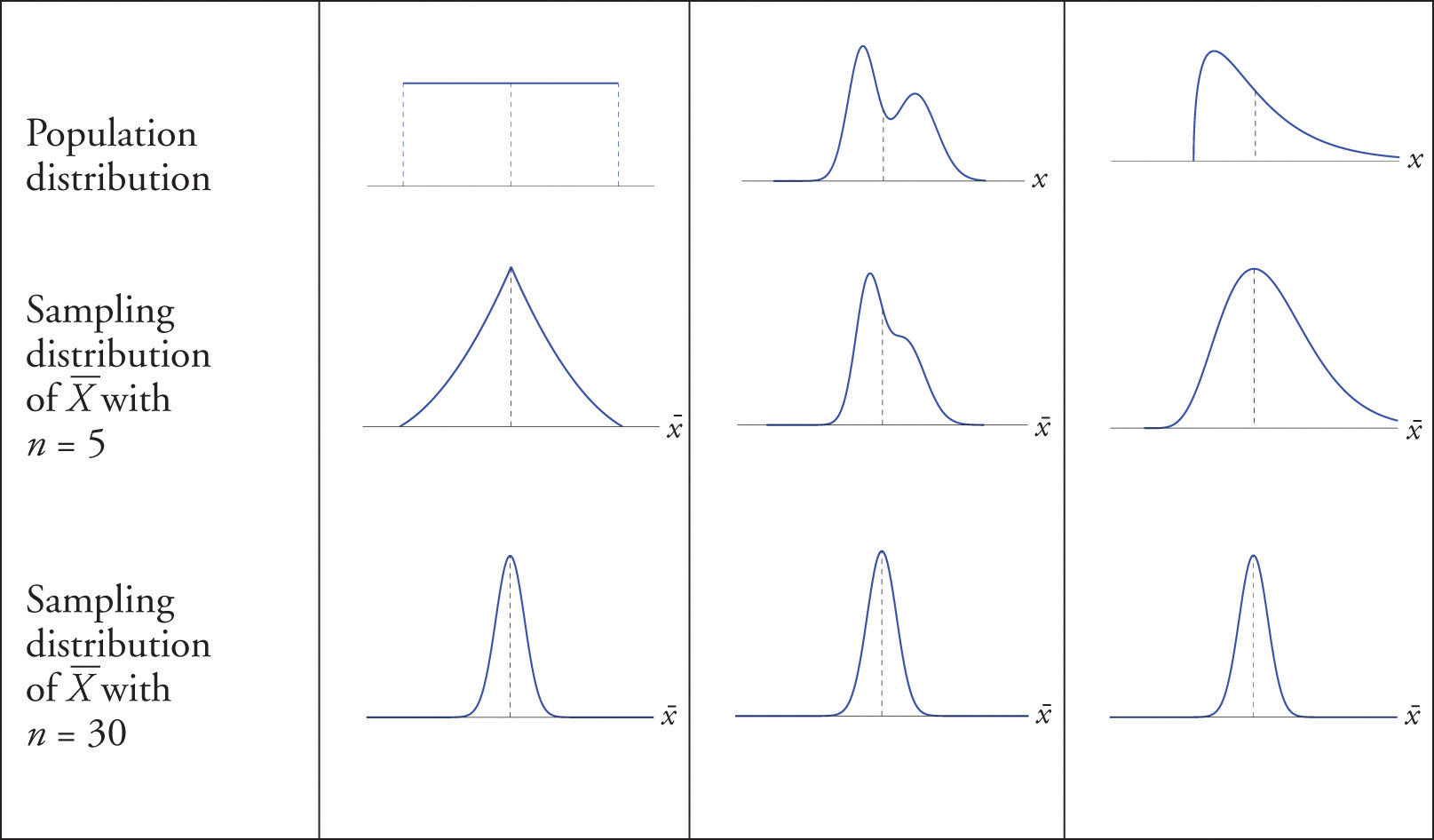
This figure compares a non-normal population to sampling distributions for different sample sizes, showing how larger samples produce more normal sampling distributions. Although drawn for a single sample mean, the same CLT logic applies to both sample means used when studying xˉ1−xˉ2\bar{x}_1 - \bar{x}_2xˉ1−xˉ2. Source.
Key reasons this condition matters include:
Large samples reduce the influence of population skewness, causing the sampling distribution to smooth out.
The distribution of the difference stabilizes only when each sample mean is itself well-approximated by a normal distribution.
Normal approximation techniques, including -procedures, require a reliable normal shape to ensure accurate probability interpretation.
When either sample is smaller than 30 and the population is strongly skewed, applying normal procedures becomes inappropriate without additional justification or alternative methods.
Why Normality Matters for Inference
Normality is not simply a theoretical preference—it determines the validity of commonly used inference tools. Whether constructing confidence intervals or conducting significance tests, analysts typically rely on the properties of the normal distribution to:
Determine critical values
Compute standardized test statistics
Estimate tail probabilities
Interpret variability in differences between sample means
Without normality or at least approximate normality, these procedures lose accuracy. Thus, verifying the conditions for normality is a required early step in any two-sample inference problem involving means.
A normal sentence belongs here to maintain the appropriate spacing before an equation box.
EQUATION
= Sample means from populations 1 and 2
Practical Interpretation of the Normality Criteria
The criteria described in this subsubtopic guide students in determining when normal distribution methods are justified:
If both populations are known or strongly supported to be normal, proceed with inference using any sample size.
If population shapes are unknown or non-normal, ensure n₁ ≥ 30 and n₂ ≥ 30 before using normal procedures.
Always verify independence and random sampling before evaluating normality conditions.
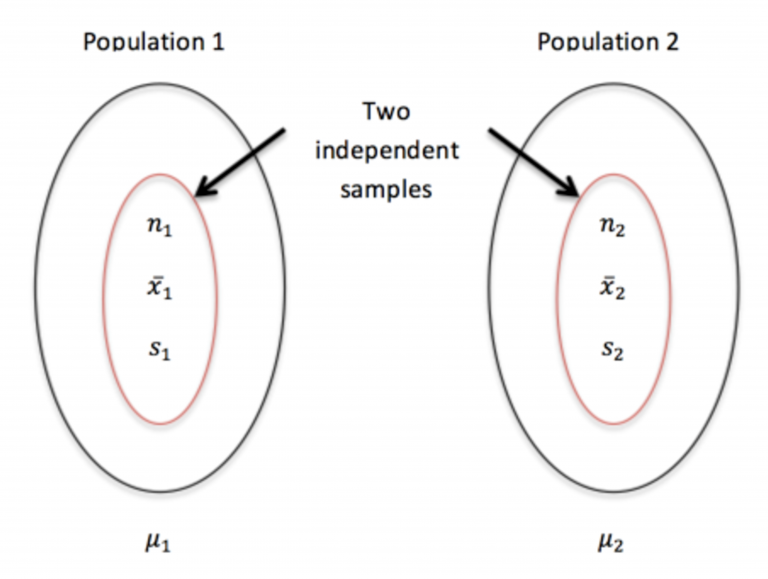
This illustration shows two independent samples drawn from separate populations, each producing its own sample mean. Independence of samples is a required condition before applying normality-based inference to the difference xˉ1−xˉ2\bar{x}_1 - \bar{x}_2xˉ1−xˉ2. Source.
These guidelines ensure that probability calculations involving reflect the true behavior of repeated sampling and that resulting inferences about the difference in population means are statistically sound.
FAQ
Highly skewed or heavy-tailed populations generally require larger samples because their sample means stabilise more slowly. Mildly skewed populations may achieve approximate normality with slightly smaller samples, but the AP guideline of at least 30 per group remains the safe threshold.
In practice, the more irregular the population shape, the more the sampling distribution benefits from increased sample size before inference is attempted.
Only the sample mean from the non-normal population requires the Central Limit Theorem to justify approximate normality.
• If its sample size is at least 30, the difference in sample means can still be treated as approximately normal.
• If its sample size is small, the overall distribution of the difference will not be reliable for normal inference even if the other population is perfectly normal.
The difference between two random variables inherits normality only when both variables are normal or approximately normal. A single non-normal component introduces asymmetry or skewness into the distribution of the difference.
Thus, approximate normality of each sample mean is required before using probability techniques based on the normal distribution for their difference.
Large imbalance is acceptable as long as both samples satisfy the minimum size requirement for non-normal populations.
However, practical considerations include:
• The smaller sample dominates concerns about skewness and non-normality.
• Extremely unbalanced samples may reduce precision, even when normality holds.
• For very small samples paired with very large ones, the larger sample offers no corrective effect on normality.
Yes—while not required by the AP curriculum, exploratory plots can provide informal insight.
Useful checks include:
• Histograms or dot plots of each sample to gauge skewness.
• Normal probability plots to judge whether each sample mean is likely to behave normally.
These tools do not replace theoretical conditions, but they help identify severe skewness or outliers that may undermine normal approximation.
Practice Questions
Question 1 (1–3 marks)
A researcher compares the mean breaking strength of two types of wire, Type A and Type B. The population distributions for both types are strongly skewed. The researcher collects two independent random samples of size n = 30 from each population.
Explain why it is appropriate to use normal distribution methods for the sampling distribution of the difference in sample means.
Question 1 (3 marks total)
• 1 mark: States that the sample size for each group is 30 or greater.
• 1 mark: States that for non-normal populations, large samples allow the sampling distribution of each sample mean to be approximately normal.
• 1 mark: Concludes that because each mean is approximately normal, the difference in sample means will also be approximately normal, making normal methods appropriate.
Question 2 (4–6 marks)
A nutritionist is studying the difference in average sugar content between two brands of cereal. Brand X has a highly skewed population distribution, while Brand Y has a moderately skewed distribution. The nutritionist collects an independent random sample of size 12 from Brand X and an independent random sample of size 40 from Brand Y.
(a) State whether it is appropriate to treat the sampling distribution of the difference in sample means as approximately normal.
(b) Justify your answer using the criteria for normality of the sampling distribution of the difference in sample means.
(c) Explain what the nutritionist would need to change in order to legitimately apply normal distribution methods.
Question 2 (6 marks total)
(a) 1 mark: States clearly that it is not appropriate to treat the sampling distribution of the difference in sample means as approximately normal.
(b) Up to 3 marks:
• 1 mark: Identifies that Brand X’s sample size (12) is less than 30.
• 1 mark: States that the population for Brand X is highly skewed, making normal approximation unreliable for small samples.
• 1 mark: States that normality requires both sample sizes to be at least 30 when populations are not normal.
(c) Up to 2 marks:
• 1 mark: States that the nutritionist must increase the sample size for Brand X to at least 30.
• 1 mark: States that once both samples meet the size requirement, the sampling distribution of each sample mean will be approximately normal, allowing normal methods for the difference.