AP Syllabus focus:
‘Lincoln used speeches such as the Gettysburg Address to portray the struggle against slavery as fulfilling America’s founding democratic ideals.’
The Gettysburg Address reframed the Civil War as a struggle to preserve and expand democratic principles, connecting wartime sacrifice to the nation’s founding ideals and the promise of equality.
Gettysburg Address in Historical Context
Delivered on November 19, 1863, at the dedication of the Soldiers’ National Cemetery in Gettysburg, Abraham Lincoln’s Gettysburg Address came after one of the bloodiest and most consequential battles of the Civil War.
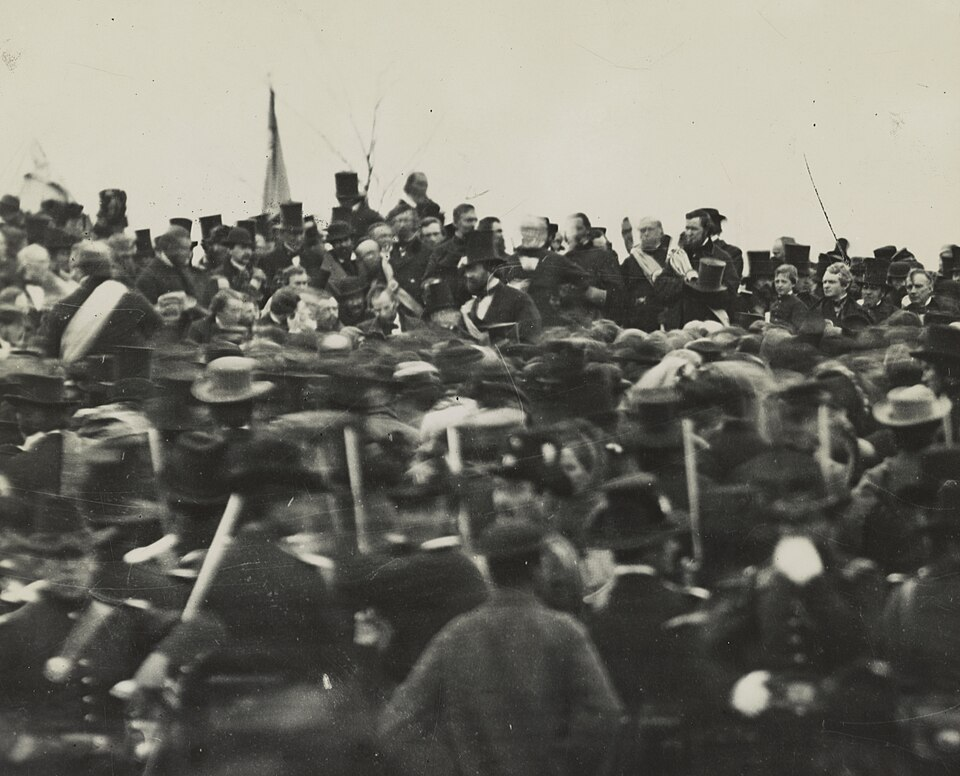
Abraham Lincoln stands among a crowded gathering during the dedication of the Soldiers’ National Cemetery at Gettysburg on November 19, 1863. This rare photograph captures the ceremonial setting in which the Gettysburg Address was delivered, emphasizing its public and national significance. The presence of dignitaries, soldiers, and citizens highlights how Lincoln linked wartime sacrifice to democratic ideals. Source.
The address was written while the Union war effort was shifting toward a strategy of total war and political rhetoric increasingly emphasized the moral purpose of ending slavery. Lincoln sought to explain why the war must continue and why the Union’s cause transcended mere preservation of the nation. By rooting his message in foundational American principles, he directly connected wartime sacrifices to a broader project of redefining the meaning of American democracy.
Democratic Ideals as the Core Message
Lincoln framed the Civil War as a test of whether a nation “conceived in Liberty” and dedicated to the proposition that “all men are created equal” could endure. These phrases invoked the Declaration of Independence, emphasizing equality as a guiding national principle. This rhetorical move elevated the Union war effort from a political dispute to a moral crusade aligned with the ideals of the country’s founding.
The Principle of Popular Government
In highlighting that government rests on the consent of the governed, Lincoln reaffirmed popular sovereignty, the idea that legitimate authority arises from the people.
Popular Sovereignty: A political principle asserting that governmental authority derives from the consent and participation of the governed.
Lincoln argued that the Civil War threatened the survival of this principle, presenting the conflict as a struggle to prove whether democratic self-rule could withstand internal rebellion. This interpretation built support for the Union cause by presenting the war as a defense of republican government rather than simply a military campaign.
A key element of the address was Lincoln’s call for “a new birth of freedom”, a phrase that signaled a national transformation toward extending liberty more fully.
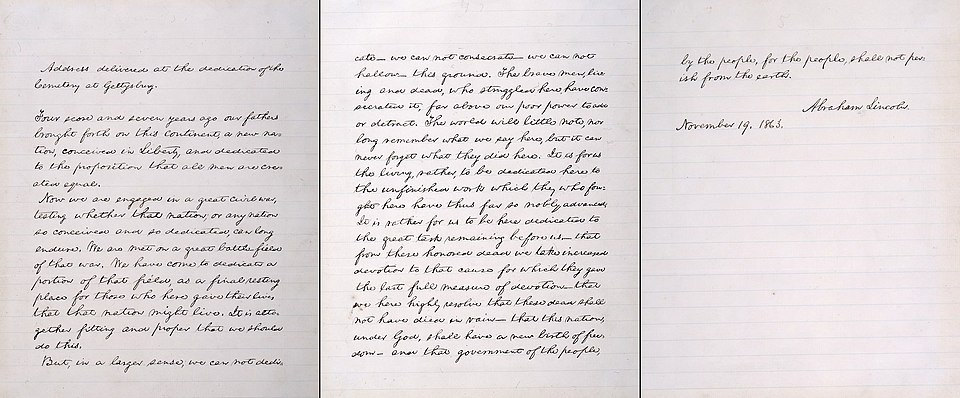
This is the Bliss copy, Lincoln’s final handwritten draft of the Gettysburg Address. It includes the now-standard phrasing such as “a new birth of freedom” and the affirmation of democratic governance. The manuscript demonstrates Lincoln’s deliberate effort to connect Union aims, emancipation, and national ideals. Source.
This message tied the Union’s objectives to the growing federal commitment to emancipation, reinforcing that the fight against slavery was central to the war’s democratic meaning.
Linking the War to the Nation’s Founding
Lincoln used the rhetorical structure of the address to draw a line from 1776 to 1863, asserting that the founding ideals must guide current action.
Founding Principles Reinterpreted
Lincoln did not reference the Constitution directly; instead, he emphasized the Declaration’s egalitarian principles. This choice allowed him to present the war as a continuation—rather than a betrayal—of the nation’s original mission.
The address suggested that the Union represented the embodiment of democratic principles, while the Confederacy threatened them through secession and the defense of slavery. In this interpretation, Union victory became essential not only for territorial unity but for the survival of democratic governance itself.
Sacrifice and National Purpose
One of the address's central themes was that the living must dedicate themselves to completing “the unfinished work” of those who died at Gettysburg. Lincoln argued that their sacrifice created a duty to ensure that democratic ideals prevailed.
Moral and Political Recommitment
Lincoln used the battlefield setting to underscore the costs of preserving democracy. He insisted that the dead had “given the last full measure of devotion”, transforming the war into a sacred national mission. This language reinforced public resolve at a moment when war-weariness was rising in the North.
Lincoln’s emphasis on national unity, equality, and freedom reoriented public understanding of the conflict. Rather than viewing the Civil War as simply a fight to restore the Union, Americans were encouraged to see it as part of an ongoing struggle to realize the nation’s democratic ideals.
Impact on Wartime Purpose and Identity
The Gettysburg Address did more than memorialize the fallen—it reshaped how Americans understood the meaning of the Civil War.
Effects on Public Opinion and Union Policy
The speech strengthened support for emancipation by portraying it as inseparable from the nation’s founding mission.
It reinforced Lincoln’s broader rhetorical strategy of connecting Union victory to moral purpose, which helped prevent European powers from recognizing the Confederacy.
It contributed to a growing national identity focused on equality and popular government, themes that would influence Reconstruction-era constitutional changes.
Legacy for Democratic Ideals
Lincoln’s articulation of democracy in the Gettysburg Address provided a framework for understanding both the Civil War and the nation’s future.
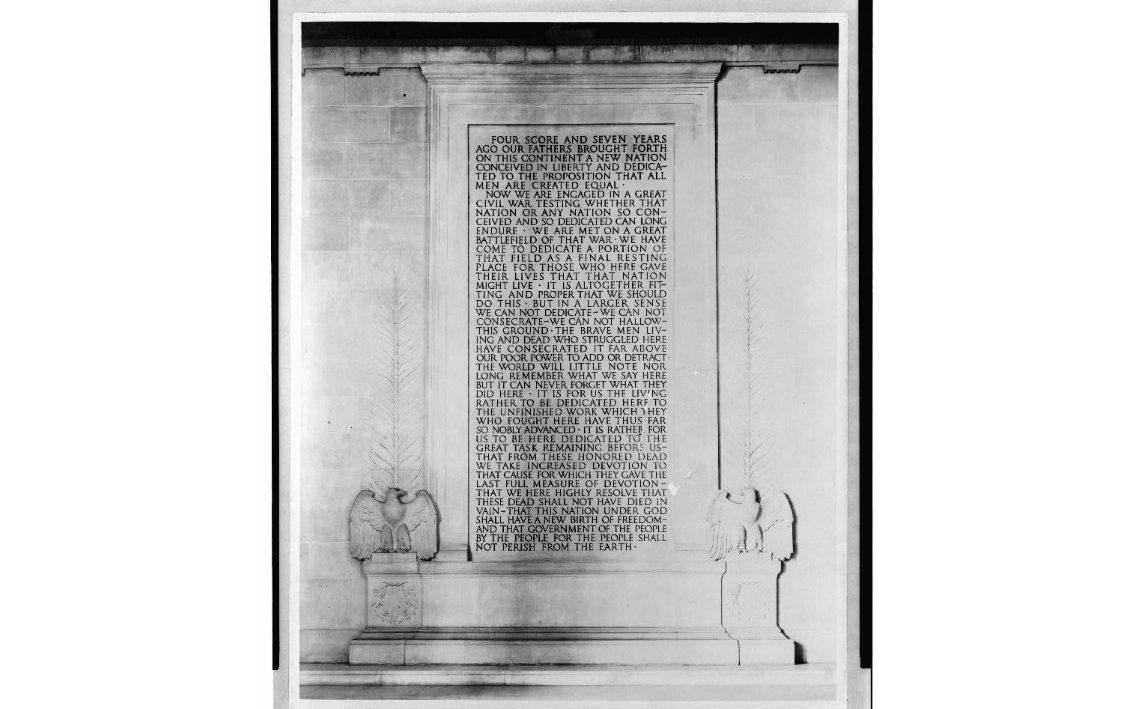
The interior of the Lincoln Memorial features the full text of the Gettysburg Address carved in stone. This monumental presentation reflects the speech’s enduring role in defining American ideals of equality and democratic governance. The architectural setting underscores how the address became a national symbol of the Civil War’s transformative meaning. Source.
His emphasis on equality and self-government helped justify wartime emancipation policies and later shaped the Reconstruction Amendments, which sought to embed those ideals into constitutional law.
The address endures because it defined American democracy not simply as a set of institutions but as a moral commitment requiring continuous effort—an idea that emerged directly from the Civil War’s transformative struggle.
Practice Questions
(1–3 marks)
Explain one way in which Abraham Lincoln’s Gettysburg Address linked the Civil War to the founding ideals of the United States.
Question 1 (1–3 marks)
Award marks for any of the following, up to a maximum of 3:
1 mark for identifying a valid link between the Civil War and founding ideals (e.g., equality, liberty, popular government).
1 additional mark for explaining how Lincoln referenced the Declaration of Independence or founding principles (e.g., “all men are created equal”).
1 additional mark for showing how this connection reframed the war as a struggle to preserve democracy or expand freedom.
(4–6 marks)
Analyse how the Gettysburg Address reshaped the Union’s understanding of the Civil War’s purpose and contributed to broader democratic ideals during the conflict.
Question 2 (4–6 marks)
Award marks for the following elements, up to a maximum of 6:
1–2 marks for describing how Lincoln reinterpreted the war as more than a fight to preserve the Union.
1–2 marks for explaining how the address emphasised democratic ideals such as equality, self-government, and national purpose.
1–2 marks for analysing broader effects, such as strengthening support for emancipation, reinforcing the moral purpose of the Union war effort, or influencing later constitutional developments.
Responses that demonstrate a clear, coherent line of argument and use accurate contextual knowledge should receive marks at the top of the range.
FAQ
Lincoln aimed for a concise, solemn tone that matched the cemetery dedication and the enormous human cost of the battle.
He believed that a short speech could deliver a powerful moral message without overshadowing the purpose of the ceremony.
The brevity also reflected his desire to elevate principles rather than provide detailed political argument, using simplicity to reinforce universal democratic ideals.
Reactions varied widely. Some newspapers praised its eloquence, while others dismissed it as too short or insufficiently ceremonial.
Many attendees reportedly did not recognise its significance at the moment, partly because the main oration lasted over two hours and dominated public attention.
The speech’s reputation grew substantially only in the decades after Lincoln’s death, when its themes gained symbolic national importance.
Lincoln employed parallelism, biblical cadence and deliberate repetition to connect the living and the dead within a shared national mission.
He used abstract but universally resonant concepts such as liberty, equality and nationhood, avoiding divisive political language.
The closing triad — “of the people, by the people, for the people” — functioned as a rhythmic reaffirmation of popular government.
Lincoln’s emphasis on equality as the nation’s founding principle encouraged later political leaders, reform movements and courts to treat the Declaration as a moral guide.
It helped shift public understanding from viewing the document solely as a statement of independence to seeing it as a blueprint for democratic rights.
This reinterpretation later shaped debates on suffrage, civil rights and constitutional amendments.
The speech links individual sacrifice to collective responsibility, presenting democracy as something requiring continuous effort.
Its framing of the nation as an unfinished project encourages citizens to view civic participation as essential to preserving freedom.
Because the address symbolically connects past, present and future, it remains a touchstone for defining what it means to belong to the American political community.