AP Syllabus focus:
‘U.S. leadership in postwar peace settlements helped define the emerging international order after 1945, reflecting America’s new global power.’
The post–World War II peace settlements reshaped diplomacy, institutions, and global power structures as the United States leveraged its unprecedented strength to design an international order intended to prevent future conflict.
U.S. Ascendancy and the Need for Postwar Reconstruction
The devastation across Europe and Asia created a vacuum in global leadership. The United States, emerging with the world’s strongest industrial capacity, military presence, and financial resources, took a central role in determining the shape of peace. American policymakers believed that economic instability had contributed to the rise of fascism; therefore, reconstruction, security cooperation, and international economic stability became essential pillars of postwar planning.
Designing a New International Order
Institutions for Collective Security and Diplomacy
U.S. influence was most visible in the creation of new international institutions intended to reduce the likelihood of war.
The United Nations (UN), established in 1945, reflected American support for multilateral diplomacy and collective security.
The UN Security Council institutionalized major-power cooperation, giving the United States a permanent seat and veto power.
Specialized UN agencies coordinated humanitarian efforts, refugees, and food distribution, projecting American ideals of global responsibility.
Collective Security: A system in which nations act together to deter or respond to threats, reducing the likelihood that any single state must confront aggression alone.
American participation in the UN marked a departure from the isolationism that characterized the interwar years, signaling that the U.S. intended to remain actively engaged in global diplomacy.
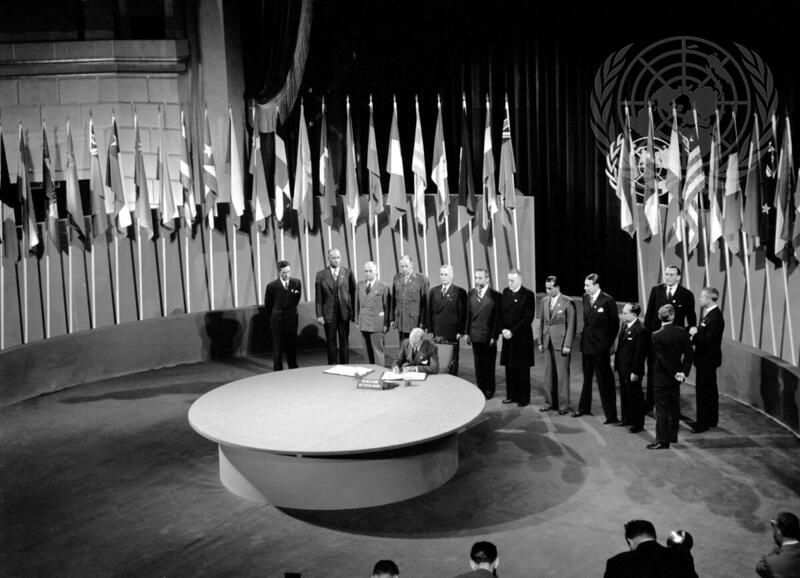
Alexander Loudon of the Netherlands signs the United Nations Charter during the San Francisco Conference in June 1945. The ceremony symbolized broad international agreement on a new collective-security organization designed to prevent another global war. The identification of this specific delegate and country provides historical detail beyond what AP students are required to memorize but helps illustrate the global scope of the settlement. Source.
A brief normal sentence must appear here before the text continues to avoid consecutive definition blocks.
The Bretton Woods Framework and Economic Stabilization
The U.S. also shaped postwar economic settlements through the Bretton Woods Conference (1944), which established rules for international finance.
Creation of the International Monetary Fund (IMF) to stabilize exchange rates.
Establishment of the World Bank to fund reconstruction and development.
Promotion of currency cooperation tied to the U.S. dollar, reflecting American financial dominance.
International Monetary System: The set of rules, institutions, and procedures governing global exchange rates, capital flows, and financial stability.
Policymakers believed that stable global markets would prevent the economic crises that had encouraged extremist politics in the 1930s.
Peace Settlements and the Reconstruction of Former Enemies
Occupation and Reform in Germany and Japan
American supervision of defeated Axis powers played a central role in shaping the postwar settlement.
In Germany, the U.S. supported demilitarization, denazification, and democratic governance in its occupation zone.
Growing tensions with the Soviet Union led the U.S. to favor rebuilding West Germany’s economy to create a stable partner in Europe.
In Japan, the U.S. oversaw constitutional reform, land redistribution, and demilitarization while promoting democratic institutions and economic modernization.
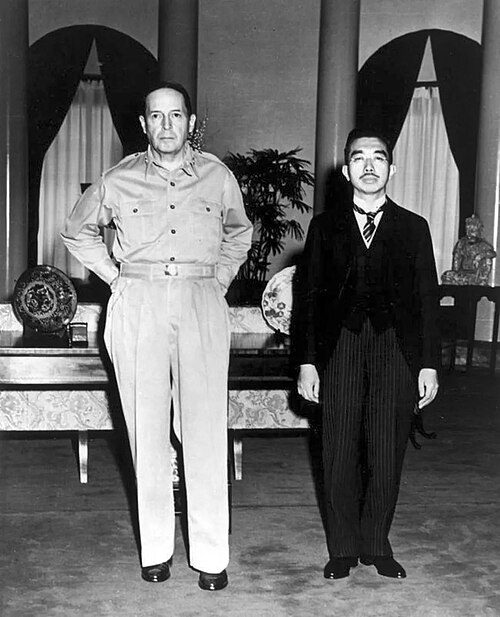
General Douglas MacArthur, the Supreme Commander for the Allied Powers, stands beside Emperor Hirohito at their first meeting in Tokyo in September 1945. The stark contrast between the casually dressed American general and the formally dressed emperor visually reflects the shift in political authority during the U.S.-led occupation. The precise date and location of this meeting go beyond AP requirements but help students situate Japan’s postwar transformation in a specific historical moment. Source.
These policies reflected both humanitarian goals and geopolitical strategies as early Cold War divisions emerged.
Territorial Adjustments and the Fate of Empires
Formal peace treaties and wartime conferences—including Yalta and Potsdam—addressed territorial issues, war crimes, and the dismantling of European empires.
The U.S. supported self-determination movements but also prioritized stability in regions essential to containing Soviet influence.
Former Axis colonies experienced rapid political changes, sometimes encouraged and sometimes managed by American policymakers seeking predictable postcolonial relationships.
Containment, Early Cold War Dynamics, and the Postwar Order
Aligning Reconstruction With Emerging Geopolitical Rivalries
Although the primary goal of peace settlements was rebuilding global stability, early conflicts with the Soviet Union shaped U.S. approaches.
American leaders feared the spread of communism, believing it threatened democratic institutions and open markets.
Economic reconstruction became tied to political alignment, particularly through the Marshall Plan (1947).
Peace settlements thus served dual purposes: rebuilding war-torn societies and encouraging governments to align with democratic capitalism.
Containment: A U.S. foreign policy strategy aimed at preventing the expansion of Soviet influence during the early Cold War.
The incorporation of economic aid and security partnerships into the peace framework ensured that U.S. leadership became a defining feature of the emerging global order.
A normal sentence is placed here to follow the required spacing between definition blocks.
Structuring Alliances and Long-Term Security
While the immediate postwar years focused on peace treaties, they laid the groundwork for later security alliances.
U.S. policymakers envisioned cooperative defense structures to deter future wars.
The stability created by occupation reforms and economic reconstruction prepared the way for alliances such as NATO (1949), though NATO itself lies beyond the formal bounds of peace-settlement agreements.
These developments demonstrated how peace settlements and diplomacy shaped not only short-term stabilization but also long-term strategic frameworks.
The Broader Impact of U.S. Leadership on the Postwar World
American dominance in military, economic, and political arenas ensured that postwar settlements reflected U.S. priorities. The resulting international order emphasized:
Democratic governance and political reform in former Axis states.
Economic interdependence through multilateral institutions.
Collective security grounded in American commitment to global engagement.
These features underscored the syllabus focus: U.S. leadership in postwar settlements defined the emerging structure of global relations after 1945, solidifying America’s position as the central power in the postwar world.
Practice Questions
Question 1 (1–3 marks)
Explain one way in which the United States shaped the post-Second World War international order through its role in peace settlements.
Question 1
• 1 mark: Identifies a valid way the US shaped the post-war order (e.g., creation of the United Nations, Bretton Woods system, occupation reforms in Japan or Germany).
• 2 marks: Provides a basic explanation of how this action influenced the international order (e.g., promoting collective security, stabilising currencies).
• 3 marks: Offers a clear and accurate explanation showing a direct link between US actions and the formation of a new international structure.
Question 2 (4–6 marks)
Evaluate the extent to which American leadership in post-war peace settlements (1944–1947) contributed to the emergence of a stable international order. In your answer, consider both diplomatic and economic factors.
Question 2
• 1–2 marks: Provides general statements about US actions after the war with limited detail (e.g., the US helped create the UN).
• 3–4 marks: Explains with some accuracy how American leadership in peace settlements contributed to stability, addressing at least one diplomatic factor (e.g., UN Security Council, occupation reforms) and one economic factor (e.g., IMF, World Bank).
• 5–6 marks: Presents a well-reasoned evaluation of the extent of US impact, including both diplomatic and economic dimensions, while acknowledging limitations or alternative interpretations (e.g., Soviet resistance, early Cold War tensions).
FAQ
The United States believed long-term stability required open markets, liberal democracy, and multilateral institutions with broad participation. The Soviet Union prioritised territorial buffers and influence over neighbouring states.
These contrasting goals led the US to promote international bodies such as the UN and economic frameworks like Bretton Woods, while the USSR favoured bilateral agreements and controlled spheres of influence.
This ideological divide shaped negotiations at Yalta and Potsdam and influenced how each superpower interpreted peace agreements.
US officials believed that global economic instability in the interwar years had contributed to rising extremism. Preventing another depression was therefore linked to preventing another war.
Key reasons included:
• Protecting access to international trade and investment
• Avoiding a return to protectionism
• Ensuring European recovery to prevent political fragmentation
• Maintaining US economic leadership through dollar-based systems
American policymakers sought a balance between international leadership and avoiding the appearance of entangling alliances, which had been widely criticised after the First World War.
Congressional attitudes influenced how the US engaged with new institutions; leaders framed the UN and Bretton Woods as cooperative rather than binding bodies.
This helped secure public support while allowing the US to guide key decisions within those institutions.
Legal restructuring was central to transforming former Axis powers into stable, democratic states that could integrate into the US-led international order.
In Japan, American officials encouraged a new constitution that reduced imperial authority and expanded civil liberties.
In Germany, decentralisation and the reorganisation of judicial structures were intended to dismantle authoritarian legal frameworks and prevent the re-emergence of militarism.
Reactions varied depending on national interests and wartime experiences.
Many welcomed American leadership because it provided economic aid and a check on Soviet expansion.
Others expressed concerns about unequal influence, particularly within the UN Security Council, where great powers received permanent seats and veto authority.
Smaller nations generally accepted US dominance as the price of a stable and functional post-war system.