AP Syllabus focus: ‘State formation showed continuity, innovation, and diversity, including new Hindu and Buddhist states emerging in South and Southeast Asia.’
State formation in South and Southeast Asia from c. 1200 to c. 1450 combined older political traditions with new strategies for control. Geography, local powerholders, and religious legitimacy produced varied state forms rather than a single dominant imperial model.
Regional Context for State Formation
South and Southeast Asia contained dense agrarian cores, upland frontiers, and island/coastal zones. These environmental differences encouraged political systems that could:
Expand through alliances and conquest
Hold territory via local intermediaries (chiefs, nobles, warrior elites)
Use religion and kingship ideology to unify diverse populations
Key Term for Political Patterning
Mandala model: A pattern of rule in which power radiated outward from a centre through shifting alliances and tribute relationships, with borders that were often fluid rather than fixed.
States often grew by drawing nearby communities into a ruler’s sphere rather than by enforcing modern-style boundaries.
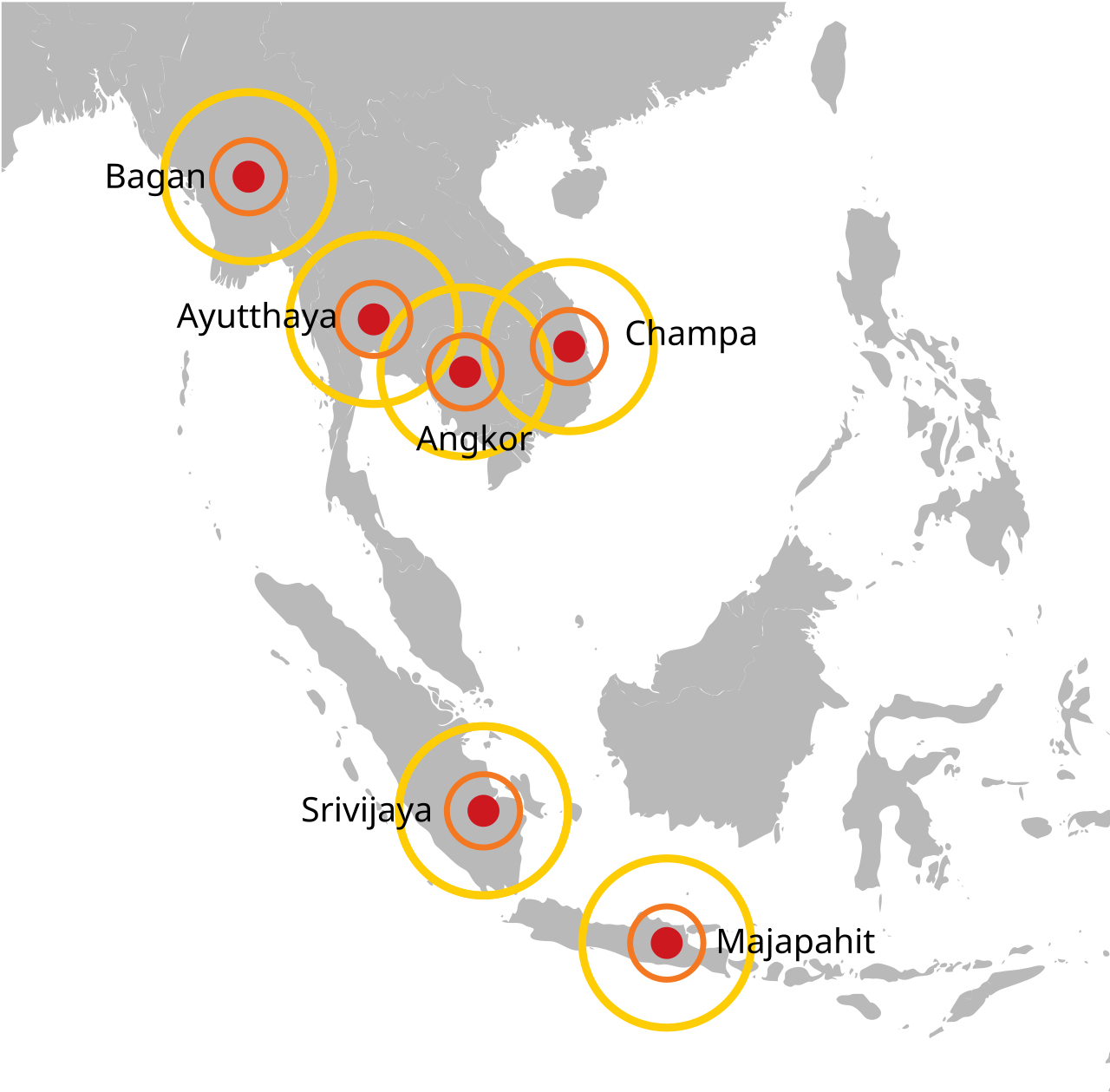
This map illustrates the mandala-style political geography of classical Southeast Asia by depicting multiple major power centers and their overlapping spheres of influence. The visualization helps students see how authority could be strongest near a core court and taper outward through tributary ties, rather than being bounded by sharp, modern borders. It is a useful schematic for comparing “networked” rule to territorial empires. Source
Continuity in State Formation
Across the period, many states drew on long-standing political expectations about rulership and social hierarchy.
Kingship as sacred or morally sanctioned persisted, with rulers presenting themselves as protectors of order and prosperity.
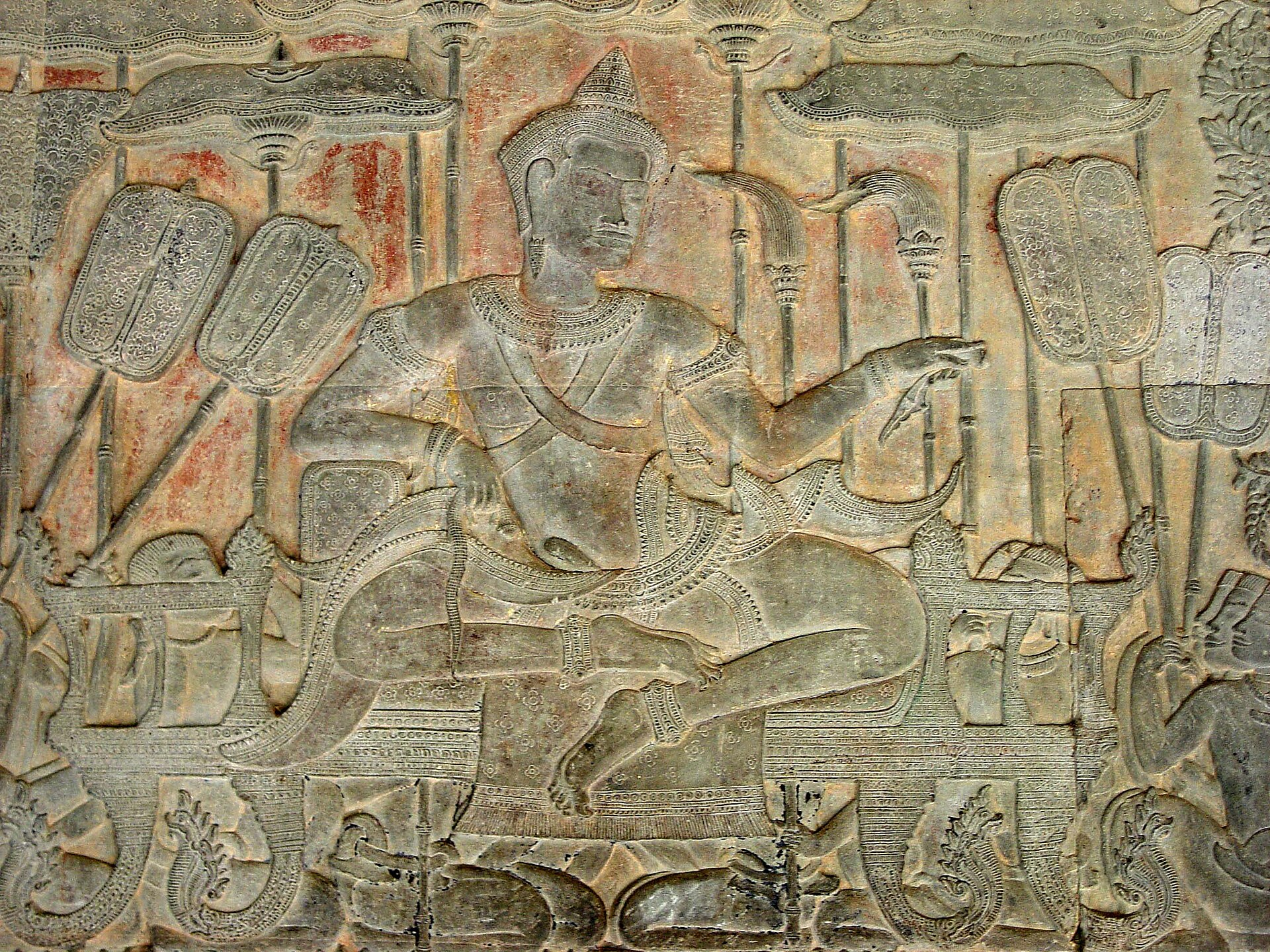
This photograph shows a section of Angkor Wat’s bas-reliefs depicting King Suryavarman II in a formal procession, surrounded by parasols and attendants that signal rank and royal authority. The scene offers a visual example of how court ceremony and sacred kingship projected legitimacy in Southeast Asian Hindu-Buddhist polities. As a primary artistic source, it also reinforces how rulers used monumental religious architecture to broadcast power. Source
Land revenue remained central: controlling farming populations and surplus supported courts, armies, and officials.
Patronage networks continued to structure politics, as rulers rewarded elites with offices, land rights, or honors in exchange for loyalty.
Continuity with Earlier Cultural-Political Frameworks
Even when dynasties changed, claims to authority frequently referenced inherited traditions of:
Courtly culture and ceremonial display
Legal and ethical ideals associated with proper rule
Institutional reliance on regional powerbrokers to administer distant areas
Innovation in Political Organisation
At the same time, c. 1200–1450 saw important adaptations as rulers responded to competition and demographic change.
States experimented with more regularised administration, including clearer chains of command and record-keeping where feasible.
Military organisation often shifted toward professionalised warrior groups or standing forces in core regions, improving a ruler’s capacity to enforce demands.
Some regimes used new capital sites or reorganised settlement patterns to strengthen control over strategic river valleys, passes, or fertile plains.
Innovation Driven by Competition
Because multiple centres of power frequently coexisted, rulers innovated to:
Secure succession and stabilise elite support
Reduce dependence on any single noble faction
Integrate newly incorporated peoples through negotiated autonomy and obligations
Diversity of State Structures
State formation showed strong diversity across South and Southeast Asia, shaped by geography and local social organisation.
Centralised cores with looser peripheries were common, especially where transport and communication limited direct rule.
City-based authority could coexist with wide rural hinterlands under varied levels of supervision.
In maritime and archipelagic settings, influence could be organised through nodes of authority rather than continuous land control.
What “Diversity” Looked Like in Practice
Political systems ranged across:
Highly ceremonial courts relying on ritual legitimacy
Pragmatic coalitions of war leaders and landed elites
Flexible mandala-style networks with overlapping loyalties among neighbouring rulers
Hindu and Buddhist State Formation
The syllabus emphasis includes the emergence of new Hindu and Buddhist states, which illustrates how religion and politics intertwined.
Rulers used Hindu and Buddhist ideas to present kingship as rightful and beneficial.
Religious institutions (temples, monasteries, learned communities) could reinforce authority by:

These museum images document Borobudur, a major Buddhist monument in Central Java associated with the Shailendra dynasty, including views of its stupas and sculptural relief program. The architectural form and iconography demonstrate how Buddhist institutions could serve as enduring, state-sponsored centers of ritual, learning, and prestige. This provides a concrete material example of religion functioning as a shared political language across diverse societies. Source
Endorsing rulers’ legitimacy
Supporting literacy and administrative skills
Providing social services that enhanced state prestige
Religious affiliation did not eliminate local variation; instead, shared traditions offered a common political language that different states adapted to their circumstances.
Practice Questions
Explain one way state formation in South and Southeast Asia (c. 1200–1450) showed continuity. (2 marks)
1 mark for identifying a valid continuity (e.g., sacred kingship, reliance on land revenue, patronage of elites).
1 mark for a brief explanation of how it supported state formation (e.g., legitimised rule, financed administration/armies, secured loyalty).
“State formation in South and Southeast Asia (c. 1200–1450) was characterised by innovation and diversity.” Explain how this statement is supported by evidence. (6 marks)
1–2 marks: Defines or clearly frames innovation and diversity in context.
2–4 marks: Provides two pieces of accurate evidence of innovation/diversity (e.g., more regularised administration, military reorganisation, centralised cores with looser peripheries, mandala-style networks).
5–6 marks: Explains how the evidence demonstrates both innovation and diversity, with clear causal links to state formation (control, legitimacy, integration).
FAQ
Control of water often meant control of harvests and labour.
Irrigation works required coordination, helping elites justify taxation and authority.
Reliable surplus supported soldiers, officials, and urban centres.
Power frequently depended on relationships rather than mapped frontiers.
Peripheral communities might pay tribute when convenient, shift loyalty after conflict, or retain local leaders while acknowledging an external ruler.
Court and religious languages could standardise rule.
Literacy supported grants, tax records, and diplomacy, while learned specialists (scribes, clerics) helped rulers project authority beyond their immediate households.
Sustained rivalry encouraged adaptation.
Leaders invested in fortifications, recruited specialised fighters, and reorganised command structures to respond faster—often strengthening central authority in core areas.
Tribute was often negotiated and symbolic as well as economic.
Payments and ceremonies signalled submission.
Obligations could include military support or hosting envoys, and they could be renegotiated as power shifted.