CIE Syllabus focus:
'Candidates should understand sole traders, partnerships and limited companies, including public limited companies, as different legal and ownership structures.'
Choosing the correct business entity affects who owns the business, who controls it, and how the law views it. This topic compares the main entity types by legal form and ownership pattern.
Understanding business entities
A business entity is the form through which business activity is carried out. For this syllabus point, the most important distinctions are:
who owns the business
whether the business has a separate legal identity
how ownership is represented
whether ownership and management are the same or separated
Legal structure explains the relationship between the business and the law. Ownership structure explains who has a claim over the business and how that claim is held.
A key distinction is whether a business is incorporated or unincorporated. Sole traders and partnerships are usually unincorporated. Limited companies are incorporated.
Sole traders
A sole trader is the simplest ownership structure because one person owns the business.
Sole trader: A business owned by one person, with the owner and the business treated as the same legal person.
In a sole trader business, the owner provides the capital, makes the main decisions, and is entitled to the profits. If the business makes a loss, that loss belongs to the owner.
Because the business is not legally separate from its owner, the assets and liabilities of the business are closely linked to the owner. The business may trade under a business name, but that does not create a separate legal entity.
This structure combines ownership and control in one person. The essential features are one owner and no separate legal identity.
Partnerships
A partnership has more than one owner, so ownership is shared.
Partnership: A business owned by two or more persons who agree to carry on business together and share its results.
In a partnership, the owners are called partners. Partners contribute capital to the business and share profits according to the agreed arrangement. They may also take part in managing the business.
For this syllabus, a partnership is normally treated as an unincorporated form of business. This means the partnership does not have the same separate legal standing as a limited company. The partners are therefore central to the identity of the business.
A partnership differs from a sole trader mainly because ownership is shared rather than held by one individual. However, it is similar in that the business is not usually viewed as a separate legal person in the same way as a company.
Limited companies
A limited company has a very different legal structure from a sole trader or partnership.
Limited company: An incorporated business that has a separate legal identity from its owners.
Because the company is a separate legal entity, it can own assets, enter contracts, and incur liabilities in its own name. The business does not legally disappear when shareholders change.
Ownership in a limited company is divided into shares. The owners are called shareholders.
This means ownership can be transferred by buying and selling shares, subject to the rules applying to that type of company. It also means that ownership and day-to-day management may be separated. Shareholders own the company, but directors usually manage it on their behalf.
Another important feature is limited liability.
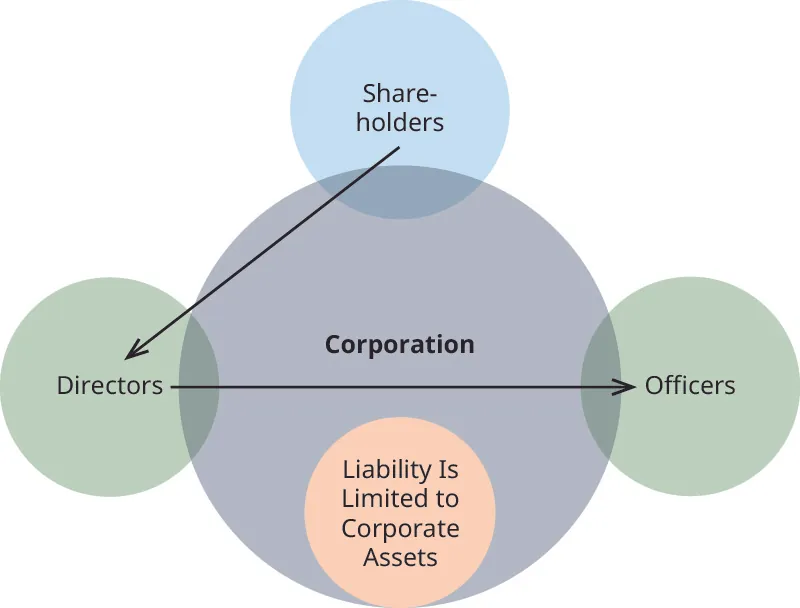
This diagram summarizes the corporate governance chain: shareholders elect directors, and directors appoint officers to run operations. It also emphasizes that limited liability generally limits financial exposure to the corporation’s assets rather than shareholders’ personal assets. This is a visual bridge between the ideas of ownership (shareholders) and control (directors/officers). Source
Limited liability: A legal position in which the owners' financial loss is normally limited to the amount invested in the company.
This legal separation between company and owners is one of the main reasons why limited companies are treated as a distinct entity type. In accounting and business language, the company itself is the legal owner of its assets, not the individual shareholders.
Public limited companies
A public limited company is a specific type of limited company.
Public limited company: A limited company that may offer its shares to the public.
A public limited company still has all the core legal features of a limited company. It is incorporated, has separate legal identity, and is owned by shareholders. The difference is mainly in the ownership structure and the way shares may be offered.
Because shares can be offered to the public, ownership may be spread across a very large number of shareholders. This can produce a much wider separation between ownership and control than in a sole trader business or a partnership.
Not every limited company is public. Some limited companies are privately owned, while a plc is organized so that public share ownership is possible. A public limited company is still a limited company, not a completely separate category outside company ownership.
Key structural differences to identify
When comparing these entities, focus on structure rather than opinion.
Sole trader
one owner
unincorporated
owner and business are the same legal person
Partnership
two or more owners
unincorporated in normal syllabus treatment
partners jointly own the business
Limited company
ownership divided into shares
incorporated
separate legal entity from shareholders
Public limited company
a type of limited company
ownership through shares
shares may be offered to the public
A strong understanding of this topic depends on separating legal structure from ownership structure. Legal structure asks whether the business exists separately from its owners. Ownership structure asks whether the business belongs to one owner, several partners, or shareholders.
Practice Questions
State two features of a partnership as a type of business entity. [2]
1 mark for each valid feature, up to 2 marks:
owned by two or more persons
ownership is shared between partners
usually unincorporated
not a separate legal entity in the same way as a limited company
Explain three differences between a sole trader and a public limited company in terms of legal and ownership structure. [6]
Award 1 mark for each valid difference identified and 1 additional mark for each linked explanation, up to 6 marks.
Valid points include:
sole trader has one owner; public limited company has shareholders and may have many owners
sole trader is unincorporated; public limited company is incorporated
sole trader and business are the same legal person; public limited company is a separate legal entity
sole trader does not issue shares; public limited company ownership is represented by shares
sole trader usually combines ownership and control in one person; public limited company may separate ownership from management
public limited company may offer shares to the public
FAQ
Yes. A sole trader may later form a partnership or incorporate as a company. A partnership may also become a company.
This changes the legal identity and ownership structure of the business. It is more than a simple name change, because the business is then operating under a different form of entity.
These endings show the legal form of the business.
Ltd usually indicates a private limited company
plc indicates a public limited company
A sole trader or partnership would not normally use these endings unless it had been incorporated as a company. This helps users identify the business entity quickly.
Yes. In many jurisdictions, one person can own all the shares in a limited company.
Even if there is only one shareholder, the company is still a separate legal entity. That is why a one-owner company is not the same as a sole trader business.
No. A public limited company can be set up so that it is allowed to offer shares to the public, but listing on a stock exchange is a separate matter.
In practice, many plcs are listed, but being a plc and being stock exchange listed are not exactly the same thing.
A shareholder is an owner of the company. A director is responsible for helping manage the company.
One person can be both, but the roles are different:
shareholders invest capital and own shares
directors make management decisions
directors act on behalf of the company, not as the company’s owners